The year I stopped explaining my closed door
I turned fifty-two in November, and I celebrated by canceling dinner.
Not rescheduling. Canceling. My husband had made reservations at a place with cloth napkins and a wait list, and I looked at him across the kitchen counter at four in the afternoon and said, “I can’t.” He didn’t ask why. After twenty-three years, he’s learned that sometimes “I can’t” doesn’t mean something is wrong. It means something is finally right.
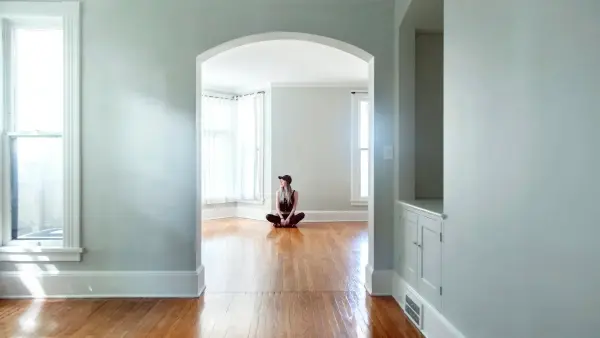
I poured a glass of wine, sat on the back porch in the November dark with a blanket over my legs, and did absolutely nothing for two hours. No book. No podcast. No phone. Just the sound of my neighbor’s wind chimes and the particular silence that only exists when you stop performing for everyone, including yourself.
It was the best birthday I’ve had in a decade. And the fact that I almost didn’t let myself have it - that I almost forced myself out the door because I thought I should - tells you everything about the forty years that came before it.
The girl who never locked the bathroom door
I grew up in a house with thin walls and thinner boundaries. My mother was a talker - warm, generous, relentlessly social. She’d call me out of my room to “be with the family,” which meant sitting in the living room while she narrated her day to anyone who’d listen. My bedroom door had a lock, but using it would’ve been an act of war.
I learned early that wanting to be alone was a form of rejection. That closing a door was closing a heart. That the good daughter, the loving daughter, was the one who made herself endlessly available.
So I did. For decades.
I shared dorm rooms without complaint. I said yes to every party, every group trip, every open-plan office. I married a man I love partly because he’s an extrovert who fills the silences I was taught I shouldn’t want. And I built a career in clinical psychology, which is - if we’re being honest - a profession that requires you to be emotionally present for other people eight hours a day.
I was always surrounded. I was always depleted. I thought those two facts were unrelated.
The body keeps the score (and eventually sends the invoice)
The turning point wasn’t philosophical. It was physical.
At forty-seven, I started getting migraines. Not the dull-ache kind - the kind where light becomes a weapon and sound feels like it’s being driven into your skull with a mallet. My neurologist ran every scan, checked every bloodwork panel. Everything came back clean.
“Are you under stress?” she asked.
I almost laughed. I was a psychologist. I knew about stress. I had stress management techniques the way a carpenter has hammers. But when she pressed - not about work deadlines or financial worry, but about how much time I spent alone in a given week - I went quiet.
The answer was almost none. I hadn’t spent a full hour alone, truly alone, in months.
Research from the University of Rochester, led by Netta Weinstein and colleagues, has shown that both introverts and extroverts benefit from periods of solitude - but that the benefit is strongest when the solitude is chosen rather than imposed. I’d been so busy choosing togetherness to prove I wasn’t broken that I’d starved myself of something my nervous system actually required to function.
The migraines weren’t a mystery. They were a demand.
The taxonomy of quiet
Here’s something I’ve learned that nobody tells you: solitude is not one thing. It’s a spectrum, and different points on that spectrum feed different hungers.
There’s functional solitude - being alone to get something done. Writing, reading, cooking without someone asking what’s for dinner. This is the kind most people accept because it has a product attached to it. You’re not just being alone; you’re being productive alone, which makes it socially permissible.
Then there’s restorative solitude - being alone to recover. After a hard day, a hard conversation, a hard week. This is the kind people tolerate if you frame it as self-care, if you light a candle and call it a ritual, if you perform your aloneness in a way that looks Instagram-worthy.
And then there’s the kind I needed most and had the hardest time claiming: existential solitude. Being alone for no reason at all. Sitting with yourself without agenda, without justification, without the nagging internal voice that says you should be doing something useful or being somewhere with someone.
That third kind is the one that terrified me. Because it required me to believe that my own company was enough. That I didn’t need to earn my right to a closed door by being tired, or overwhelmed, or sick.
I could just want it.
What happened when I stopped explaining
The first time I told a friend I couldn’t come to her Saturday brunch because I needed a morning alone, I rehearsed the explanation for twenty minutes. I had a whole speech prepared - about introversion, about self-care, about how it wasn’t personal.
She said, “Okay, next time then.”
That was it. No interrogation. No guilt trip. No concerned follow-up text asking if I was depressed.
I sat with the phone in my hand, stunned by how much energy I’d wasted constructing a defense for a jury that didn’t exist.
This is what I began to understand at fifty-two: most of the judgment I feared was an echo. My mother’s voice. My younger self’s voice. The internalized belief that wanting to be alone meant being unlovable. The actual people in my actual present-day life were, for the most part, completely fine with it.
The ones who weren’t fine with it - the ones who took my need for solitude as a personal insult - told me something important about the maintenance costs of those particular relationships.
The science of what I already knew
I’m a researcher. I need data the way some people need caffeine. So even as I was learning to trust my own instincts, I was reading the literature.
Aron and Aron’s work on sensory processing sensitivity confirmed what my nervous system had been trying to tell me for years: some people are neurologically wired to process stimuli more deeply, which means social environments - even pleasant ones - consume more cognitive resources. This isn’t introversion as personality quirk. This is introversion as a measurable difference in neural processing load.
A 2020 study in the British Journal of Psychology by Thuy-vy Nguyen and colleagues found that solitude increases feelings of relaxation and reduces feelings of anger - but crucially, these benefits were strongest for people who chose solitude freely rather than feeling forced into it by circumstances. The freedom was the active ingredient.
I’d spent forty years choosing togetherness because I felt I had to. The moment I started choosing solitude because I wanted to, everything changed. Not dramatically. Quietly. The way a room changes when you finally open a window you didn’t realize was painted shut.
The people who understand without being told
My husband brings me coffee on Saturday mornings and sets it outside my office door without knocking. My daughter, who is twenty and magnificently extroverted, texts me “recharging?” when I don’t answer the phone, and I text back a single thumbs-up that means yes, I love you, I’ll call tomorrow.
My closest friend of thirty years meets me for a walk once a week where we talk for the first mile and are silent for the second. Neither of us decided this. It just happened, the way most true things do.
These people don’t need me to explain my closed door. They don’t need me to apologize for it. They understand that my absence is not a withdrawal of love. It’s the thing that allows me to show up with love that hasn’t been diluted by depletion.
I wasted so many years thinking that the people who needed me to be constantly available were the ones who loved me most. I had it backwards. The ones who love me most are the ones who can tolerate my disappearance - because they trust I’ll come back.
What I’d tell the girl with the unlocked door
If I could sit with her - that eight-year-old in the thin-walled house, reading with a flashlight under the covers because it was the only privacy she could steal - I wouldn’t tell her she’s an introvert. I wouldn’t give her a label or a diagnosis or a book recommendation.
I’d just close the door for her. Gently. From the outside.
And I’d stand there for a while, making sure no one opened it.
I’m fifty-two. I’ve finally stopped apologizing for needing time alone. Not because I stopped caring what people think - I’m a psychologist, not a monk - but because I realized that the apology was never really for them. It was for me. It was the fee I’d been paying to forgive myself for a need I was never supposed to have.
The need wasn’t the problem. The fee was.
I don’t pay it anymore.