7 things that quietly happen to people who always sit in the same seat at every restaurant, every meeting, every family gathering, not because they are rigid or boring but because they were children whose entire environment shifted without warning and the position of their own body in a room became the first and only variable they could control, according to psychology
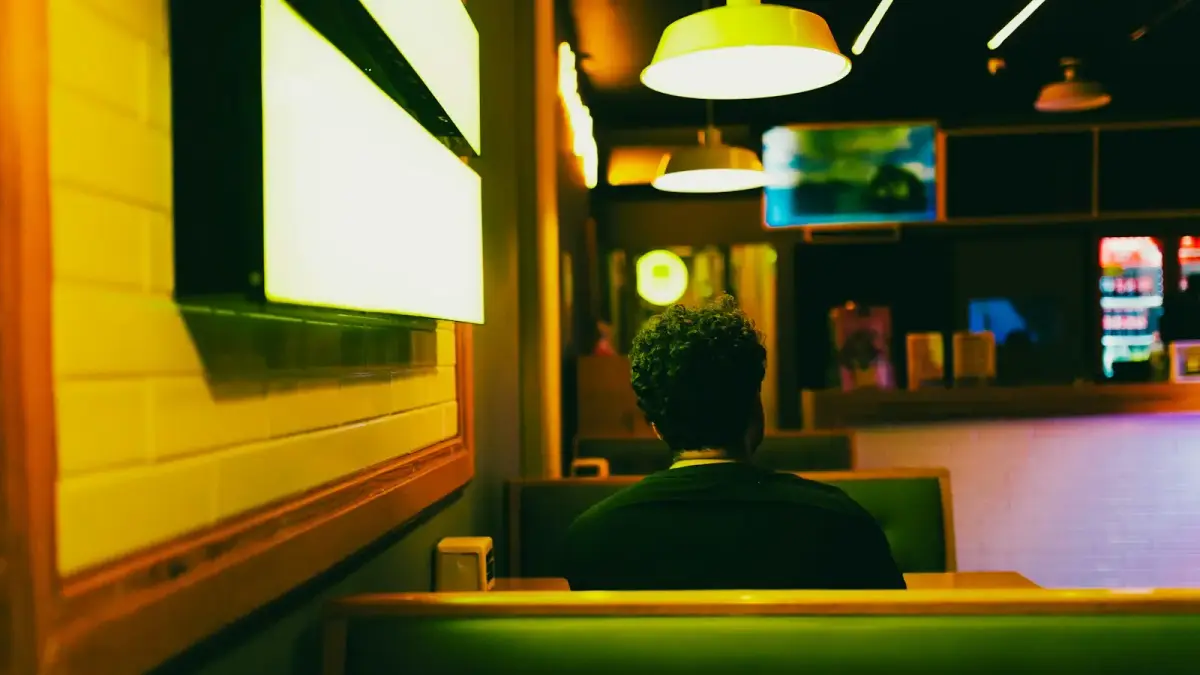
I have a seat at our kitchen table. Third from the left, back to the wall, facing the doorway. My husband knows not to sit there. My kids figured it out by age four. When we go to restaurants, I angle toward the same kind of chair - corner booth if available, clear sightline to the entrance, something solid behind me.
For most of my adult life, I assumed this was just preference. A quirk. Maybe mild type-A behavior.
Then I started studying environmental mastery in developmental psychology, and I realized that my seating habit wasn’t a personality trait. It was a relic. A leftover survival system built by a child who grew up in a house where the furniture moved, the moods shifted, and the only thing that stayed the same from one evening to the next was the spot she picked to sit and watch from.
If you always choose the same seat - the same chair, the same corner, the same side of every table you’ve ever sat at - here are seven things that are probably happening underneath the habit, and none of them have anything to do with being controlling.
1. You scope out seating before you walk into a room
You don’t just enter places. You case them.
It happens fast - a glance through the restaurant window before you pull the door, a scan across the conference table before you choose a chair, a quick read of the coffee shop layout while you’re still standing at the counter pretending to look at the menu. You’re not deciding what to eat. You’re deciding where to sit. And the decision isn’t casual. It’s a full-body assessment disguised as a moment of hesitation.
A 2019 study published in the Journal of Environmental Psychology found that individuals who experienced high environmental unpredictability in childhood demonstrate elevated “spatial vigilance” - a heightened awareness of physical layout and positioning in new environments. The brain is not being picky. It’s running an old program. One that says: before you settle, know your exits. Know where the noise comes from. Know where the surprises enter.
Most people walk into a room and sit wherever’s available. You walk into a room and feel the geometry of it. You clock the wall at your back, the distance to the door, the proximity of strangers. You’ve been doing this so long it doesn’t even register as unusual. It feels like being thorough. It’s actually your nervous system doing a threat assessment in the time it takes someone else to hang up their coat.
2. When someone takes your seat, you feel something that makes no rational sense
Your coworker sits in the chair you always use. Your sister-in-law takes your usual spot at Thanksgiving. A stranger at the coffee shop is sitting in the corner table by the window - your table - and you feel a spike of something in your chest that is completely out of proportion to the situation.
It’s not anger exactly. It’s closer to panic. A low-frequency alarm that says: your plan just broke. The one stable coordinate you mapped out before arriving has been removed, and now you have to improvise. And improvisation, for you, was never neutral. It was dangerous.
Research on territorial behavior and attachment, published in a 2021 edition of Frontiers in Psychology, found that place attachment - the emotional bonding to specific physical locations or positions - is significantly stronger in adults who reported childhood home environments as chaotic or unstable. The researchers described it as “compensatory anchoring.” When emotional safety is unreliable, physical positioning becomes a substitute. Your seat isn’t just a preference. It’s a proxy for the stability you couldn’t count on anywhere else.
You probably recover quickly. You sit somewhere else, you tell yourself it doesn’t matter, you make a joke. But the spike was real. And the two or three minutes it takes your body to recalibrate after losing your spot tells you more about your childhood than a hundred therapy intake forms.
3. You always sit where you can see the door or the room’s activity
Back to the wall. Eyes on the entrance. This is the one your friends have noticed, even if they’ve never said it out loud.
You choose the chair that faces outward. In restaurants, you take the booth side so your back is protected and the dining room opens up in front of you. At parties, you drift toward walls and corners, not because you’re antisocial but because your body will not let you sit with a blind spot behind you.
This isn’t paranoia. It’s a regulatory strategy your nervous system built decades ago.
Psychologist Gavin de Becker wrote about this pattern in his work on intuition and threat perception - the way children raised in unpredictable households develop a heightened orientation response, a need to monitor the environment for incoming changes. When you grew up in a house where the mood of the room could shift the moment someone walked through a door, you learned to watch that door. You learned to position yourself so that nothing could arrive without your knowledge.
The irony is that as an adult, you live somewhere safe. Nobody is about to come through the door with a face that changes the temperature of the room. But your body doesn’t know that. Your body still sits the way a child sits when the only warning system they had was their own two eyes.
4. You carry a mental map of every room you regularly visit
Ask you where you sit at your desk, and you’ll tell me. Ask you where you sit at your mother-in-law’s dining table, and you’ll tell me that too. The pew at church. The row in the movie theater. The exact position on the couch where you watch television every night - left cushion, arm on the side, feet tucked under the same blanket.
You have a complete spatial inventory of your life, and you maintain it without thinking.
A 2017 study in Psychological Science on cognitive mapping found that individuals with high trait anxiety maintain more detailed and rigid mental representations of familiar environments than individuals with low trait anxiety. The brain, under conditions of chronic uncertainty, compensates by mapping what is known. If the emotional landscape is unreliable, the physical landscape becomes a substitute source of information. You can’t predict what someone will say when they get home, but you can predict which chair you’ll be in when they say it.
This mental mapping isn’t obsessive. It’s not even conscious most of the time. It’s just there - a quiet, running catalog of your coordinates in every room that matters. You know your place. You’ve always known your place. That’s not a metaphor. It’s literal.
5. The people closest to you know not to sit in your spot
Your partner doesn’t take your side of the bed. Your kids don’t sit in your chair. Your best friend, if you always sit on the same side at lunch, has simply accepted the arrangement without discussion.
Nobody made an announcement. There was no argument, no formal request. They just learned. They watched you gravitate to the same position over and over, and at some point they stepped aside and let you have it. Maybe because they love you. Maybe because they felt the quiet tension that filled the room the one time someone sat in your spot and you spent the entire meal slightly off-center.
Psychologist Adam Grant has written about the concept of “silent contracts” in relationships - unspoken agreements that regulate behavior without ever being verbalized. Your seating arrangement is one of these contracts. The people who know you best have learned that your need for positional consistency isn’t a preference to be challenged. It’s a boundary to be respected. And they respect it the same way they’d respect any other boundary that keeps you feeling steady, even if they don’t fully understand where it comes from.
What they may not know - what you may not have told them, because you may not have the language for it yet - is that their willingness to let you have this one small thing is one of the kindest things anyone has ever done for you. Because growing up, nobody let you have your thing. Nobody noticed that you needed a fixed point. They just kept moving the furniture.
6. You arrive early to events specifically to secure your position
You are always early. Not because you’re punctual by nature, though people assume that. Not because you respect other people’s time, though you do. You are early because arriving after a room is full means sitting wherever is left, and sitting wherever is left means sitting without choosing, and sitting without choosing sends your entire system into a low hum of unease that will last the duration of the event.
So you show up first. You walk into the empty conference room and take the chair you need. You get to the restaurant ten minutes ahead of the reservation and request the booth. You arrive at the theater before the previews so you can sit on the aisle, or in the center, or wherever the geometry makes sense to your body.
A 2020 study in the Journal of Research in Personality found that adults who score high on “need for predictability” - a trait strongly correlated with childhood instability - are significantly more likely to engage in pre-planning behaviors around physical space. They don’t just prefer routine. They engineer it. They build the conditions for safety before anyone else arrives, so that by the time the room fills, they are already anchored.
This isn’t rigidity. This is the opposite of rigidity. This is a person who learned, very young, that the world will not arrange itself around your needs - so you arrive before the world does and arrange yourself first.
7. The habit extends to cars, airplanes, cinemas - any shared space where position can be chosen
It’s not just restaurants and dining tables. It’s the passenger seat of the car. The same side of the couch during movie night. Window seat on every flight. Second row from the back in every cinema. The bench on the left at the park. The same treadmill at the gym - not just any available one, but that one, the third from the end, by the window.
Every shared space you enter, you’ve already determined your coordinates. And if someone else gets there first, if the treadmill is taken, if you’re assigned a middle seat - you manage. But managing costs you something. A little focus. A little energy. A small expenditure from a reserve you’ve been drawing on since childhood.
Research on what psychologist Judith Herman calls “environmental mastery” suggests that the need for physical predictability is one of the most enduring legacies of an unpredictable upbringing. Long after the chaos ends, long after you’ve built a stable life with stable people in a stable home, the body retains its protocol. It still scans. It still maps. It still settles into the known coordinate and exhales only when the position is confirmed.
Your partner might joke about it. Your friends might tease you about being a creature of habit. And you laugh, because it is a little funny from the outside. A grown adult who has a specific seat on their own couch.
But you know what it is, even if you’ve never named it. It’s the one thing you figured out how to keep steady when nothing else would stay still. It’s the first boundary you ever drew. It’s the earliest evidence that you were already, as a small child, trying to build something you could count on - even if the only material you had to work with was the position of your own body in a room that kept changing around you.
That’s not a quirk. That’s not rigidity. That’s resourcefulness so deep it became invisible, even to you.
And if the seat you always choose is the one that lets you see the door, face the room, and feel something solid behind your back - that’s not a habit. That’s a child’s engineering. Still running. Still holding. Still keeping you safe in the only language it ever learned.