8 things people who always position themselves near the exit at parties - who stand by the door at social gatherings, who choose the seat closest to the way out in restaurants, who map every room for escape routes before they can relax enough to have a conversation - do without realizing it, according to psychology, because a child who learned that leaving quickly was the only power they had in a house where staying meant absorbing whatever came next never stopped scanning for the nearest way out
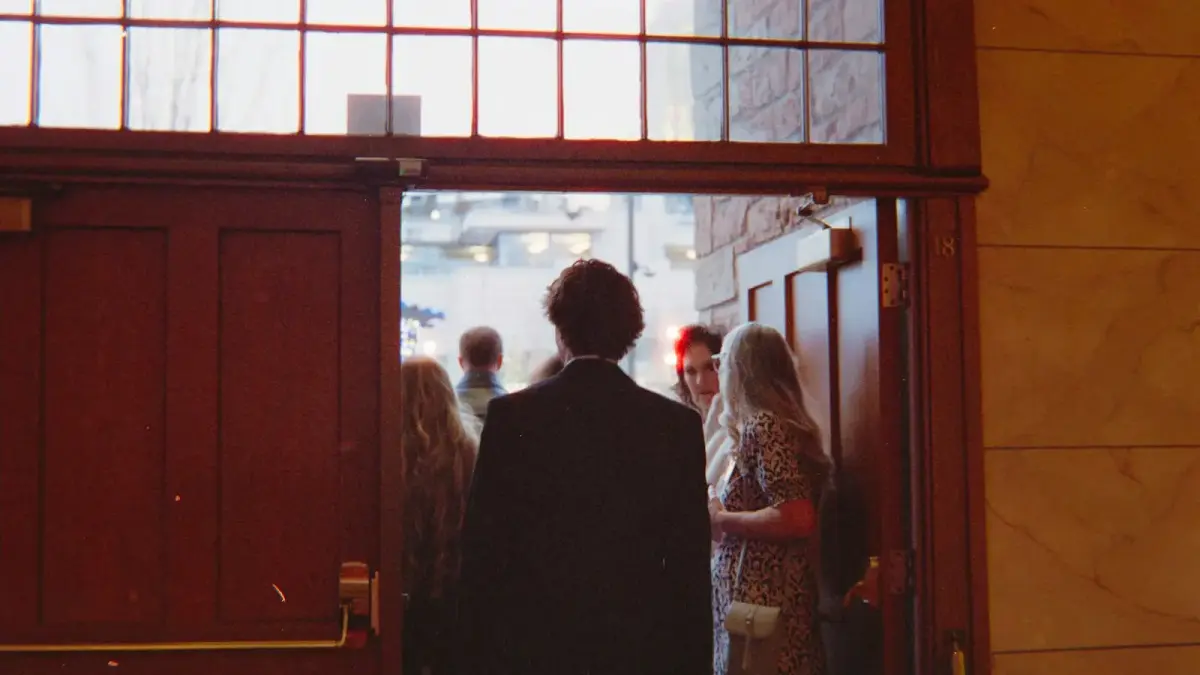
I was at a dinner party last month - the kind where everyone seems to know each other and the host has put out the good wine and the conversation is already flowing before I’ve even taken off my coat. It was a beautiful evening. The kind of night most people look forward to.
And the first thing I did, before I said hello to anyone, before I even registered who was in the room, was locate the back door.
I didn’t decide to do it. My body just turned slightly, like a compass needle swinging north, and my eyes landed on the door to the kitchen, which I could see led to the patio, which led to the side of the house, which led to the street where my car was parked. The whole route assembled itself in my head in about three seconds. Then I chose the chair at the end of the table. The one closest to that kitchen door.
My wife has watched me do this for twenty years. She used to think I was antisocial. Now she just squeezes my hand and doesn’t say anything, because she understands what it took me a long time to understand myself - that this has nothing to do with not wanting to be here and everything to do with a boy who learned very early that the only safe room is the one you know how to leave.
If you recognize any of this - if you’ve ever mapped an exit before you’ve tasted the appetizers - here are eight things you probably do without ever having been taught them.
1. They scan every room within seconds of entering it
It doesn’t look like scanning. It looks like glancing around. Maybe they appear to be admiring the decor or looking for a familiar face. But what’s actually happening is a rapid assessment that would impress a fire marshal - doors, windows, hallways, the width of the corridors, whether that sliding glass door is locked or just closed.
A 2018 study published in the Journal of Anxiety Disorders found that individuals with histories of childhood adversity demonstrate what researchers called “spatial vigilance” - an automatic tendency to orient toward exits and open spaces in enclosed environments. The subjects weren’t aware they were doing it. Their eyes moved to the exits before conscious thought could intervene.
This is not paranoia. This is a nervous system that was trained in a very specific classroom, doing exactly what it was taught.
2. They never sit with their back to the door
The host says sit anywhere. Everyone else sits wherever there’s space. But the person running exit calculations has already identified the one chair that faces the entrance, or at least the one that doesn’t leave them cornered against a wall with people on both sides.
They’ll give up the better seat, the one with the nice view, the one next to the person they actually want to talk to. Because comfort is negotiable. Sightlines are not.
Ask them why they chose that seat and they’ll say something casual. “I just ended up here.” They did not just end up there. They calculated their way there before the first glass was poured.
3. They arrive early - not for punctuality, but for reconnaissance
Getting there before other people means getting to see the room empty. It means understanding the layout before bodies fill it and the noise starts and the options narrow.
A child who needed to know the geography of every room they entered - because the geography determined whether they could get out - grows into an adult who cannot walk into a crowded space cold. They need the preview. They need to see the room the way a stage manager sees it before the audience arrives - as a set of possible movements, not a place to relax.
If you’ve ever felt a flash of something close to panic when you arrive at a gathering that’s already full, this is why. It’s not the people. It’s the loss of your preparation window.
4. They stand at the perimeter instead of the center
At any party, there are center-of-the-room people and edge-of-the-room people. The edge people often get labeled as shy, introverted, or aloof. Sometimes they are. But sometimes what looks like introversion is actually positioning.
The perimeter offers two things the center doesn’t - a wall at your back and a clear path to the door. The center of a room is an island. If something shifts - a voice gets too loud, a conversation turns, someone’s energy changes in a way that activates an old alarm - there is nowhere to go without making it obvious you’re leaving.
Psychologist Gabor Mate has described how children in volatile homes develop what he calls a “perimeter orientation” - a physical tendency to stay near the edges of spaces where the emotional climate is unpredictable. The edge isn’t distance. It’s insurance.
5. They always know where their keys are
Not in the general sense that most responsible adults know where their keys are. In the specific, tactile sense that they can feel them right now - in their pocket, in their bag, on the counter six feet to the left.
This is because keys are not just keys. Keys are the mechanism of departure. A child who once needed to leave and couldn’t - because the keys were in a pocket that belonged to someone whose mood determined whether anyone was going anywhere - learned that access to exit is never something you leave to chance.
The adult version of this looks like organization. It feels like readiness. And the readiness has an origin that nobody in the room would guess from looking at the perfectly composed person whose hand occasionally drifts to the pocket where the car key sits like a small metal promise.
6. They have an exit script rehearsed before they’ve finished their first drink
Most people leave a party when the evening winds down. They say their goodbyes, thank the host, maybe linger by the door for one last conversation. The whole thing is organic and unscripted.
But the person who mapped the exits on arrival also drafted the departure plan. They know what they’ll say. “Early morning.” “The sitter can only stay until ten.” “I’m fighting something off.” The script is ready before it’s needed, tucked away like a passport in an inside pocket - not because they plan to use it, but because having it makes staying possible.
A 2020 study in Psychological Science found that the perception of available escape options significantly reduces anxiety responses in social situations. The researchers concluded that it wasn’t actually leaving that calmed the nervous system - it was knowing that leaving was possible. The exit script isn’t about going. It’s about being allowed to stay.
7. They feel a physical shift when someone blocks the exit path
This is the one that surprises people when I describe it. You’re at a gathering, positioned near the door, and someone steps into the doorway to have a conversation. They’re not blocking you on purpose. They don’t even know you exist in relation to that doorway. But the moment a body fills the gap between you and the way out, something tightens in your chest.
It’s subtle. It’s fast. And it passes the moment they move. But it happened. And it happened because for a very brief instant, your nervous system registered the same signal it registered a thousand times in childhood - the exit is blocked, you cannot leave, you are here until someone else decides you’re not.
You won’t mention this to anyone. You probably haven’t even fully admitted it to yourself. But your body knows it, and your body has been keeping this particular score for a very long time.
8. They feel guilty for needing the exit they never use
Here’s the part that nobody talks about. Most of the time, they don’t actually leave. They stay for the whole dinner. They laugh at the jokes. They have the second glass of wine. They drive home and their partner says “that was fun” and they agree, because it was.
But underneath the fun there was a layer of work that nobody else at the table was doing. The scanning, the positioning, the scripting, the peripheral monitoring of doorways and keys and the distance between their chair and the closest way out. And sometimes, on the drive home, they feel tired in a way that has nothing to do with the hour and everything to do with the weight of managing a system that was running all evening long beneath the surface of their enjoyment.
And then comes the guilt. Because the party was fine. Nobody raised their voice. Nobody’s mood shifted without warning. The threat that the whole system was built to detect never materialized, and now there’s a quiet voice that says you should be over this by now.
That voice is wrong.
A 2021 study published in Frontiers in Psychology found that hypervigilance responses rooted in childhood adversity can persist for decades, independent of current environmental safety. The researchers noted that this persistence is not a failure of healing - it is evidence of how thoroughly the original learning was absorbed. The nervous system isn’t broken. It was brilliant. It built an early warning system so effective that it still runs flawlessly forty years later in rooms where it is no longer needed.
You are not antisocial. You are not difficult. You are not the person who ruins parties by standing near the door.
You are the person who survived something by learning the architecture of rooms, and you have been carrying that knowledge so quietly and for so long that it looks like a preference instead of a history. The chair near the door, the keys in the left pocket, the script in the back of your mind - these are not symptoms. They are the resume of a child who figured out how to feel safe in a world that didn’t offer safety as a standard feature.
And the fact that you still show up - that you still walk into rooms and stay for the conversation and laugh at the jokes and drive home and say “that was fun” - is not a small thing. It is the bravest thing a person can do with a nervous system that is still, after all these years, quietly mapping the exits just in case.