8 things people who have never been able to walk past a beautiful stone without picking it up - who fill their jacket pockets with smooth flat rocks from every beach, who line their windowsills with pebbles from places they can name but will never visit again, who reach for a stone the way other people reach for a photograph - do according to psychology, because a child who learned that the best moments in life leave no evidence unless you carry something home in your hand built a collection that was never about geology but about proving to herself that the beauty was real
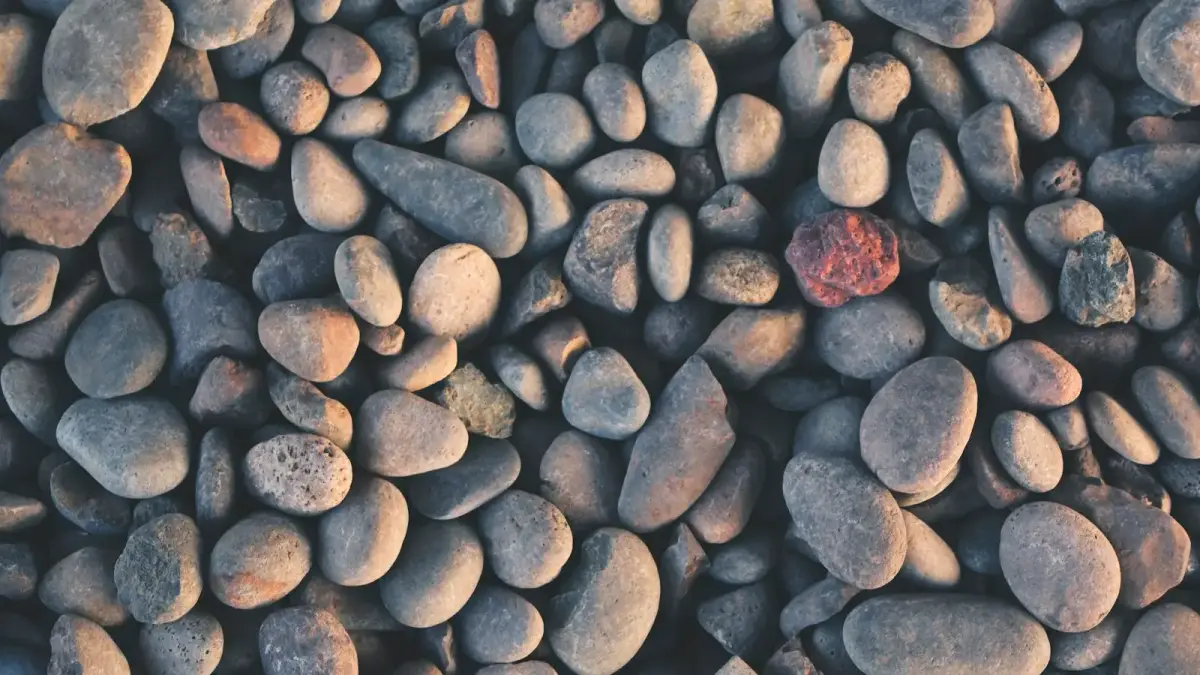
I have a stone in my coat pocket right now. I don’t know which coat, exactly, because there are stones in most of them. A grey one from a lake in Vermont. A rust-colored sliver from a trail I hiked with my mother. Something pale and egg-shaped that I found in a parking lot in November and kept because the afternoon light made it look like it was glowing.
I am not a geologist. I have no tumbler, no display case, no field guide. I just cannot walk past a beautiful stone.
If you are reading this and already nodding, you don’t need me to explain the impulse. You know the feeling of scanning the ground while everyone else is looking at the view. You know the quick, private thrill of finding one that fits perfectly in the curve of your palm. And you know that the collection on your windowsill is not decoration. It is something much more personal than that.
Psychology has a lot to say about people like us. And almost none of it is about rocks.
1. You perform a selection ritual that is more instinct than logic
You don’t grab the first stone you see. You test it. You weigh it in your hand. You run your thumb across the surface, checking for the right combination of smooth and cool and heavy.
The stone has to feel right. Not look right. Feel right.
This is not random. A 2009 study published in the journal Psychological Science found that people form rapid emotional attachments to objects based on tactile experience, not visual appearance. The way something feels in your hand activates the same neural pathways involved in evaluating safety and comfort.
You are not choosing a rock. You are choosing a sensation. And the ones that make it into your pocket are the ones that your nervous system recognized as something worth holding onto.
2. Your pockets always have sand in them, and you have stopped apologizing for it
There is grit at the bottom of every bag you own. Your washing machine has tumbled pebbles you forgot to remove. You have, at least once, heard the terrible sound of a stone hitting the inside of a dryer drum and thought, with genuine guilt, “I hope it’s okay.”
You have learned to check your pockets before laundry day the way other people check for tissues or chapstick. But you still miss one. You always miss one.
This is not carelessness. This is what happens when collecting is so woven into your daily life that it stops being a conscious decision. You pick up a stone the way you take a deep breath near the ocean. Your hand just does it. Your body knows before your mind catches up.
3. Your windowsill collection is a map that only you can read
Visitors see a row of rocks. You see a timeline.
That pale blue one is Cape Cod, July, the summer your daughter learned to swim. The dark flat one is the trail behind your friend’s cabin in the Catskills. The tiny white pebble is from the hospital parking lot the morning your father came home after surgery, and you picked it up because you needed to hold something solid while your hands were shaking.
Donald Winnicott, the British psychoanalyst, wrote extensively about what he called transitional objects - physical things that carry emotional weight far beyond their material value. He studied this in children, but the impulse never fully goes away. Adults just find more sophisticated containers for it. Your windowsill is one of them.
Every stone is a receipt for a moment your memory might otherwise soften or lose. You are not decorating. You are archiving.
4. You almost never throw a stone back, and the idea of it feels like a small betrayal
Someone once told me to toss a stone I had just picked up. “It’s just a rock,” they said. And I understood, logically, that they were right. But I could not do it.
Putting a stone back feels like abandoning something that chose you. That sounds irrational, and it is. But the emotional weight is real.
Research on object attachment, particularly work published in the Journal of Consumer Psychology, has shown that once a person forms a tactile bond with an object, discarding it activates the same brain regions associated with social loss. The stone is not a person. Your brain knows that. But your hands don’t.
You keep it. You always keep it. And the collection grows in a way that feels less like accumulation and more like responsibility.
5. You give stones as gifts, and you mean it completely
You have handed someone a rock and said, “This reminded me of you.” You have tucked a smooth pebble into a birthday card. You have left a stone on a friend’s desk without explanation, trusting that they would understand.
Not everyone does understand. Some people look at you with polite confusion when you press a cold, flat stone into their palm. But the people who get it - the people who close their fingers around it and say “oh, it’s perfect” - those are your people.
Giving a stone is an act of translation. You are saying: I was somewhere beautiful, and I thought of you, and I wanted to bring you proof. A photograph would have been easier. But a photograph doesn’t have weight. It doesn’t warm in your hand. A stone does.
6. Certain stones have become worry stones, rubbed smooth by years of anxious hands
There is one you keep in your pocket for hard days. You hold it during phone calls that make you nervous. You rub it with your thumb in waiting rooms. You have carried it so long that its surface has changed, shaped by the oil of your skin and the pressure of your grip.
A 2012 study in the journal Frontiers in Psychology found that repetitive tactile stimulation - the kind you get from rubbing a smooth surface - activates the parasympathetic nervous system and measurably reduces cortisol levels. Your worry stone is not a superstition. It is a regulation tool.
Your body figured out, long before any therapist told you, that holding something solid and smooth could quiet the noise. The stone doesn’t fix anything. But it gives your hands something to do while your mind works through the hard part.
7. Some stones are impossible to let go of because the person you found them with is gone
This is the one that catches in your throat.
There is a stone on your shelf from a beach trip with someone who is no longer alive. Maybe it was your mother. Maybe a friend. Maybe a partner who walked beside you on a shoreline that looked exactly like every other shoreline, except it wasn’t, because they were there.
You cannot throw that stone away. You would sooner throw away a photograph, because at least photographs can be copied. The stone is singular. It was in that exact place on that exact day, and they were standing next to you when you picked it up, and now the stone is all that is left of that specific afternoon.
Grief researchers call this continuing bonds - the psychological need to maintain a tangible connection with someone who has died. The stone is not a metaphor. It is a physical anchor to a moment that otherwise exists only in your memory, which you do not entirely trust.
You hold it, and for a second, you are back on that beach. That is worth more than anything the stone could ever be made of.
8. You need physical proof that beauty existed, and you always have
Here is the pattern underneath all of it.
You do not trust moments to survive on their own. You learned, somewhere along the way, that the most beautiful experiences are also the most fragile. The light changes. The trip ends. The afternoon dissolves into the next one. And unless you carry something home in your hand, you worry that it was never quite real.
The stone is not the thing you are keeping. It is the proof that you were there, and that it mattered.
Adam Grant has written about how certain personality types - those high in openness and emotional sensitivity - are more likely to seek tangible markers of experience. They are not being sentimental for the sake of it. They are building a physical record of a life that moves too fast to hold any other way.
Your pockets are heavy. Your windowsill is crowded. Your collection makes no sense to anyone who sorts the world into useful and useless.
But you have never sorted the world that way. You sort it into felt and unfelt. And every stone you have ever picked up was a vote for the side of felt.
That is not a quirk. That is a way of paying attention to your own life. And most people could use a little more of it.
So keep picking them up. Keep lining your windowsills. Keep reaching down, mid-conversation, to close your hand around something cool and smooth and exactly the right weight.
The collection was never about geology. It was always about proving that the beauty was real. And it was. Every single time, it was.