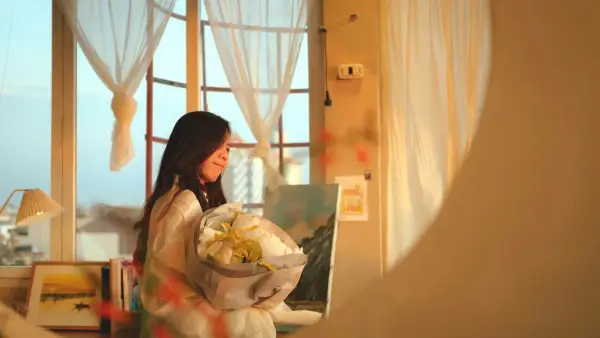
8 things that quietly happen to people who apologize for existing in their own home - the ones who say sorry for leaving a book on the couch, sorry for running the bath too late, sorry for wanting the light on to read - because a child whose needs were treated as impositions grew up into an adult who still pays rent on space she already owns, according to psychology

I said sorry to my husband last Tuesday for leaving my reading glasses on the kitchen counter.
They were on the counter for maybe forty minutes. They weren’t in anyone’s way. Nobody had mentioned them. But I walked past, saw them sitting there, and felt a hot little flare of something in my chest - the feeling that I had left evidence of myself in a shared space, and that evidence needed to be cleaned up before anyone noticed.
“Sorry about the glasses,” I said, scooping them up. He looked at me the way he sometimes does - not annoyed, not confused exactly, but sad. “Julia,” he said. “You live here.”
I do live here. I’ve lived here for fourteen years. And still, some part of me moves through this house like a guest who arrived without an invitation and keeps checking people’s faces to see if it’s time to leave.
If you recognize this - the apologizing for your book on the couch, your shoes by the door, the bath you ran at 9 PM because you thought maybe that was too late, maybe that was inconvenient - then you already know this isn’t about manners. This is about a childhood that taught you your existence was something other people had to tolerate.
Here are 8 things that quietly happen when you grow up believing your needs were impositions on the people who were supposed to meet them.
1. You apologize reflexively, and you no longer hear yourself doing it
The sorrys come out like breathing. Sorry for being in the kitchen when someone else walks in. Sorry for wanting to watch something different on television. Sorry for existing in a doorway for two seconds too long.
A 2019 study in the journal Psychological Science found that people with chronic low self-worth apologize at rates dramatically higher than the situation warrants - not because they believe they’ve done something wrong, but because they’ve internalized the idea that their presence itself requires justification.
You aren’t apologizing for the thing. You’re apologizing for being there at all. And the truly disorienting part is that you’ve been doing it so long you don’t register it as unusual. It’s just how you move through space. Everyone else hears it. You don’t.
2. You make yourself physically small in rooms you pay for
You sit on the edge of the couch instead of the middle. You take the smallest portion. You fold yourself into corners at your own dinner table, leaving the comfortable chair for someone else even when no one asked you to.
This isn’t modesty. This is a body that learned, very early, that taking up physical space invited commentary. The child who spread her homework across the table and heard a sigh learned to work on a clipboard in her room. The child whose toys were described as clutter learned to play quietly, compactly, contained.
By midlife, the shrinking is architectural. You’ve designed your entire physical presence around the principle of minimum disruption. And you call it being considerate when it’s actually the muscle memory of a child who was taught that her footprint was a problem.
3. You ask permission for things that are already yours
“Do you mind if I take a bath?” You’re asking your partner for permission to use the bathtub. In your house. That you own.
“Is it okay if I turn on this lamp?” You’re requesting authorization to use light. In the evening. To read a book.
These questions sound polite. They feel like partnership. But Dr. Gabor Mate has written extensively about how children who grew up in environments where their basic needs provoked irritation develop a lifelong habit of seeking approval for things that require no approval at all. The asking isn’t collaboration - it’s a preemptive flinch. You’re giving someone the opportunity to say no before they can make you feel like a burden for saying yes to yourself.
4. You have a specific radar for sighs, shifts in tone, and cabinet doors closed slightly too hard
You can hear a mood change from two rooms away. A fork set down with a fraction too much force. A breath that lasted half a second longer than a normal breath. An “it’s fine” that arrived one beat too late.
This is hypervigilance, and a 2021 study published in Frontiers in Psychology confirmed that adults who grew up in emotionally unpredictable households develop heightened sensitivity to vocal tone and microexpressions - not as a gift, but as a survival system.
You learned to read the weather of the house before you could read a book. Because in your childhood home, the difference between a neutral evening and a tense one lived in those tiny atmospheric shifts. And the price of missing one was becoming the reason the atmosphere got worse.
5. You pre-clean your own existence before anyone can notice it
You wash your coffee cup immediately. You wipe the counter before the water ring can form. You put your book back on the shelf even though you’re mid-chapter. You erase the physical proof that you were somewhere, doing something, needing something.
This isn’t tidiness. Tidy people clean because order feels good. You clean because evidence feels dangerous.
The child whose mother said “Why is this still here?” about a glass of water left for ten minutes learned that objects out of place were an indictment. Not of the object - of the child who put it there. So you became an eraser. You move through your own home like someone covering tracks, making sure the house looks like no one inconvenient lives in it.
6. You feel guilty for having preferences
Someone asks where you want to eat and you say “I don’t mind, wherever you want.” Someone asks what movie you’d like to watch and you say “I’m happy with anything.” Someone asks how you’d like to spend your Saturday and you say “Whatever works for you.”
This isn’t easygoing. This is a person who learned that preferences were expensive.
A 2022 study in the Journal of Personality and Social Psychology found that individuals with childhood emotional neglect are significantly more likely to suppress personal preferences in adult relationships - not because they lack opinions, but because expressing a preference feels, on a nervous system level, like placing a demand. And demands, in the home you grew up in, came with consequences.
You have preferences. You have strong ones. You just buried them under forty years of “I’m easy” because wanting something specific felt like asking too much of people who already seemed stretched thin by your existence.
7. You experience your own rest as something you need to justify
You can’t sit down and read in the middle of the afternoon without an internal courtroom convening to decide whether you’ve earned it. You can’t take a nap without waking up guilty. You can’t spend a Sunday doing nothing without constructing an elaborate defense for why you needed it - you were tired, you didn’t feel well, you worked hard this week.
Rest, for you, was never neutral. In your childhood home, rest was something that belonged to the people who ran the household. A child resting was a child not helping. A child watching television was a child being lazy while someone else carried the weight.
Susan Cain has written about how many adults carry an internalized conviction that they must be productive to deserve space - that stillness without output is selfishness. For you, this goes deeper than productivity culture. This is a body that was taught, before it had language for it, that existing without contributing was a form of taking.
8. You feel a strange, disorienting grief when someone tells you to stop apologizing
This is the one that catches people off guard. Your partner says “You don’t have to say sorry for that.” A friend says “Stop apologizing, you haven’t done anything wrong.” And instead of relief, you feel something crack open in your chest that’s closer to sorrow than comfort.
Because when someone tells you that you don’t need to apologize for existing, they are contradicting a story you’ve been telling yourself for your entire life. They are saying: your presence is not a burden. Your book on the couch is not an offense. Your bath at nine o’clock is not an imposition. You are allowed to be here.
A 2020 study in the Journal of Research in Personality found that when individuals with deep-seated self-worth wounds receive unconditional positive regard, the initial response is often destabilizing rather than comforting - because the acceptance challenges a core belief that has functioned as an organizing principle for decades.
The grief isn’t weakness. The grief is your body catching up to what your mind is only beginning to entertain: that maybe, this whole time, you were allowed.
I still catch myself apologizing for things that don’t require apologies. My jacket on the back of a chair. The way I laughed too loud during a phone call. The light I left on in the hallway because I was coming right back.
But I’m starting to notice it now. That’s the shift - not that the impulse disappears, but that you hear it. You catch the “sorry” forming and you hold it for a second and you ask: what exactly am I apologizing for? For being in my own kitchen? For reading my own book? For existing in a house where I am wanted?
You were a child who learned that your needs made rooms heavier. That your preferences created work for other people. That the quieter, smaller, and more invisible you were, the smoother everything went.
But you are not a child anymore. And this home - this life, this space, these rooms - they’re yours. You don’t owe rent on air you’ve already bought. You don’t need to apologize for the lamp, the bath, or the book on the couch.
You’re allowed to leave the glasses on the counter.
You’re allowed to be here.