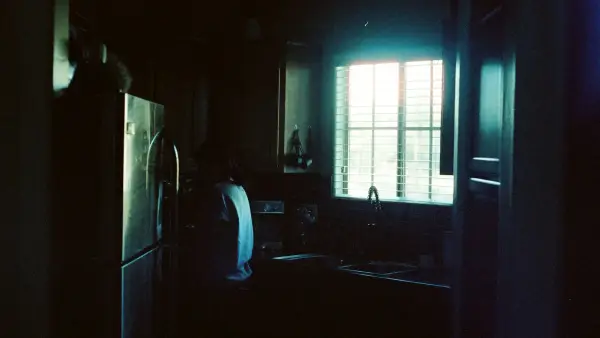
8 things that quietly happen in the mind of a man who has never once walked into a social gathering without knowing exactly where the nearest exit is, because a boy whose childhood home could shift from calm to catastrophic in the time it took a parent to walk from the car to the kitchen learned that the safest thing a body can do in any room is know how to leave it before anyone notices, according to psychology
I walked into a friend’s backyard cookout last July and before I’d even said hello to anyone, I’d already cataloged two things: the gate along the side of the house and the sliding glass door that led back through the kitchen.
I wasn’t afraid. I wasn’t in danger. I was holding a six-pack of beer and wearing a shirt I’d ironed for the occasion.
But my body had already done its homework.
By the time someone handed me a plate, I’d chosen my spot - the chair nearest the side gate, angled so I could see the driveway. I knew how many steps it would take to get to my car. I knew I could say “I’ve got to grab something from the trunk” and no one would question it.
I’ve done this my entire adult life. Every wedding reception, every office party, every holiday dinner. The scanning happens before conscious thought does. It’s faster than language. And for most of my life, I assumed everyone did it.
They don’t.
What I eventually came to understand - through years of reading, therapy, and the slow work of naming things I’d never been taught to name - is that this reflex was built somewhere very specific. It was built in a house where the sound of a car pulling into the driveway could change the temperature of an entire evening.
Here are 8 things that quietly happen in the mind of a man who still maps the exits in every room he enters.
1. He builds a floor plan of the room before he builds a single conversation
Within the first thirty seconds of arriving, his eyes do a sweep that has nothing to do with looking for familiar faces. He’s clocking doors, windows, hallways, how many people are between him and the way out.
A 2017 study published in Psychological Science found that individuals with early exposure to unpredictable home environments develop heightened spatial awareness as part of a broader vigilance response. The researchers called it adaptive attention - the brain learning to prioritize environmental layout over social cues.
He doesn’t think of it as scanning. He thinks of it as arriving. But most people arrive and look for the host. He arrives and looks for the geometry of the room.
It was never a choice. It was a curriculum. The house he grew up in taught him that knowing where you are in relation to the nearest door is not paranoia. It’s preparation.
2. He chooses his seat the way a strategist chooses a position
He doesn’t sit where there’s space. He sits where there’s access.
Near the door. Against the wall. Never in the center of the room, never with his back to an entrance. If the only available seat is a couch wedged between two people in the middle of a living room, he’ll stand. He’ll say his back hurts. He’ll lean against the counter and make it look casual.
But the truth is, he can’t relax in a seat that doesn’t offer a clear line to the exit.
This started at a dinner table where the wrong chair meant being trapped when the mood shifted. Where sitting closest to the hallway meant you could disappear to your room before the volume reached the part that left marks on the evening.
The adult version is quieter, more polished. But the logic is identical. He positions his body the way a boy once positioned himself - not for comfort, but for options.
3. He has an exit excuse rehearsed before the first drink is poured
Somewhere between parking the car and walking through the front door, he’s already written a script. “I’ve got an early morning.” “The dog’s been acting weird - I should probably check on her.” “I told my buddy I’d call him tonight.”
None of these are lies, exactly. They’re pre-loaded alibis. They exist so that when the moment comes - and some part of him always believes the moment will come - he can leave without disruption.
A 2019 study in the Journal of Personality and Social Psychology found that adults who grew up in volatile households are significantly more likely to engage in anticipatory coping - mentally rehearsing responses to threats that haven’t materialized yet. It’s not pessimism. It’s a body that learned to stay two steps ahead of chaos.
He doesn’t rehearse these excuses because he wants to leave. He rehearses them because knowing he can leave is the only thing that lets him stay.
4. He monitors the emotional weather of the room the way a sailor monitors the sky
He doesn’t just notice when the energy shifts. He notices before.
Someone’s laugh gets a little too loud. A couple in the corner has gone quiet. The host refills their glass for the third time in an hour. He catches all of it - not because he’s nosy, but because his survival wiring trained him to read rooms the way other kids learned to read books.
Growing up, the difference between a good night and a bad one was often a matter of minutes. A tone change. A cabinet closed too hard. The pause between a parent’s car door shutting and the front door opening - that pause held everything.
So he learned to read silence the way most people read words. He became fluent in micro-shifts. And now, at fifty-three, standing at a perfectly lovely dinner party, he’s still tracking the emotional barometric pressure of a room full of people who are just having a nice time.
The exhausting part isn’t the tracking. It’s that he can’t turn it off.
5. When someone else leaves first, he feels a wave of relief he can’t explain
There’s a particular kind of exhale that happens when the first guest says goodnight. It’s not that he wanted them to leave. It’s that their departure opens a door - not just literally, but psychologically.
Someone leaving first means he’s no longer the one who has to break the seal. He can follow in fifteen minutes without being the person who “left early.” The social math suddenly works in his favor.
This matters more than it should. Because somewhere in him lives a boy who learned that leaving a room could be interpreted as a statement. Leaving meant you were upset. Leaving meant something was wrong. Leaving could trigger the very confrontation you were trying to avoid.
So he waits. He always waits. And when someone else goes first, his whole body softens in a way that would look strange to anyone who noticed it.
They never do. He’s made sure of that.
6. He never fully relaxes because part of his brain is always standing guard
He laughs at the jokes. He asks people about their kids. He refills drinks and compliments the food and looks, by every external measure, like a man who is comfortable.
But underneath the performance, there’s a sentry. A part of him that never sat down. A part that’s still listening for the garage door, still waiting for the footsteps that meant the evening was about to turn.
Psychologist Daniel Goleman, in his work on emotional intelligence, described this kind of divided attention - the ability to function socially while simultaneously running a background threat assessment. For people who grew up in unpredictable homes, this becomes so automatic it doesn’t feel like effort. It feels like being alive.
He doesn’t know what it would feel like to be fully in a room. To let every part of himself arrive at the same time. He’s always partly there and partly positioned near the door in his mind, coat half-on, keys already in his hand.
The tragedy isn’t that he can’t enjoy the party. He can. The tragedy is that he’s never once enjoyed it with his whole self.
7. The exhaustion afterward is not from socializing - it’s from the silent performance of appearing calm
He gets home and he’s wrecked. Not because he talked to too many people or stayed too late. But because for three hours, he ran two parallel operations: being a pleasant guest and being a man who could vanish in under ninety seconds if the room required it.
That kind of dual processing drains something deep. It’s the fatigue of managing an interior that no one in the room can see.
His wife might say, “You seem tired.” And he’ll say, “Yeah, long week.” But the truth is more specific than that. He’s tired because he held the entire architecture of the evening in his head - every exit, every shift in energy, every contingency - while also remembering to ask about someone’s new kitchen renovation.
A 2021 study in Frontiers in Psychology found that individuals with heightened vigilance responses expend significantly more cognitive energy in social settings, even when they report enjoying the event. The body doesn’t distinguish between a real threat and the anticipation of one. The fuel cost is the same.
He’s not an introvert. He’s a man whose body never stopped doing the math it learned at eight years old.
8. His body still does this in rooms full of people who love him
This is the one that gets him.
Thanksgiving at his sister’s house. His daughter’s birthday party. A weekend at his best friend’s cabin - the friend who’s known him for thirty years and would walk through fire for him.
He still maps the exits.
He still sits near the door.
He still has a reason ready to leave.
Not because he doesn’t trust these people. He does. Not because he doesn’t feel loved. He feels it more than he can say.
But the part of him that learned all this - the boy who figured out, silently and without instruction, that the safest thing a body can do in any room is know how to leave it - that part doesn’t update based on evidence. It updates based on something slower. Something that lives below thought, in the place where the body stores what it learned before it had words for any of it.
He can know, intellectually, that he is safe.
His body keeps doing the math anyway.
If you recognized yourself in any of this, I want to say something plainly.
You are not broken. You are not antisocial. You are not the guy who “can’t just relax.”
You are a man whose body learned something very early, and it learned it well. It learned that safety is not a feeling - it’s a position in a room. It learned that calm can collapse without warning. It learned that the kid who knows where the door is gets to keep some small piece of himself intact when everything else falls apart.
That intelligence kept you alive. It kept you whole in a house that could have taken much more from you than it did.
The work now - and it is slow, patient, unglamorous work - is not to silence that part of you. It’s to let it know, gently and repeatedly, that the rooms you walk into now are not the room you grew up in.
You can stay.
You can sit in the middle of the room.
You can let your whole self arrive.
And the exits will still be there if you need them. They just don’t need to be the first thing you look for anymore.