Children who always closed the curtains the moment the lights came on inside - who moved through the house at dusk pulling fabric across glass before anyone had to ask - were not being helpful or tidy but running a privacy patrol that was installed the night a neighbor mentioned something at the school gates that could only have been seen through the kitchen window, and the adult who still cannot sit in a lit room with open curtains is not anxious but protecting an interior that was never supposed to be visible
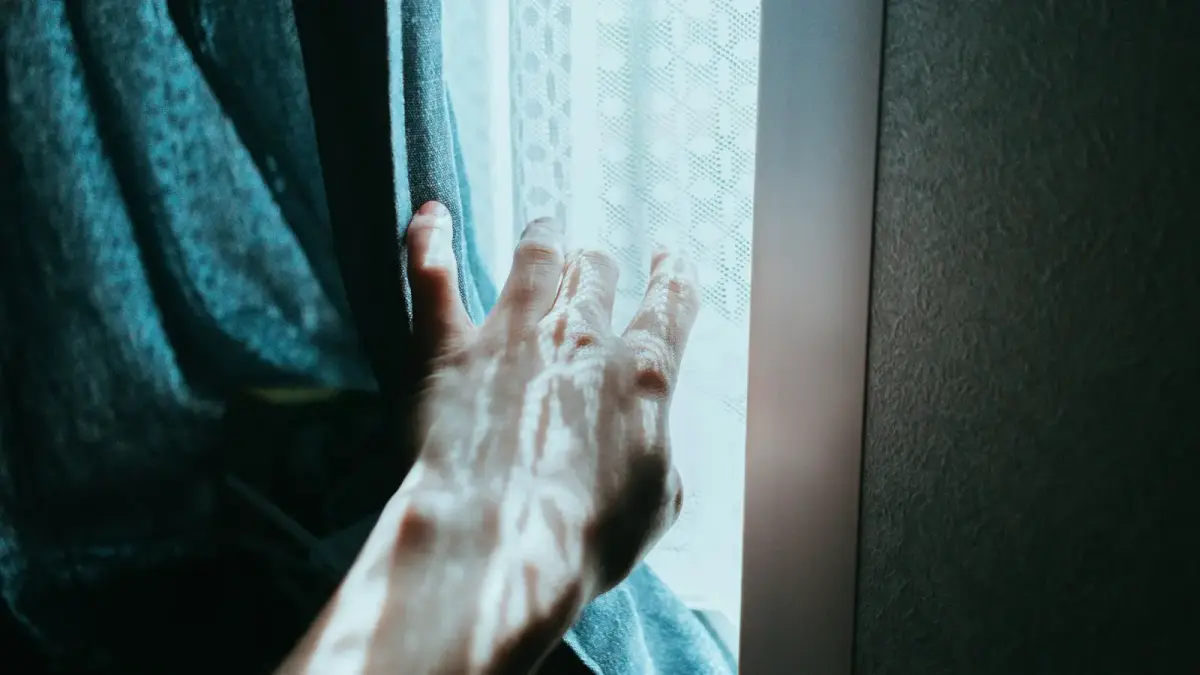
I was maybe eight the first time I noticed the neighbors could see us.
It was winter, so it got dark early. The kitchen light was on and my mother was at the stove, and I was sitting at the table drawing with markers while my little brother kicked his legs against the chair and whined about being hungry. A normal Tuesday. Nothing worth remembering.
Except I looked up and saw the window, and the window was a screen. Our kitchen was a lit stage and the dark yard beyond it was the audience. Anyone walking past, anyone glancing over from the house next door, could see everything. The dishes piled in the sink. My mother’s slippers. The laundry basket on the counter because there was nowhere else to put it.
I got up and pulled the curtains shut without being asked.
My mother looked over. “Thank you, sweetheart,” she said, like I had done something thoughtful. And I had. But what she didn’t know - what I didn’t have words for yet - was that I hadn’t been thoughtful. I had been terrified. Because a week earlier, Mrs. Patterson from two doors down had said something to my mother at the school gates. Something small, something that was supposed to sound friendly. “I saw you up late the other night - your kitchen light was still on at midnight.”
That was it. That was the whole sentence. But I watched my mother’s face change when she heard it, and I understood something I would carry for decades: a lit window is a confession. And if you don’t close the curtains, the whole neighborhood gets to read it.
The dusk patrol
If you grew up in a house where the curtains mattered, you know the ritual.
It starts around the time the light outside shifts from gray to blue. You don’t wait for full dark. You move through the house with a specific kind of purpose - living room first, then the kitchen, then the bedrooms if they face the street. You pull each curtain with the same efficient motion. Not aggressive. Not panicked. Just thorough.
You check the gaps. You make sure the fabric overlaps in the center so no sliver of light escapes. If a curtain is too short and leaves a two-inch gap at the bottom, you notice that gap every single time and you angle your body to block it until you can get to the other side of the room.
Nobody taught you this. Nobody sat you down and said, “At dusk, you must close every curtain in the house.” You absorbed it the way you absorbed everything important in that house - by watching what happened when it wasn’t done.
Maybe a parent said something sharp one night. “Why are the curtains still open? The whole street can see in.” Maybe you overheard a neighbor’s comment that landed like a small bomb in your mother’s chest. Maybe you just noticed that your family looked different from the inside than it did from the outside, and you understood - without anyone explaining - that the inside version was not for public viewing.
A 2017 study published in the Journal of Environmental Psychology found that individuals who grew up in households with high boundary vigilance - defined as heightened awareness of the permeability between private and public space - carried that vigilance into adulthood as a stable trait. The researchers noted that this wasn’t learned as a rule but absorbed as a felt sense. The children didn’t remember being told to close the curtains. They remembered the feeling of a window being open when it shouldn’t have been.
What the window revealed
Every family has an interior that doesn’t match the exterior. That’s not dysfunction. That’s just the nature of living with other people behind walls.
But some interiors carry more risk than others when they’re seen.
Maybe your house was messier than the neighbors’ houses. Maybe there were bottles by the recycling bin that told a story your parents didn’t want told. Maybe the furniture was old or mismatched or broken in ways that revealed a class position your family was working hard to disguise. Maybe your parents argued in a way that was audible through walls and visible through glass.
None of these things make a family broken. But to a child, they all translate the same way: if people see this, something bad will happen. If the interior is exposed, the exterior - the careful, maintained, everything-is-fine exterior - collapses.
You became the person who made sure it didn’t collapse. You became the household’s visibility manager.
Not because anyone asked. Because you understood the stakes.
Brene Brown has written about how shame operates through the fear of exposure - that the core experience of shame is not doing something wrong but being seen doing it. For children in high-privacy households, this equation gets installed early. The problem isn’t the mess, or the argument, or the bottles. The problem is the window.
The adult who still can’t sit with open curtains
Here is where the story bends from past to present.
You are forty-five or fifty-five or sixty-three. You live in your own house. You have your own curtains. And every evening, as the light shifts, something in your body activates and you get up and close them.
You might not connect this to your childhood. You might call it preference. “I just don’t like feeling like a fishbowl.” You might call it practical. “The neighbors don’t need to see me eating dinner in my pajamas.”
But notice the speed. Notice how it’s not a leisurely choice but a task with urgency. Notice how you feel if someone visits and the curtains are still open after dark - the low hum of something being wrong, the way your eyes keep drifting to the uncovered glass.
A 2019 study in Psychological Science examined how early environmental scanning behaviors persist into adulthood. The researchers found that individuals who developed perimeter-checking habits in childhood - scanning doors, windows, and boundaries of spaces - continued these behaviors decades later, even in objectively safe environments. The behavior had become automatic, detached from the original threat but still running on the original software.
You are not paranoid. You are not controlling. You are running a program that a very smart child wrote to protect a family that needed protecting.
Beyond curtains
The privacy patrol rarely stays at the windows.
If you were the child who closed the curtains, you were likely also the child who noticed what could be heard through the walls. The one who turned the television up slightly when the argument got loud. The one who pulled the bathroom door shut when a parent was crying. The one who made sure the car was clean before anyone got picked up from school, because a messy car was another kind of open curtain.
You managed the perimeter. You monitored what was visible, audible, detectable from outside.
And as an adult, you probably still do. You might be the person who tidies the house before anyone comes over - not just straightens, but scrubs, as if a guest seeing a dirty dish is equivalent to being exposed. You might be the person who curates social media with surgical precision, showing only the angles that reveal nothing real.
You might struggle with vulnerability. Not because you don’t want closeness, but because closeness requires leaving the curtains open. It requires letting someone see the interior without checking first whether it’s safe to be seen.
That’s not a wall. That’s a curtain. And curtains can be opened. But they open on your terms, when you decide, at the pace your nervous system can handle.
The child who protected the house
I want to say something to the person reading this who recognized themselves in the first paragraph. The person whose body tensed slightly at the phrase “the whole street can see in.”
You were not anxious. You were not uptight. You were not the weird kid who cared too much about curtains.
You were the child who understood, before you had language for it, that your family’s interior was vulnerable. And you appointed yourself its guardian. You took on a role that no child should have to take on, and you performed it so well that nobody ever knew you were doing it.
That is not a disorder. That is an act of love so quiet it doesn’t even register as love. It registers as habit. It registers as preference. It registers as “I just like the curtains closed.”
But underneath the preference is a child standing at a window at dusk, pulling fabric across glass, making sure the inside stays inside.
If that’s you - if you’re still closing curtains at the first hint of dark, still scanning for what can be seen from outside, still managing the boundary between your private world and everyone else’s eyes - I want you to know something.
The house is safe now. The interior is yours. And whenever you’re ready, you can leave a curtain open. Not because you have to. Not because there’s something wrong with closing them.
But because the child who pulled them shut deserves to know that what’s inside is worth seeing. That the kitchen light at midnight is not a confession. That a life visible through glass is not a life exposed.
It’s just a life being lived. And it was never as fragile as you were taught to believe.