Children who always closed doors softly - who held the handle and eased the latch into place with both hands, who caught the screen door before it could slam, who turned every knob like someone disarming something delicate - often become adults who still move through every room as though the house is listening, because a girl who learned before seven that the wrong sound could change the temperature of an entire evening never stopped treating every door as the first line of a conversation she was not willing to start
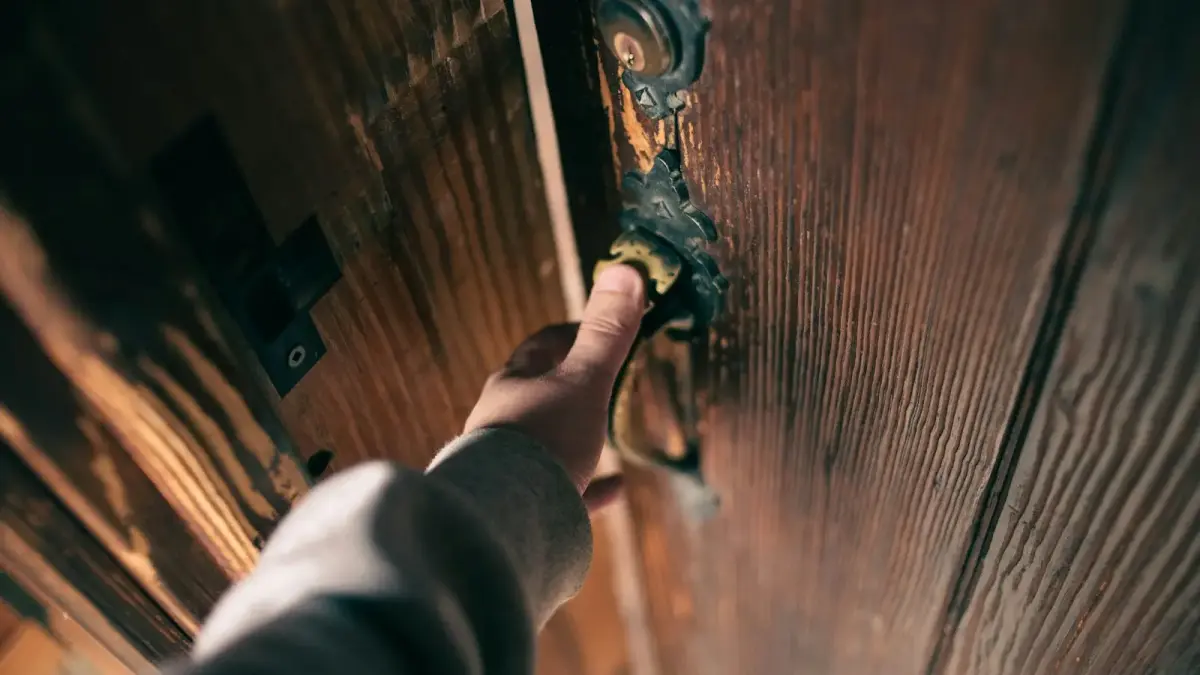
I still hold every door handle the entire way through.
I don’t mean sometimes, or with heavy doors, or when a baby is sleeping nearby. I mean every door, every time, in every building I enter. My right hand finds the knob, my left hand steadies the frame, and I guide the latch into its pocket the way you might lower a sleeping child into a crib - slowly, completely, without a single sound that could be mistaken for a statement.
I am forty-six years old. I have lived in my own home for two decades. No one in my house is going to hear that door close and decide it means something. But my hands don’t know that. My hands are still seven, still standing in the hallway of a house where a door closing at the wrong volume was the first domino in a chain of events that could ruin a Tuesday.
I thought this was just me. Then I started paying attention to the people around me - friends, colleagues, the woman at the coffee shop who holds the glass door with her whole body and releases it like she’s returning something borrowed. And I realized that there are millions of us. People who close doors like we’re apologizing in advance for the sound.
We weren’t born gentle. We were built that way.
The Door Was Never Just a Door
In a calm home, a door is hardware. It opens, it closes, it does its job without commentary. A child growing up in that kind of house slams doors during tantrums and nobody flinches - the door is not a loaded object.
But in a volatile home - the kind where mood shifts arrived without warning and silence was the only reliable forecast - a door became something else entirely. It became a barometer.
A door closing too hard was an accusation. A door opening at the wrong moment was an intrusion. The sound of a screen door slapping its frame was an overture, the first note of something that had been building all afternoon and just needed one careless sound to justify itself.
Children in those homes figured this out fast. Not intellectually - they didn’t sit down and reason through the acoustics of domestic tension. Their bodies figured it out. Their nervous systems, operating on a kind of survival logic that doesn’t require language, started cataloging which sounds were safe and which sounds summoned something terrifying.
Stephen Porges’ polyvagal theory describes exactly this process. His research shows that the human nervous system is constantly scanning the environment for cues of safety or danger - a process he calls neuroception. In children from unpredictable homes, this system becomes exquisitely tuned. It doesn’t just register obvious threats. It registers the precursors to threats. The footstep pattern that means someone is in a bad mood. The cabinet that closes a little too firmly. The door.
The door became the thing the child could control.
Learning the Physics of Silence
Here is what a child in a volatile home learns about doors before she learns long division.
She learns that a door has three separate sounds: the swing, the contact, and the latch. Each one can betray her. The swing creaks if the hinges haven’t been oiled. The contact - wood meeting wood, or wood meeting frame - produces a thud that carries through walls. The latch, that small metal tongue clicking into its socket, is the sharpest and most dangerous sound of all because it is the sound of finality. It says: I closed this door on purpose.
So she develops a technique. She turns the handle before she pushes the door shut, holding the latch retracted so the metal never strikes the plate. She guides the door with both hands until the frame absorbs it. Then - only then - she releases the handle, letting the latch slide into place with a whisper so faint it could be the house settling.
She does this at five, at six, at seven. She does it hundreds of times a week. And her body memorizes it the way a pianist’s fingers memorize scales - not as a decision but as the default way hands behave near doors.
A 2019 study published in the journal Development and Psychopathology found that children raised in high-conflict households develop significantly heightened sensory-motor responses to environmental stimuli. Their bodies learn to modulate their own physical output - how loudly they walk, how carefully they set things down, how much space they take up - as a regulatory strategy. The researchers called it “environmental accommodation.” The children were not being polite. They were being safe.
The Catalog of Quiet
Doors are the most recognizable version of this, but they’re not the only one.
1. The way they set things down
Watch someone who grew up in a volatile home put a glass on a counter. They don’t set it down - they place it. Their hand stays on the glass for an extra half-second after it touches the surface, absorbing the vibration, making sure the contact doesn’t ring out. They do the same with plates, with car keys, with their phone. Everything is placed, never dropped, never tossed.
2. The way they walk
These are the people who move through a house like they’re visiting a museum after hours. Sock feet on hardwood, weight distributed evenly, avoiding the floorboard that creaks near the bathroom. They learned the topography of sound in their childhood home the way other children learned the layout of a playground.
3. The way they handle cabinets
Kitchen cabinets are particularly loaded. In many volatile homes, the kitchen was the most dangerous room - the room where exhaustion and frustration and hunger and proximity created a density of feeling that needed almost nothing to ignite. A cabinet slammed shut after a long day was enough. So these children learned to close cabinets the same way they closed doors - slowly, with both hands, cushioning the final inch.
4. The way they modulate their voice
This one is subtler but just as consistent. Children from unpredictable homes often become adults with extraordinarily well-controlled voices. Not monotone - just measured. They learned that volume was a variable that could escalate a room, and they internalized the rule that their own sound should never be the thing that tips the balance.
5. The way they enter rooms
They knock softly, even on open doors. They pause at thresholds. They scan the room before stepping in - reading faces, measuring temperature, calculating whether their presence will improve or worsen whatever is happening. This is not social anxiety, though it often gets mistaken for it. It is reconnaissance.
James Gross, whose research at Stanford has shaped our understanding of emotional regulation for decades, has written about how children in unpredictable environments develop what he calls “antecedent-focused” regulation strategies. Instead of managing their emotions after a conflict erupts, they learn to prevent the conflict from erupting in the first place. They become architects of prevention. Every quiet footstep, every softly closed cabinet, every carefully modulated greeting is a preemptive act of emotional management - not for themselves, but for the entire household.
The Adult Who Still Holds the Handle
Here is the thing that breaks my heart about this.
It works. The strategy works beautifully in the house where it was built. The child who learned to close every door in silence really did reduce the number of explosions. She really did protect herself - and often her siblings - by becoming so physically undetectable that the house could forget she was in it.
But then she grows up. She moves out. She builds a life in a home where nobody is listening for the sound of a latch. And her body keeps doing it anyway.
She is forty-nine years old, hosting a dinner party, and she excuses herself to use the bathroom. She closes the bathroom door with both hands, holds the handle, and eases the latch into place so slowly that a guest passing in the hallway wouldn’t hear it over the sound of conversation. Nobody asked her to do this. Nobody would have noticed a normal door closing. But her body doesn’t believe in “normal door closing.” Her body believes that every door is the first line of a conversation she is not willing to start.
She holds the car door and pushes it closed with her hip instead of swinging it shut. She catches the screen door before it can bounce back against the frame. She opens the office door so slowly it takes ten seconds, and her coworkers think she’s just considerate.
She’s not considerate. She’s trained. There is a difference - and it matters because calling it consideration erases the cost of learning it.
The Weight of Being Quiet
A 2021 study in Frontiers in Psychology examined what researchers described as “chronic environmental hypervigilance” in adults who grew up in high-conflict homes. The findings were striking. These adults showed elevated cortisol responses to sudden environmental sounds - a door slamming, a dish breaking, a raised voice in the next room - even when they consciously knew the sounds posed no danger. Their thinking brains understood they were safe. Their bodies did not agree.
This is the tax. The door-closing, the gentle cabinet-shutting, the measured voice - these are not free skills. They are powered by a nervous system that never fully transitioned out of surveillance mode. The body that learned to monitor every sound it made is also monitoring every sound around it. All the time. In every room.
It is exhausting in a way that’s difficult to explain to someone who grew up in a house where doors were just doors.
And yet - here is the part I want to sit with - there is something in this vigilance that deserves more than just a clinical label. These children built something. Not on purpose, not by choice, but they built it. They developed an attentiveness to physical space, to the emotional texture of a room, to the impact of their own presence on others, that most people never acquire.
The woman who closes every door softly is reading the room in a way that is genuinely rare. She knows when someone at the table is about to cry before they know it themselves. She can feel the shift in a conversation three sentences before it becomes an argument. She knows, in her body, that small sounds carry enormous meaning - because in her first home, they did.
What Your Hands Already Know
If you recognized yourself in this article - if you felt that familiar tightness when I described holding the handle, guiding the latch, catching the screen door - I want you to know something.
You are not overly sensitive. You are not anxious for no reason. You are not “too careful” or “too aware” or any of the gentle dismissals people offer when they notice you moving through the world with more precision than seems necessary.
You are carrying a skill that was built under pressure and has never been properly acknowledged. You learned to read rooms and regulate atmospheres before you learned to ride a bike. That is not a flaw. That is an extraordinary adaptation that cost you something real, and you deserve to know what it is rather than spending another decade thinking you’re just a quiet person.
You might always hold the handle. You might always catch the screen door. That’s okay. Your body learned this language young, and it may never fully unlearn it.
But you can know, now, that the door you’re so careful with is your own door. In your own home. And nobody on the other side is listening the way they used to.
The house is yours. And you’re allowed to let the latch click.