Children who always drew a picture for their parents after a fight - who left folded paper on the kitchen counter and slid crayon cards under the bedroom door - often become adults who respond to every conflict by producing something, because the child who discovered a drawing could change the weather in a house learned to carry art supplies into every storm
I was eight years old the first time I realized I could fix a room with a piece of paper.
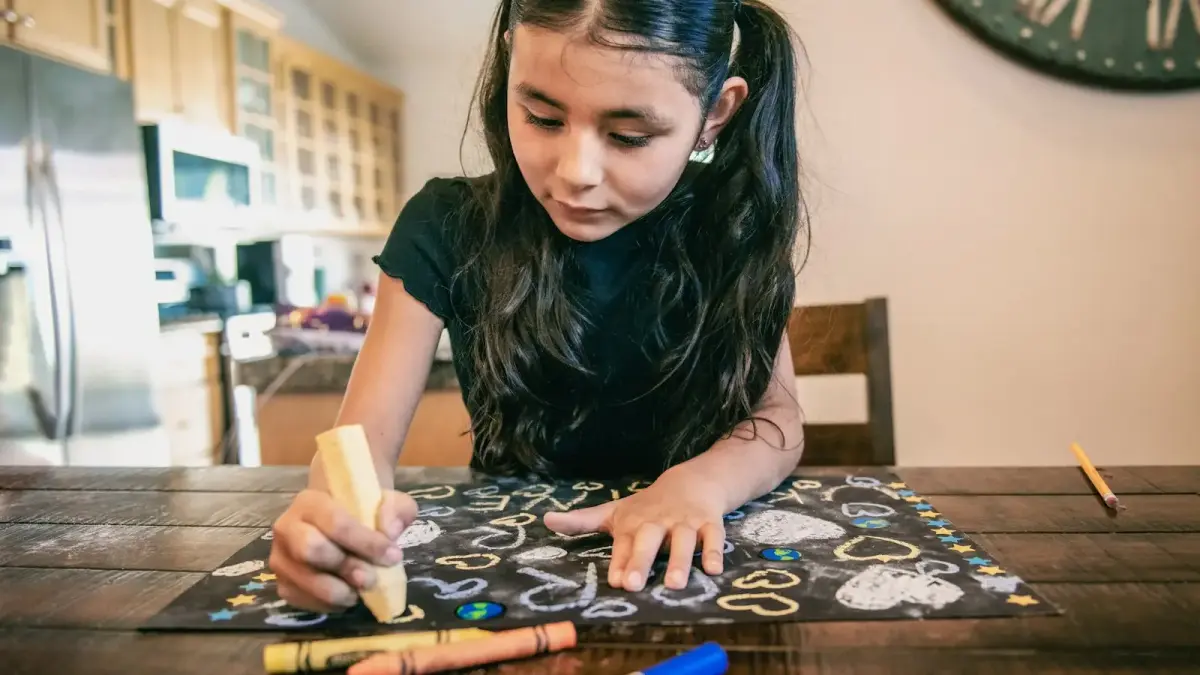
My parents had been arguing in the kitchen - not the loud kind, the worse kind, the kind where every sentence was measured and quiet and carried the weight of something neither of them would explain to me. I sat on my bedroom floor with a box of crayons and drew a picture of our family standing in front of our house. Everyone was smiling. The sun had a face. I folded it in half, crept down the hallway, and slid it under their door.
Twenty minutes later, my mother came out. She hugged me. She said it was beautiful. And the house exhaled.
I didn’t know it then, but I had just learned the most dangerous lesson of my childhood - that my creative output had the power to regulate other people’s emotions. That a drawing could stop a storm. That if I just made something good enough, the tension would dissolve and I would be safe again.
I am forty-one now, and I still reach for the crayons. They just look different.
The kitchen counter peace treaty
If you were this child, you already know exactly what I’m describing. You were the one who left things on the counter for people to find - folded notes, little drawings, cookies you baked without being asked. You didn’t storm into the room and say what you felt. You made something and placed it where it could speak for you.
Maybe you taped a card to a parent’s bathroom mirror after they yelled at dinner. Maybe you cleaned the entire living room while they slept off an argument. Maybe you arranged your stuffed animals in a display that said, without language, please be okay again.
A 2019 study published in the Journal of Research in Personality found that children who develop what researchers call “proactive harmony behaviors” - actions taken to restore relational calm before being asked - tend to carry these patterns well into adulthood. The study noted that these children weren’t simply being kind. They were performing emotional labor before they had the vocabulary to understand what emotional labor was.
You weren’t making art. You were making a bid for peace.
And it worked. That’s the part that locked it in.
When production becomes your only language for repair
The thing about a strategy that works in childhood is that it doesn’t retire when you grow up. It just changes costume.
The child who drew pictures after fights becomes the adult who cooks an elaborate meal the evening after a tense conversation. Who deep-cleans the kitchen at eleven at night because something was said at dinner that still sits unresolved in their chest. Who writes a long, careful message to a friend after a minor disagreement - not because the disagreement warranted it, but because silence feels like danger and the only way to outrun danger is to make something.
You don’t argue. You produce.
You don’t say “that hurt me.” You reorganize the pantry.
You don’t say “I need to talk about what happened.” You bake bread. You fold laundry. You show up with a gift. You write a card.
Dr. Edward Tronick, whose research on parent-child attunement at the University of Massachusetts Boston has shaped how we understand early emotional development, describes this pattern as a form of “reparative signaling” - the child learns that their distress is not going to be met with direct comfort, so they develop an indirect channel. They build a bridge out of whatever materials they have. For some children, those materials are crayons and construction paper. For the adults they become, those materials are labor, effort, and visible proof of care.
The exhaustion of never sitting still with tension
Here is what nobody tells you about being this person: it is profoundly tiring.
Because you are never just in a conflict. You are always already solving it. The moment tension enters a room, a part of you activates - not fight, not flight, but fabricate. Make something. Do something. Prove, through output, that you are still good, still valuable, still worth keeping around.
A 2021 study in Frontiers in Psychology examined what the researchers called “compulsive reparative behavior” in adults who reported high levels of childhood emotional responsibility. They found that these individuals experienced significantly more fatigue, more difficulty identifying their own emotions during conflict, and more anxiety when prevented from taking action after a disagreement. In other words, sitting still with unresolved tension felt not just uncomfortable but physically unsafe.
You might recognize this. The inability to just let a fight breathe. The immediate need to do something - to text, to cook, to clean, to plan, to offer. The feeling that if you stop producing, the relationship will collapse. That your worth in any room is measured by what you contribute to it, and if you contribute nothing, you are nothing.
This isn’t a personality trait. This is a survival strategy wearing a productive person’s clothes.
The invisible transaction
What makes this pattern so hard to see - and so hard to change - is that people reward it constantly.
You are the friend who always knows what to bring. The partner who cleans up after hard conversations without being asked. The coworker who smooths every tension with a thoughtful gesture. People call you considerate. Generous. Emotionally intelligent. The person who just naturally takes care of things.
And you smile and accept the compliment because you cannot explain the truth, which is that you are not generous. You are terrified. Every casserole is a crayon drawing. Every cleaned kitchen is a folded piece of paper slid under a door. Every thoughtful gesture is a child saying please don’t leave, please don’t be angry, please let me fix this with my hands because I was never taught that my words were enough.
Brene Brown has written extensively about how people-pleasing is often misidentified as kindness when it is actually a fear response. The distinction matters. Kindness is a choice. Production-as-repair is a compulsion. One comes from overflow. The other comes from dread.
What the child was actually learning
Let me be careful here, because I am not saying your parents were monsters. Most of the time, this pattern develops in homes that were normal by every external measure - homes where love was real but communication was limited, where conflict existed but resolution was never modeled explicitly.
The child in this pattern didn’t learn that love was absent. They learned that love was conditional on contribution. That the emotional climate of the house could shift, and that their job was to shift it back. That feelings were problems to be solved rather than experiences to be shared.
A 2020 study in Developmental Psychology tracked children who exhibited early “emotional caretaking” behaviors and found that by adolescence, these children showed higher rates of alexithymia - difficulty identifying and describing their own emotions. The researchers suggested a straightforward explanation: when a child spends their developmental years focused on managing other people’s emotional states, they simply don’t get enough practice identifying their own.
You learned to read every room. You just never learned to read yourself.
The meal that is actually a letter
I want you to think about the last time you had a disagreement with someone you love. Not a screaming match - just a moment of friction, a cold silence, a conversation that ended without resolution.
What did you do next?
If you are this person, you probably didn’t bring it up again. You probably made dinner. Or tidied the house. Or sent a text that was warm and careful and said everything except the thing that actually needed to be said.
You made a meal that was actually a letter. You cleaned a kitchen that was actually a prayer. You organized a closet that was actually a plea.
And maybe it worked. Maybe the tension dissolved. Maybe the other person felt your effort and softened. But the thing that was unspoken stayed unspoken. And the feeling that started the conflict - your feeling, the one that mattered - got folded into a casserole dish and served to someone else.
This is what psychologist Dr. Susan David calls “emotional avoidance through prosocial behavior.” You look like the most emotionally available person in the room, but you are actually the one doing the most sophisticated form of hiding. You are present with your hands and absent with your heart.
Learning to put the crayons down
I want to be honest: I don’t have a five-step plan for undoing forty years of this pattern. It doesn’t work that way. A survival strategy this old and this rewarded doesn’t just uninstall because you read an article about it on your phone.
But I can tell you what has started to shift things for me.
The first thing is recognition. Just naming it. The next time you feel the urge to produce your way out of a conflict - to cook, to clean, to write, to fix - pause long enough to notice what you are actually feeling underneath the urge. There is always a feeling under the production. It is usually fear. Sometimes grief. Sometimes just the raw, old ache of a child who believed they had to earn their way back into a room.
The second thing is tolerating stillness. Sitting in the tension without making something. This will feel awful. It will feel like drowning. Your whole body will tell you to get up and do something, anything. But the tension will not kill you. The silence will not end the relationship. You are allowed to be in a room where something is unresolved and not be the one who resolves it.
The third thing - and this is the hardest one - is using words instead of labor. Saying “I felt hurt by that” instead of baking a pie. Saying “can we talk about last night” instead of reorganizing the garage. Letting your voice carry the repair instead of your hands.
You spent your childhood learning that a drawing could change the weather in a house. You were right. It could. But you are not a child anymore, and the weather is not yours to manage.
Your hands have done enough. Your words are allowed to take a turn.