Children who always needed the closet door completely closed before they could fall asleep - who got out of bed to push it shut even when their parents had just checked, who could feel the gap between the door and the frame like a draft of unfinished business - often become adults who cannot sleep until every open loop is closed, every message answered, every light checked, because a child who learned that the boundary between safe and unsafe was literally the width of an open door never stopped believing that sleeping with something unresolved was sleeping with something watching
I was seven years old the first time I understood that a half-inch gap could ruin an entire night.
My mother had tucked me in, kissed my forehead, checked under the bed the way she always did - with theatrical confidence, like she was proving a point to an invisible jury. She turned off the overhead light, left the hallway one on, and pulled my bedroom door to that almost-closed position parents seem to think is comforting. Then she walked away.
And I lay there, staring at the closet.
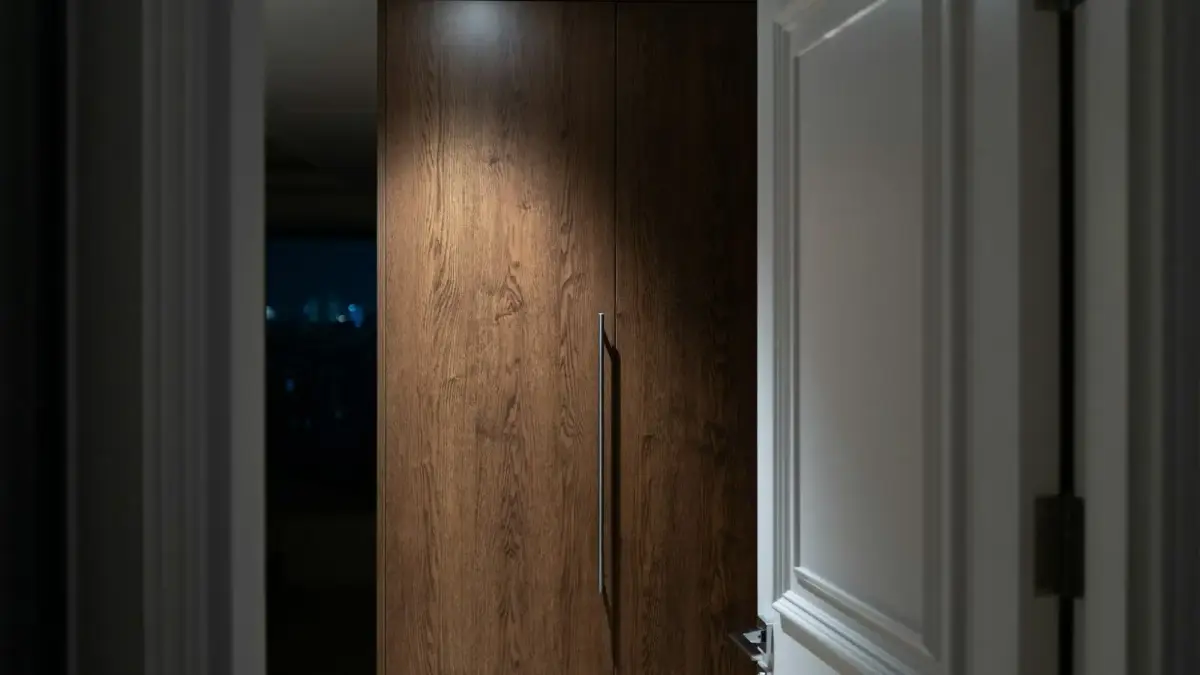
It was open. Not wide open. Not even noticeably open, if you were a person who didn’t notice these things. But the door had drifted about two inches from the frame, and I could see a sliver of darkness inside that was different from the darkness in my room. Thicker. More deliberate.
I lasted maybe ninety seconds before I got up, crossed the cold floor in bare feet, and pressed that door shut with both palms until I heard the click. Then I got back into bed, pulled the covers up to my chin, and finally exhaled.
If you were that child - the one who could feel an open door the way other people feel a change in temperature - then I probably don’t need to explain what happened next. Because you already know where this goes.
1. The nightly patrol wasn’t about monsters
Let’s be honest about what the closet door ritual actually was.
It wasn’t really about monsters. Even at seven, I think I half-knew that. It was about the feeling that something in my environment was unfinished, unsealed, not fully under my control - and that I couldn’t surrender to sleep while that was true.
The closet door was just the most visible version of it. Some of us also needed the curtains to hang a certain way. The bedroom door had to be open exactly six inches - not five, not eight. The glass of water had to be on the nightstand, not the dresser. The stuffed animals had to face outward, toward the room, like sentries.
We weren’t being difficult. We were building a perimeter.
A 2019 study published in the Journal of Anxiety Disorders found that children who display rigid bedtime rituals - particularly those involving environmental control - often score higher on measures of intolerance of uncertainty. Not because they’re more anxious than other children, necessarily, but because their nervous systems are more attuned to ambiguity. They register open loops the way a smoke detector registers particles in the air. Not with logic. With alarm.
2. What we were really doing was holding our own boundaries
Here is something I wish someone had told me when I was small and pressing closet doors shut in the dark: you were doing the work that nobody else was doing for you.
Not because your parents were bad. Not because your home was dangerous. But because somewhere, early on, your nervous system got the message that safety was something you had to build yourself. That the world didn’t just come pre-sealed. That if you wanted to feel contained, you had to be the one doing the containing.
For some of us, that message came from chaos at home - unpredictable moods, doors that slammed without warning, voices that rose after bedtime. For others, it was subtler. Maybe your parents were loving but distracted. Maybe they were present but anxious themselves, and you absorbed their vigilance without anyone naming it.
Either way, the lesson landed the same: boundaries are not given. They are enforced. And if you stop enforcing them, even for a moment, something gets in.
3. The closet door becomes the inbox
Fast forward twenty, thirty, forty years. The closet door is gone, or at least it’s in a different house now. But the pattern is alive and well, and it has found new doors to close.
You cannot go to bed with an unanswered text message. Not because you’re obsessively attached to your phone, but because the notification sits in your chest like that two-inch gap in the dark. Something is open. Something needs to be sealed.
You check the front door lock twice. You check it a third time because the second time didn’t feel right - your hand turned the deadbolt, but your brain didn’t register the click. You need the click. You have always needed the click.
You lie in bed and suddenly remember that you didn’t respond to your coworker’s email about the Tuesday meeting. The meeting is ten days away. It doesn’t matter. The loop is open, and your body knows it the way it used to know about the closet.
You make lists before bed - not because productivity culture told you to, but because the act of writing everything down is the adult equivalent of pressing both palms against the door until it latches. You are transferring the open loops from your nervous system to a piece of paper so your body will finally believe it’s safe to stop watching.
4. Your brain is actually wired to hate incomplete patterns
There is real neuroscience behind why this happens, and it’s older than any of us.
The Zeigarnik Effect, first described by psychologist Bluma Zeigarnik in the 1920s, demonstrates that the human brain holds onto incomplete tasks with significantly more intensity than completed ones. Unfinished business literally takes up more cognitive real estate. Your brain keeps a tab open for every unsent email, every conversation that ended without resolution, every lock you’re not sure you checked.
A 2021 study in Psychological Science found that people who score high on need-for-closure measures show heightened activity in the anterior cingulate cortex - the brain region responsible for error detection and monitoring - when presented with ambiguous or incomplete information. Their brains are not malfunctioning. They are doing exactly what they were trained to do: scanning for gaps, for unsealed edges, for the places where something unresolved might get in.
This is not a character flaw. This is architecture.
And if you built that architecture early - if you spent your childhood monitoring doors and curtains and the exact position of everything in your room - then your anterior cingulate cortex has been in overdrive since before you could spell your own name.
5. The bedtime checklist is a trauma response dressed in productivity clothing
I want to be careful here, because I don’t want to pathologize something that many of us have come to see as simply being thorough or responsible.
But there is a difference between a person who checks the stove once because it’s sensible and a person who checks it three times because their body won’t release them until it does. The first person is being practical. The second person is completing a ritual that began decades ago in a bedroom where safety had to be manually constructed every single night.
Gabor Mate has written extensively about how early childhood experiences of environmental unpredictability wire the nervous system for perpetual vigilance. The child doesn’t choose this. The child’s body chooses it for them, because the body’s job is survival, and survival means monitoring every boundary, every edge, every seam where danger might enter.
The adult version looks different on the surface. It looks like responsibility. It looks like being the person who always remembers to lock up, who always responds to the email, who always ties up the loose end before bed. People might even praise you for it.
But underneath the competence is a seven-year-old who cannot sleep until every door in the house is shut.
6. You weren’t anxious - you were accurate
Here’s what I need you to hear, because it’s the thing I wish I’d understood decades ago.
You were not an anxious child. You were an accurate one.
You perceived, correctly, that your environment had gaps. That doors drifted open. That things left unsealed had a way of becoming problems. That the adults around you - however loving - were not always monitoring the perimeter the way your nervous system needed them to.
And so you did it yourself. You built a nightly practice of closing every gap, checking every edge, making sure the boundary between you and the unknown was physically, tangibly sealed. And it worked. You fell asleep. You survived the night. Your system learned: closure equals safety.
The problem is that your system never got the update that you’re not seven anymore. That the closet doesn’t need checking. That an unanswered text at 11 p.m. is not a gap in your defenses.
A 2020 study in Frontiers in Psychology found that adults with high intolerance of uncertainty often trace their patterns back to childhood environments where predictability was inconsistent - not necessarily traumatic, but inconsistent. The researchers described it as a “calibration issue”: the nervous system set its sensitivity dial early, and it never got recalibrated for adult life, where most open loops resolve themselves and most open doors are just open doors.
7. The two-inch gap was never really about the closet
What I’ve come to understand - slowly, reluctantly, lying awake at 2 a.m. with my phone in my hand, rereading a message I already answered to make sure my answer was complete enough - is that the closet door was never the point.
The point was that I needed to know, with absolute physical certainty, that nothing could reach me while I was sleeping. That the borders of my world were sealed. That I could let go of consciousness without something slipping through the gap.
And that need - that desperate, specific, bone-deep need - didn’t go away when I grew up. It just found more sophisticated doors to close.
The inbox. The to-do list. The locks. The stove knobs. The conversation that ended without a clear resolution. The text that said “we should talk” without saying when. Every single one of them is a closet door, cracked two inches in the dark.
8. Learning to sleep with the door open
I’m not going to tell you to stop checking. I’m not going to suggest a breathing exercise or a mindfulness app or a five-step program for letting go.
What I’m going to tell you is this: the part of you that cannot rest until everything is closed is not your enemy. It’s the part that kept you safe when safe was something you had to build with your own two hands, in the dark, alone.
That part of you deserves respect. It deserves acknowledgment. It does not deserve to be told it’s broken or irrational or too much.
But it might deserve to be told - gently, firmly, the way you’d talk to a child standing in the dark with both palms pressed against a door - that you’ve got it from here. That you’re the adult now. That some doors can stay open without anything coming through.
You might not believe it yet. That’s okay. The seven-year-old didn’t believe the room was safe either, not until the click.
But maybe tonight, you leave one loop open. One message unanswered. One small, harmless gap between the door and the frame.
And you notice that the draft you feel isn’t danger. It’s just air. It’s just the world, breathing alongside you, asking nothing, watching nothing, waiting for nothing.
Just air. Just you. Just the kind of quiet that doesn’t need a click to be safe.