Children who always noticed when the light under their parents' bedroom door was still on past midnight - who would lie awake tracking the low voices through the wall - often become adults who cannot fall asleep until everyone in the house is settled, because a child who learned to read the emotional weather of a household through a strip of light under a door never found the part of adulthood where it becomes safe to close their eyes without checking first
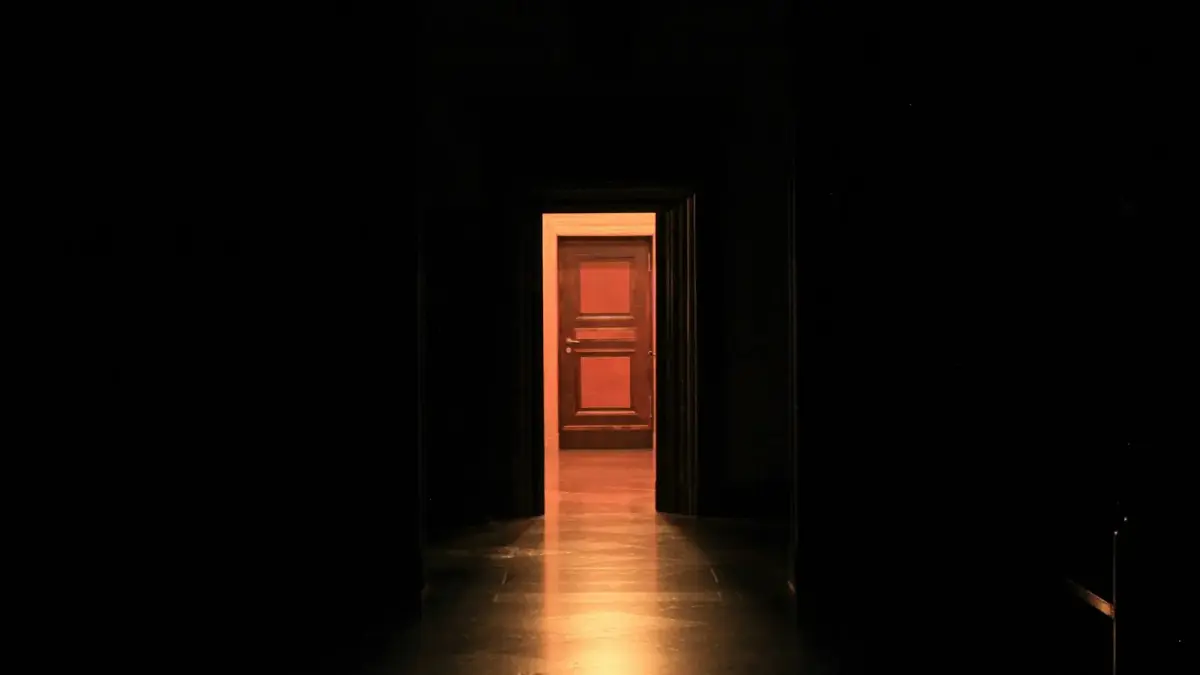
I was nine the first time I realized I could tell the difference between my parents talking about the electricity bill and my parents talking about whether my father was going to leave.
It wasn’t the words. I couldn’t make out most of them through the wall. It was the rhythm. The bill conversation had pauses - normal, bored pauses, the kind where someone takes a sip of tea or flips a page. The other conversation had no pauses at all. It was a low, continuous current, and sometimes it would spike, and sometimes it would drop to a murmur that was somehow worse than the spike.
I tracked these conversations from my bed like a meteorologist tracking a pressure system. I didn’t know that word yet. I didn’t know any words for what I was doing. I just knew that if the light under their door went off by ten, tomorrow would be a pancake morning. And if it was still on at midnight, I needed to prepare for a different kind of morning entirely.
If you know exactly what I’m describing - if your body just recognized that feeling before your mind caught up - then you probably already know what comes next.
The strip of light was never just a strip of light
For most children, a bedroom door is a boundary. For children in emotionally unpredictable homes, it’s a weather station.
That thin line of light at the bottom of the door becomes the most important data point in the house. Light on at a normal hour means the system is stable. Light on past the usual time means something has shifted. Light on at one in the morning means the child needs to start running calculations - who will be angry tomorrow, who will be absent, whether the morning will hold together or quietly fall apart.
A 2017 study published in the journal Development and Psychopathology found that children in high-conflict homes develop heightened perceptual sensitivity to emotional cues - they become faster and more accurate at detecting anger in facial expressions, tone of voice, and ambient household signals. The researchers called it an adaptive response. The child’s nervous system reorganizes itself to prioritize threat detection.
But what looks like a gift in childhood - this extraordinary attunement to the emotional atmosphere - becomes something else entirely in adulthood. It becomes the inability to rest.
1. They learned to read a room before they learned to read a book
These children didn’t just notice the light under the door. They noticed everything.
The way a cabinet closed. The specific weight of a footstep on the stairs. Whether the TV was turned on to something someone wanted to watch or turned on to fill the silence after a fight. They catalogued these signals the way other children catalogued baseball cards or dinosaur names - methodically, obsessively, because the collection had a purpose.
By seven or eight, they had a complete sensory map of their household’s emotional state. They could walk into the kitchen and know within three seconds whether this was a safe morning or a careful morning.
This is not something a child should have to be good at.
2. Bedtime was never about sleep - it was about surveillance
For the child tracking the light, being sent to bed was not a relief. It was a loss of information.
During the day, they could see faces, gauge distance between bodies, watch for the small signals that preceded a shift. But at night, behind their own closed door, they lost visual access. All they had left was sound and that strip of light.
So they lay there and listened. The clink of a glass. A chair scraping back. The particular quality of silence that meant someone had left the room versus the silence that meant two people were sitting in the same room refusing to speak. They learned to distinguish between these silences the way a musician learns to hear the difference between two notes a half-step apart.
And they could not fall asleep until the light went off. Because the light going off meant the system had powered down for the night. It meant no more decisions would be made. It meant the version of the household they’d fall asleep in would be the same one they’d wake up to.
3. The nervous system never got the memo that they moved out
Here is what developmental psychologist Gabor Mate has described in his work on childhood stress and its long-term effects: the body keeps running the program long after the original conditions have changed. A child who spent years in a state of nocturnal vigilance doesn’t simply stop being vigilant because they grew up and got their own apartment.
Instead, the vigilance migrates. It finds new targets.
Now it’s a partner’s breathing pattern. Now it’s whether the teenager texted that they got home. Now it’s the sound of the furnace cycling on, or a creak in the hallway, or the particular quality of quiet that means everyone is asleep versus the quiet that means someone is lying awake upset about something they haven’t said yet.
The adult version of this child lies in bed running the same calculations they ran at eight years old. Is everyone accounted for. Is the emotional weather stable. Is it safe to stop monitoring.
Their partner falls asleep in four minutes. They lie there for an hour, ears tuned to the house like a satellite dish, waiting for some signal that never quite arrives.
4. They became the last one awake in every household they’ve ever lived in
This is one of the most consistent patterns. The child who tracked the light becomes the adult who is chronically, structurally the last person awake.
They do the final loop. Check the locks. Check the stove. Stand in the hallway and listen. Not because they think someone broke in. Not because they think the house is on fire. But because their body will not release them into sleep until they have confirmed that the perimeter is secure and every person inside it is settled.
A 2019 study published in the Journal of Research in Personality found a strong correlation between childhood emotional parentification - taking on the role of emotional caretaker in the family - and adult sleep onset insomnia. The researchers noted that these individuals showed elevated cognitive arousal at bedtime, meaning their minds continued processing relational and emotional data long after their bodies were physically exhausted.
They’re not anxious in the clinical sense. They’re completing a protocol. A protocol they wrote when they were seven and never had permission to retire.
5. They check on sleeping people
This one is quieter, and the people who do it rarely talk about it.
But many adults who grew up monitoring the household at night will, before they finally allow themselves to sleep, physically check on the people they live with. They’ll crack open a child’s bedroom door. They’ll look at their partner’s chest to confirm breathing. They’ll stand in a doorway for a few seconds longer than makes logical sense, just watching.
It looks like love. And it is love. But it’s also the echo of a child who learned that the people you depend on can be fundamentally different in the morning than they were the night before - and that the only way to track the change is to keep watching.
6. They feel responsible for the emotional temperature of the night
This is perhaps the deepest pattern. These adults don’t just monitor the household at night - they feel personally responsible for it.
If their partner goes to bed upset, they cannot sleep. Not because the conflict bothers them - though it does - but because an unresolved emotional state in the house at bedtime is the same signal their childhood nervous system flagged as dangerous. Light still on. Voices still going. Something unresolved. The system cannot power down.
So they become the person who always wants to resolve things before bed. Who says “can we just talk about this for a minute” at eleven at night. Who cannot tolerate the idea of someone falling asleep angry, not because they read that advice in a marriage book but because their body literally will not let them rest while emotional static is still in the air.
7. They never learned that sleep could feel safe
For most people, falling asleep is a neutral act. You’re tired. You close your eyes. You drift off.
For the child who spent years using bedtime as a listening post, falling asleep was always an act of surrender. It meant giving up the watch. It meant accepting that whatever happened next would happen without their awareness, without their ability to intervene or prepare.
Research published in Psychological Science in 2021 found that individuals with a history of childhood relational stress showed altered sleep architecture, including longer sleep onset latency and more frequent night wakings. The researchers suggested that for these individuals, the transition from wakefulness to sleep itself carries an implicit sense of threat - because sleep means the loss of monitoring capacity.
They didn’t learn that sleep was rest. They learned that sleep was the period during which you couldn’t protect anyone, including yourself.
What the light under the door actually taught them
If you recognize yourself in any of this, I want you to hear something clearly.
You were not a nervous child. You were not an anxious child. You were a child who was paying extraordinary attention because the situation required extraordinary attention. You developed a skill set that most adults don’t have - the ability to read an emotional environment with precision and speed - and you developed it because nobody else in your house was managing that information on your behalf.
The fact that you still lie awake listening to the house settle is not a disorder. It’s a loyalty. Your body is still keeping the watch because no one ever formally told it the watch was over.
You are allowed to put it down.
Not all at once. Not tonight, probably. But you can start by naming what you’re doing when you lie there in the dark running your check. You can say to yourself: I am running the childhood protocol. The light under the door is off now. It has been off for a long time.
You can let the house hold itself tonight.
You did enough listening for one lifetime. The strip of light is gone. The hallway is dark and quiet, and everyone you love is safe, and the morning will be the same morning you fall asleep in.
You can close your eyes now.