Children who always drew on foggy windows - who pressed one finger against the cold glass and wrote their name or drew a sun while the adults talked in the next room - often become adults who still trace shapes on any surface their hands can reach, because a child who discovered that a foggy window was the only canvas that disappeared before anyone could judge it was learning the only form of self-expression that ever felt completely safe
I was eight the first time I realized I’d been making art for years without telling anyone.
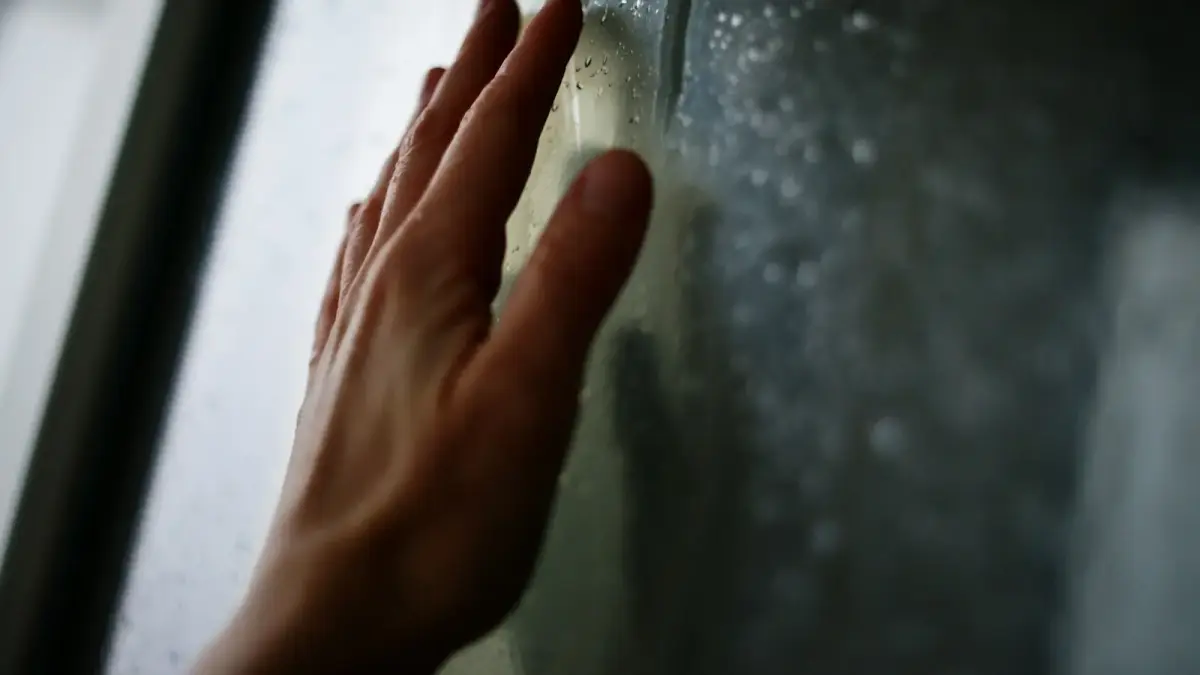
It was a Saturday morning in November, and the kitchen windows were thick with condensation. My parents were having one of their long, slow weekend conversations at the table - the kind where the coffee goes cold and nobody notices. I was sitting on the counter by the window, dragging my index finger through the fog, drawing a house with smoke curling from the chimney.
When the heater kicked on and the glass cleared, the house vanished. And I remember feeling something I couldn’t name at the time but understand perfectly now - relief. Not sadness that it was gone. Relief that nobody would ever see it.
That was the contract I’d made with myself without knowing it. I could create anything I wanted, as long as it didn’t last.
If you were that child - the one with your nose near the glass, your fingertip wet and cold, drawing suns and spirals while the grown-ups carried on without you - I want you to know something. That wasn’t idle fidgeting. That was the beginning of a creative identity so private, so self-protective, that it shaped how you interact with every surface your hands have ever touched.
And it’s still shaping you now.
1. You doodle in the margins of everything, but you’d never call yourself an artist
There’s a notebook somewhere near you right now - on your desk, in your bag, next to the phone - and the margins are covered. Spirals. Stars. Repeating patterns that look almost like fabric designs. You did them during phone calls, during meetings, during moments when your conscious mind was elsewhere and your hands just needed something to do.
But if someone pointed at those doodles and said, “You’re really creative,” you’d wave it off. You’d say, “Oh, that’s nothing. I was just bored.”
A 2017 study published in The Arts in Psychotherapy found that spontaneous doodling activates the brain’s default mode network - the same system involved in daydreaming, self-reflection, and emotional processing. Your doodling isn’t boredom. It’s your inner world leaking out through your fingertips the same way it leaked onto that cold glass when you were seven.
You learned early that real art gets scrutinized. Foggy window art doesn’t. So you kept your creativity in the margins where nobody looks too hard.
2. You trace circles in condensation rings on coffee tables and don’t realize you’re doing it
Someone sets down a cold glass on a warm day. A ring of water forms on the table. And before you’ve made any conscious decision, your finger is in it - spreading the moisture, drawing a line, making a shape.
You’ve done this a thousand times. At restaurants. At your own kitchen table. At someone else’s house, and then suddenly you look down and realize you’ve turned their coffee table into a canvas and you pull your hand away like you’ve been caught.
This is the foggy window impulse, fully intact. Your hands still seek out surfaces that will accept a temporary mark. Wood grain. Dust. Condensation. Anything that says, “You can touch me, and the evidence will disappear.”
The child in you still remembers that the safest place to be an artist is somewhere the art can’t follow you home.
3. You write words in sand at the beach and feel something you can’t quite explain when the water takes them
Everyone writes in the sand. But not everyone stands there afterward, watching the tide creep closer, feeling their chest tighten with something that sits right between peace and grief.
You do. Because the sand is the adult version of the foggy window - a surface that invites creation and promises destruction in the same breath. You write a name, or a word, or just draw a long curving line, and then you watch the water smooth it away. And the feeling that rises in you is familiar. Ancient. It’s the same feeling you had at eight years old when the heater kicked on.
Psychologist D.W. Winnicott wrote extensively about what he called “transitional space” - the psychological territory between inner reality and the external world where a child first learns to play, imagine, and create. The foggy window was your transitional space. The sand is its echo. You keep returning to surfaces that let you exist creatively without leaving proof.
4. You run your finger through dust on dashboards and shelves, and it feels like a secret
Here’s one you probably haven’t admitted to anyone. When you notice dust on a surface - the dashboard of your car, a neglected shelf, the top of a dresser - you don’t just see dirt. You see a canvas.
Your finger moves through it before your brain catches up. You write a letter. You draw a line. You make a small shape that nobody will ever see because the next person who wipes down that surface will erase it completely.
This is the purest form of what the foggy window taught you. Dust is temporary. The mark is temporary. The whole interaction is so small and private that it barely registers as an event.
But it is one. Every time your finger moves through dust on a forgotten surface, you are honoring an agreement you made with yourself as a child - that you are allowed to create, as long as creation doesn’t cost you anything. As long as nobody can hold it up and say, “Is this what’s inside you?“
5. You choose pencils over pens and you’ve never questioned why
If someone hands you a pen and a pencil, you reach for the pencil. You might rationalize it - pencils feel better, pencils are more forgiving, you like the texture. But the real reason runs deeper.
Pencils can be erased.
A 2020 study in the Journal of Research in Personality found that individuals who score high in introversion and sensitivity tend to show stronger preferences for reversible actions - choices that can be undone, commitments that can be walked back, marks that can be removed. This isn’t indecisiveness. It’s a deeply ingrained need to maintain creative control, including the control to unmake something.
The foggy window taught you that creation and erasure could be the same gesture. A pencil carries that same promise. You can make something, and if it doesn’t feel right - if it reveals too much, if it’s not quite the shape of what’s inside you - you can take it back. The pen doesn’t offer that mercy. So you avoid it.
6. You have a complicated relationship with posting anything online
You write something - a thought, a caption, a reflection - and your thumb hovers over the post button for a long time. Sometimes you publish it. Sometimes you delete the draft. Sometimes you post it, then delete it twenty minutes later, hoping nobody saw.
This is the foggy window problem scaled up to the size of the internet. The window let you create something that vanished on its own. Social media creates something that never vanishes. Every post is permanent. Screenshottable. Quotable out of context. Judgeable by people you’ve never met.
For someone who learned to create safely only in spaces where the art self-destructed, the permanence of digital expression feels like standing in a room where the windows never fog up. There’s nowhere to practice. Nowhere to be tentative. The first draft is the final draft, and everyone is watching.
If you’ve ever felt a strange anxiety about posting something that’s genuinely you - not a shared article, not a joke, but something real - this is why. Your creative nervous system was calibrated for disappearing ink. The internet is the opposite of that.
7. You fidget with surfaces constantly and people think it’s a nervous habit
Your fingers are always busy. You peel labels off water bottles. You scratch patterns into the frost on a frozen car window. You press your palm flat against a table and slide it, feeling the texture. You fold napkin corners into tiny triangles.
People around you might read this as anxiety. Restlessness. Something to manage.
But researcher Ruth Fortus, writing in the Creativity Research Journal, noted that tactile engagement with surfaces often functions as a form of embodied cognition - thinking through touch, processing emotion through physical contact with the material world. Your hands aren’t nervous. They’re thinking. They’ve been thinking this way since you were small enough to stand on tiptoe to reach the fogged-up bathroom mirror after a shower.
The foggy window didn’t just teach you how to create safely. It taught you that your hands were your primary creative instrument. Not a brush. Not a keyboard. Your actual fingertip on an actual surface. That’s the medium you were trained in, and your hands have never stopped practicing.
8. You make things in private that you never show anyone, and it feels like the most natural thing in the world
Maybe it’s a journal you write in at night. Maybe it’s sketches in a book that lives in your nightstand drawer. Maybe it’s recipes you adjust by instinct but never write down. Maybe it’s playlists you build with the care of someone arranging flowers, each song chosen for how it sits next to the one before.
You make things. Quietly. Consistently. With real care and real attention. And then you close the book, or clear the counter, or move on to the next task, and nobody ever knows.
This doesn’t feel like hiding to you. It feels like the natural state of creation. You learned on a foggy window that making something was its own reward - that the moment of contact between your fingertip and the glass was the point, not the thing it left behind. The product was never the purpose. The act was.
Susan Cain, in her research on introversion and creative solitude, has observed that many of the most original thinkers work best - and most authentically - when they believe nobody is watching. The foggy window gave you that. A place where nobody was watching. A place where creation was immediate, sensory, and entirely yours.
You’ve been carrying that place inside you ever since.
Here is what I want you to hear, from one foggy-window kid to another.
You were never just killing time. You were never just fidgeting. You were building a creative practice so instinctive and so private that you didn’t even recognize it as one.
Every surface you’ve ever traced your finger across - every napkin, every dusty shelf, every patch of sand - was a continuation of the same impulse that put your small hand against that cold glass decades ago. The impulse to make something. To feel the surface respond to your touch. To know that you could create without consequence, without judgment, without the terrifying permanence of being seen.
That’s not a limitation. That’s a gift.
The foggy window was your first studio. And the truth is, you never left it. You just found new windows - everywhere you go, in every quiet moment, with every surface your hands can reach.
Your art has always been real. Even when it disappeared before anyone else could see it.
Especially then.