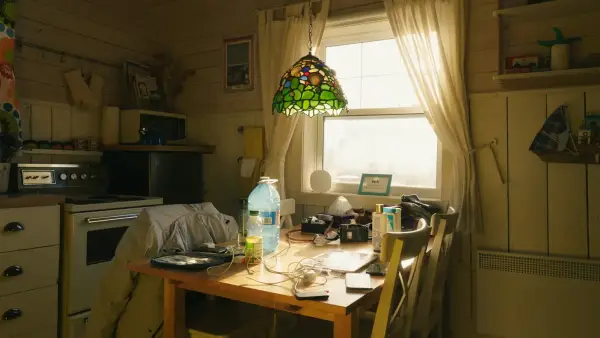
Children who learned to laugh quietly because someone in the house was always sleeping or always angry often become women who still cover their mouths at fifty, because the girl inside them was taught that the loudest thing in the room was always the thing that was wrong

I was at a dinner party last year when someone told a joke that genuinely caught me off guard. The kind that sneaks up on you before your defenses can arrange themselves.
I laughed - really laughed - and then immediately clapped my hand over my mouth. Like I’d said something terrible. Like the sound of me enjoying myself was something that needed to be caught and contained before it reached someone who would mind.
The woman across from me did the same thing. Hand over mouth. Eyes darting sideways. Then the apology: “Sorry, I’m being so loud.”
She wasn’t loud. Neither of us was. But we both knew, somewhere in our bodies, that we were supposed to be.
I’ve thought about that moment for months. Not because it was unusual, but because it was so ordinary. Because women do this every day - muffle the laugh, shrink the sound, whisper the joy - and nobody asks why. We assume it’s politeness. Modesty. Good manners.
But it’s not manners. It’s memory. And for a lot of us, the memory started in a house where being heard meant being in trouble.
The house that required silence
Some children grow up in homes where noise is neutral. A door slams, a glass breaks, a kid shrieks with laughter, and the adults absorb it the way a house absorbs weather. It’s just living.
But other children grow up in homes where noise is a trigger. Where someone is always sleeping off last night, or someone’s mood is a wire pulled so tight that any sound - any vibration at all - might snap it.
In those homes, the child learns something very specific. Not “be quiet.” Something more surgical than that.
She learns that her happiness has volume. And that volume has consequences.
A 2014 study published in the journal Developmental Psychology found that children who grew up in emotionally volatile households developed what researchers called “affect regulation strategies” - essentially, unconscious systems for monitoring and controlling their own emotional expression based on the perceived safety of the environment.
But here’s the part the research doesn’t say plainly enough: those children weren’t suppressing anger or sadness. Most of them were suppressing joy.
Because joy is loud. Joy is uncontrolled. Joy is the emotion most likely to take up space without asking permission first.
And in a house where space was rationed, joy was the first thing that had to go.
How a child learns to muffle herself
It doesn’t happen in a single moment. There’s no speech. No formal instruction.
It happens in the flinch. The parent’s face tightening when a child laughs too hard at the television. The older sibling hissing “shut up” because Dad just got home and nobody knows what kind of night it’s going to be.
It happens in the geometry of sound. The child learns that her laughter travels. Through walls, down hallways, into rooms where someone is lying in the dark with a headache or a grudge or a half-empty bottle.
She learns to modulate. First consciously - pressing her lips together, biting the inside of her cheek, laughing into a pillow. Then unconsciously. The body takes over. The diaphragm learns not to fully engage. The throat learns to catch the sound before it blooms.
Dr. Gabor Mate has written extensively about how the body stores the adaptations of childhood long after the threat has passed. The nervous system doesn’t distinguish between “I’m seven and my father will yell if I’m too loud” and “I’m fifty-two and sitting in a restaurant with friends.” It runs the same program.
The hand goes to the mouth. The laugh comes out sideways - half-formed, apologetic, truncated.
Not because the woman is shy. Because the girl she used to be was trained.
1. You cover your mouth when you laugh
This is the most visible marker, and it’s the one most people dismiss as a quirk or a cultural habit. But if you watch closely, there’s a difference between someone who covers their mouth out of social grace and someone who covers their mouth out of reflex.
The reflex version is faster. More urgent. The hand moves before the laugh finishes, as if trying to catch something that escaped. It’s not decoration. It’s containment.
2. You apologize for volume you never actually produced
“Sorry, I’m being so loud.” You say this in restaurants. In living rooms. On the phone. And the people around you look confused because you weren’t loud at all.
But you feel loud. Because your internal volume meter was calibrated in a house where any sound above a whisper could become a problem. Your baseline for “too much” was set at a level most people would consider perfectly normal.
3. You scan the room before you let yourself enjoy something
Before the laugh comes out, your eyes move. You check the faces around you. Are they okay? Is anyone annoyed? Is someone sleeping? Is someone about to be upset?
This scan takes less than a second. You’ve been doing it since you were small enough that the room you were scanning was a kitchen, and the face you were reading belonged to someone who was supposed to make you feel safe.
4. You feel guilty after moments of unguarded happiness
A 2019 study in the journal Emotion found that individuals with childhood histories of emotional suppression often reported feelings of guilt or anxiety following episodes of spontaneous positive emotion. The researchers described it as a “joy tax” - an internal cost levied on happiness that the person couldn’t consciously explain.
You know this tax. You’ve paid it your whole life. The party was wonderful, and on the drive home you felt a vague dread, as if you’d done something wrong. You hadn’t. You’d just been happy without monitoring it, and your nervous system flagged that as dangerous.
5. You describe yourself as “not a loud person” - and it sounds like an apology
When you say this, you’re not stating a preference. You’re describing a constraint. You say it the way someone might say “I’m not a big spender” when what they mean is that they grew up without money and the anxiety never left.
You’re not quiet because you prefer quiet. You’re quiet because you were taught that the alternative was unsafe.
6. You startle easily at other people’s loudness
Someone drops a pan in the kitchen and your whole body goes rigid. Someone raises their voice in excitement - not anger, excitement - and you feel your chest tighten.
Because in your childhood, loud sounds were never neutral. They were warnings. They were preludes. The bang of a cabinet door meant something was coming, and the only thing you could control was how small and silent you could make yourself.
7. You have a “real laugh” that almost nobody has heard
There’s the laugh you use in public - controlled, measured, appropriate. And then there’s the laugh that lives underneath it. The one that comes out when you’re truly alone, or when something catches you so off guard that your defenses don’t have time to assemble.
That laugh is louder. Fuller. More alive. And it terrifies you a little, because it sounds like the girl you were before you learned that your joy was a liability.
The body remembers what the mind forgives
Here’s what makes this pattern so stubborn: most women who carry it have already done the cognitive work. They’ve forgiven the parent, or at least understood them. They know, intellectually, that they’re allowed to be loud now. That nobody in their current life is going to punish them for laughing.
But the body doesn’t update on the same timeline as the mind. Research in Frontiers in Psychology has shown that somatic responses learned in childhood - particularly those tied to threat detection - can persist for decades after the original threat has been removed.
Your body still believes you live in that house. Your diaphragm still catches. Your hand still flies to your mouth. Your voice still drops to a register that was designed to keep you safe in a room where safety depended on silence.
This isn’t a personality trait. It’s an artifact. It’s the fossil record of a home where a child’s laughter was treated as a disruption rather than a sign that she was alive and well.
Permission is not a one-time event
If you recognize yourself in any of this, I want to say something that might sound simple but isn’t.
You are allowed to be loud.
Not performatively loud. Not loud to prove a point or make a statement. Just loud enough to let the laugh finish. Loud enough to stop catching yourself mid-joy. Loud enough to let the sound of your happiness fill the actual space you’re in, rather than the cramped, monitored space you carry inside you from childhood.
A therapist once told me that healing isn’t about having a single breakthrough where the old pattern dissolves. It’s about catching the pattern in the moment and making a slightly different choice. Letting the hand drop. Letting the laugh land. Letting someone hear you enjoy something without immediately apologizing for the disruption.
You weren’t too loud then. You were a child, and someone in your house was carrying something they couldn’t manage, and your joy got caught in the crossfire.
You’re not too loud now. You’re a woman who survived a home that couldn’t hold the full sound of her, and you’ve been holding it yourself ever since.
The quietest laugh in the room often belongs to the person who learned first - and youngest - that their happiness was an inconvenience. That lesson was never true. It was just the only lesson available in a house where someone else’s pain took up all the air.
You can let the laugh out now. The house is different. The room can hold it. And the people who love you - the ones sitting across from you at dinner, the ones who make you laugh until you forget to be careful - they’re not waiting for you to be quieter.
They’re waiting to hear you.