Children who always licked their thumb before turning a page - not because their fingers were dry or the paper was slick but because they watched a grandmother or grandfather do it at the kitchen table every Sunday morning, and the fifty-year-old who still moistens a fingertip before turning a page in a waiting room is not performing a function but repeating a gesture they inherited from hands they will never hold again
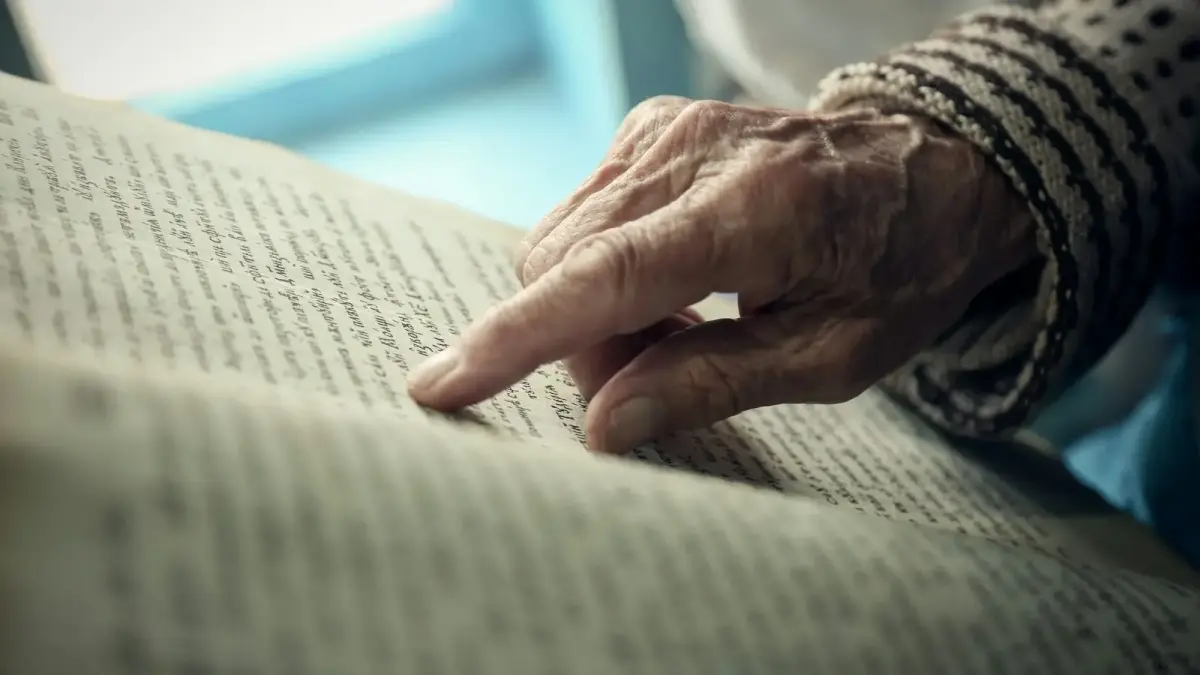
I caught myself doing it last Tuesday in a dentist’s waiting room. I picked up an old issue of National Geographic, and before I even registered the cover, my right thumb went to my lips. A quick touch of moisture, then I turned the page.
Nobody taught me to do that. Not with words, anyway.
But I know exactly where I learned it. I learned it from a woman who wore reading glasses on a beaded chain and smelled like jasmine tea and cedar. She sat at a round kitchen table with a vinyl tablecloth, and every Sunday morning she read the newspaper from front to back while I ate cereal beside her. And every time she turned a page, her thumb went to her tongue first - a quick, efficient motion, practiced over decades.
I was maybe five when I started doing it too. I remember my mother noticing. She laughed and said, “You look just like Nai Nai.” I didn’t understand what she meant. I thought everyone turned pages that way. I thought that was simply how reading worked.
My grandmother has been gone for twenty-two years. But her hands are still in my hands every time I pick up a magazine.
You didn’t learn it - you absorbed it
There is a difference between being taught something and inheriting it. Being taught involves instruction, correction, repetition. Someone says “do it this way” and you practice until it sticks.
Inheriting a gesture is quieter than that. It happens without anyone noticing - not the person doing it, and not the child watching.
A 2019 study published in Developmental Psychology examined what researchers call “incidental motor learning” in children under six. They found that children who regularly observed a caregiver performing a physical task - folding laundry, stirring a pot, handling tools - would reproduce those specific motor patterns months later, even when the task didn’t require that particular approach. The children weren’t copying a technique. They were absorbing a person.
This is what happened with the thumb and the page. You didn’t need moisture on your finger to turn a page in a picture book. The pages were thick and glossy. Your small hands had plenty of grip.
But you watched someone you loved do it. And your body decided that this was how pages get turned - not because of physics, but because of belonging.
The body remembers what the mind files away
When I talk to people about inherited gestures, the stories come fast and specific. A man in his sixties who still taps the bottom of a ketchup bottle with his palm the exact way his father did - three firm strikes, then a pause, then one more. A woman who folds towels into thirds instead of halves because that’s how her mother’s hands moved, and she has never once considered doing it differently.
These aren’t habits in the way we usually use that word. A habit is something you develop through your own repetition. These are replicas - faithful reproductions of someone else’s body in motion, stored in your muscle memory like a recording you didn’t know you were making.
Albert Bandura’s foundational work on observational learning showed that children don’t just imitate what they see - they internalize the motor sequences and reproduce them in new contexts. But Bandura was mostly studying intentional behaviors. What’s remarkable about inherited gestures is that they bypass intention entirely.
Nobody decided to lick their thumb before turning a page. It just appeared in their hand one day, summoned by proximity and love and the quiet machinery of a child’s attention.
The kitchen table was the classroom
Think about where most of these gestures were learned. Not in a school. Not in a structured environment. They were learned in kitchens, on porches, in living rooms where a grandparent sat in their usual chair and did what they always did.
The kitchen table, in particular, is a powerful site of physical inheritance. It’s where you sat close enough to someone to see exactly how their hands worked. How they held a pen. How they tore bread. How they shuffled a deck of cards - the bridge style, with the two halves arching together, or the riffle, with the corners bending up and cascading down.
You sat there drawing or eating or just existing, and the whole time your nervous system was taking notes.
A 2021 study in Frontiers in Psychology found that children’s motor imitation was significantly more detailed and persistent when the observed behavior occurred in what the researchers called “shared proximity contexts” - situations where the child and the adult were physically close, engaged in parallel activity, without direct instruction. The emotional warmth of the setting deepened the encoding.
In other words, you didn’t just learn the gesture. You learned the gesture inside a feeling. And the feeling is what made it permanent.
The moment you realize whose hands you’re using
For most of your life, you don’t think about these inherited gestures at all. They’re invisible. They’re just how you do things.
And then one day you catch yourself. You’re licking your thumb before turning a page, and something flickers. A kitchen. A tablecloth. A Sunday morning. The smell of newsprint and someone’s perfume.
Or someone else catches you. Your spouse says, “You do that thing with the page - just like your dad used to.” And the recognition hits you sideways because you didn’t know you were doing it, and you didn’t know anyone else had noticed, and suddenly you’re holding a dead person’s gesture in your living hand and you don’t know what to do with the weight of it.
This is the grief embedded in inherited gestures. It’s not the sharp grief of a funeral or an anniversary. It’s the ambient grief of the body carrying forward something the mind has moved past. Your conscious self has processed the loss. Your thumb has not.
The difference between a habit and a memorial
There are things you do because they’re efficient. You tie your shoes a certain way because it works. You hold your phone in your left hand because your right hand is dominant.
And then there are things you do because someone you loved did them, and your body refuses to let go.
The thumb-lick page turn is almost never functional for the person doing it. Modern paper doesn’t require moisture. Most pages separate easily with dry fingers. People who do it will even tell you - “I don’t know why I do that.” They’ll laugh about it. They’ll call it a silly habit.
But it is not silly, and it is not exactly a habit. It is a memorial service conducted by the hand, repeated every time a page needs turning, in every waiting room and library and quiet evening with a book.
Research by psychologist Francesca Gino and colleagues, published in 2013 in Psychological Science, found that rituals - even small, seemingly meaningless ones - carry significant emotional weight and serve as mechanisms for processing loss. The key finding was that the ritual didn’t need to be intentional or understood to provide comfort. The repetition itself was the container for grief.
Your thumb touching your lips before turning a page is a ritual. It is your body saying a name your mouth may not have said in years.
We are libraries of the dead
I don’t mean that in a morbid way. I mean it as the most tender thing I know about being human.
You are carrying the physical signatures of people who shaped you - not through their wisdom or their warnings but through the simple fact of being near you while they lived their lives. Every person who sat beside you and let you watch them exist left something in your body.
The way you clear your throat before speaking in front of a group - that might be your father’s gesture. The way you push your sleeves up before starting a task - that might be your mother’s. The way you hold a book open with your thumb pressed into the spine, bending it just slightly - that might belong to someone who read to you before you could read yourself.
These gestures are not conscious choices. They are inheritances, passed not through DNA but through Sunday mornings and kitchen tables and the kind of attention that only happens when a child is quietly watching someone they love.
What the fifty-year-old in the waiting room is really doing
When you see someone in their fifties or sixties lick their thumb before turning a magazine page, you’re watching something ancient. Not ancient in a historical sense - ancient in a personal one. You’re watching a five-year-old sitting at a kitchen table, reproducing a gesture they learned from someone who may have learned it from someone before them.
The chain goes back further than you can trace. Your grandmother licked her thumb because her grandmother did. The gesture traveled through generations not because it was useful but because it was loved. Because it happened inside moments of closeness that the body decided were worth preserving.
And now here you are. Fifty years old, sitting in a plastic chair under fluorescent lights, and your thumb goes to your lips before you turn a page, and for just a moment - half a second, barely conscious - you are not alone.
You are sitting beside someone again. Someone whose hands looked like yours will look in twenty years. Someone who never told you to do this, who probably never noticed you watching.
Someone whose gesture you carry like a locket you never take off. Not because you chose to. Because your body chose for you, a long time ago, in a kitchen that may not even exist anymore, on a morning you almost forgot.
That isn’t a habit.
That is the quietest kind of love the body knows how to hold.