Children who watched their grandmother iron everything in the house - the pillowcases, the napkins, the kitchen towels nobody would ever see - often become adults who cannot explain why a wrinkled sheet feels like something is wrong, not because they are fussy but because a child whose earliest memory of being cared for was the sound of an iron on cotton and the smell of steam learned that love was not a word but a crease, and the woman at fifty-two who still irons the pillowcases is not old-fashioned but fluent in the only dialect of devotion she was ever taught
I can still hear the sound if I close my eyes.
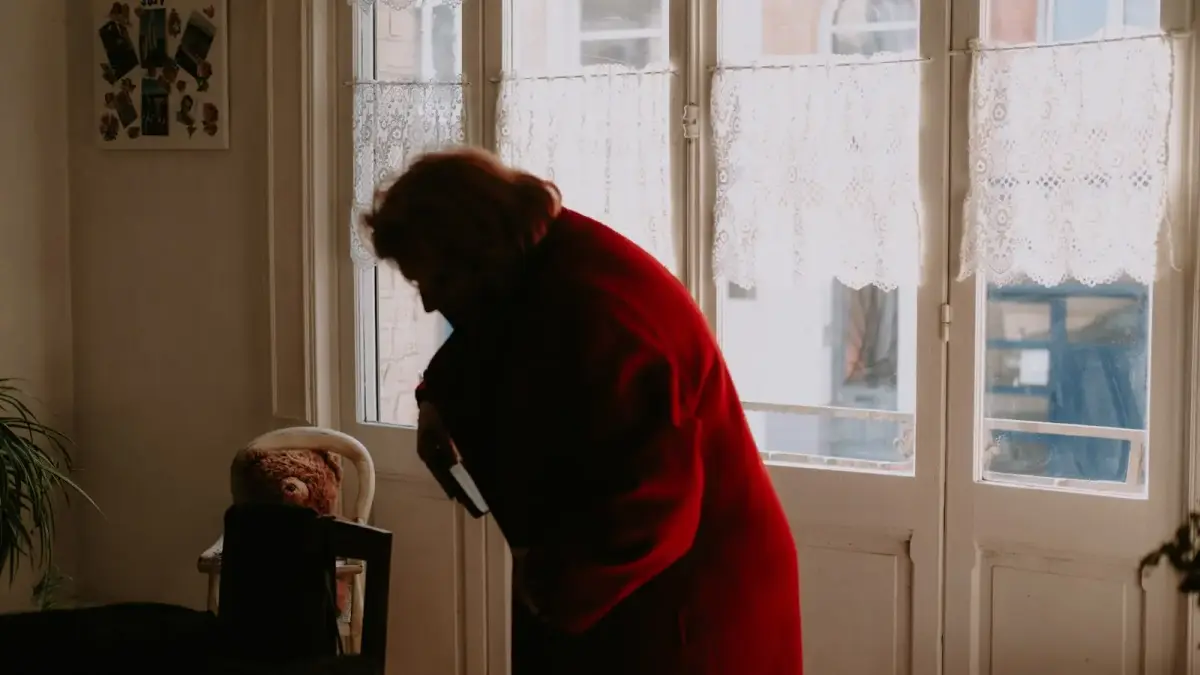
Not the hiss of steam - that came later, once the iron was moving - but the soft, metallic click of the iron being set upright on the board. That particular tap of metal meeting padded surface. My grandmother’s kitchen on a Saturday morning, the windows fogged, the air smelling like heated cotton and something I didn’t have a word for yet.
She ironed everything. The pillowcases. The cloth napkins that only came out when company visited, and the cloth napkins that never saw company at all. The kitchen towels that hung on the oven handle and would be crumpled again within the hour. I sat on the linoleum floor with my knees pulled up, watching her arms move in long, slow passes, and I didn’t understand what I was learning. I just knew that the room felt safe.
It took me thirty years to realize that what I absorbed on that kitchen floor wasn’t a habit. It was a language. And I’ve been speaking it ever since without knowing the grammar.
The iron was never about the wrinkles
My grandmother never said “I love you.” Not once, in all the years I knew her. She was born in 1932 in a household where emotion was something you managed, not something you announced. Affection was demonstrated through labor. You didn’t tell people you cared about them. You fed them. You kept their clothes clean. You made their bed with corners so tight you could bounce a coin off the sheet.
The ironing was the purest expression of this philosophy. Nobody was going to inspect the pillowcases. Nobody was going to run their hand across a napkin and evaluate whether it had been pressed. The labor was invisible by design - which is exactly what made it devotion rather than performance.
She wasn’t ironing for an audience. She was ironing because a smooth pillowcase under someone’s cheek at night meant something to her that she couldn’t say out loud. It meant: I thought about your comfort when you weren’t watching. I tended to the details of your rest. I was here, in this kitchen, caring for you in a way you’ll never see.
A 2019 study published in the Journal of Personality and Social Psychology found that nonverbal expressions of care - particularly those involving physical labor on behalf of another person - activate the same neural reward pathways as verbal affirmation, but tend to produce longer-lasting attachment bonds. The researchers called these “maintenance behaviors,” the small, unglamorous acts that sustain relationships not through grand gestures but through the quiet accumulation of invisible effort.
My grandmother didn’t know the term. She just ironed the towels.
What the child’s body remembers
Here is what developmental psychology tells us about those Saturday mornings on the kitchen floor, and it’s more significant than most people realize.
A child’s nervous system doesn’t catalog experiences the way an adult’s does. It doesn’t file memories under headings. It records them as sensory patterns - temperature, sound, texture, smell - and associates those patterns with emotional states. Dr. Allan Schore, whose research on right-brain development has shaped decades of attachment theory, describes this as “implicit relational knowing.” The child doesn’t think, “My grandmother’s ironing means she loves me.” The child’s body simply registers: iron sound plus steam smell plus warm room equals safe.
This is not metaphor. This is neurobiology.
The smell of heated cotton becomes inseparable from the feeling of being cared for. The rhythmic sound of the iron - that slow, deliberate glide and return - syncs with the child’s heart rate the way a lullaby does. The visual of the grandmother’s steady hands becomes a template for what calm looks like in another person’s body.
And this imprint doesn’t fade. A 2022 study in Frontiers in Psychology found that sensory memories formed in early childhood - particularly those associated with a caregiver’s repetitive routines - remain neurologically active well into late adulthood. Participants in their sixties and seventies could be brought to tears by a specific scent or sound that their conscious mind hadn’t thought about in decades but their body had never forgotten.
You don’t remember deciding that smooth sheets meant safety. Your nervous system decided for you, on a Saturday morning, while you sat on the floor and watched someone love you without saying a word.
The adult who irons and doesn’t know why
She’s fifty-two. Maybe fifty-seven. Maybe she’s you.
She stands at the ironing board on Sunday morning - not because someone asked her to, not because the pillowcases are dirty, but because the ritual itself produces a feeling she can’t name. A settling. A sense that the house is in order, that the people sleeping in those beds are being tended to, that something small and invisible has been done right.
Her husband has told her she doesn’t need to iron the sheets. Her daughter thinks it’s quaint. Her friends don’t iron anything at all and their lives seem perfectly fine.
But she keeps doing it. And when she tries to explain why, she says something vague about how she just likes things nice. About how wrinkled sheets bother her. About how it only takes a few minutes.
None of those are the real reason.
The real reason is that her grandmother stood at a board just like this one, in a kitchen that smelled just like this, and the child who watched her absorbed a definition of love so deep it bypassed language entirely. The real reason is that ironing the pillowcases makes her feel like the kind of person her grandmother was. And her grandmother was the safest person she ever knew.
This isn’t nostalgia. This is what Gabor Mate would call a body memory - an emotional truth stored not in the mind but in the muscles, the posture, the hands. The woman at the ironing board isn’t performing domesticity. She’s speaking her grandmother’s language. She’s keeping a conversation going with someone who died twenty years ago.
The generational handoff nobody talks about
We talk a lot about generational trauma. We’ve built an entire therapeutic vocabulary around it - the ways pain is passed down, the patterns that repeat, the wounds that don’t heal because they were never acknowledged.
But we almost never talk about generational tenderness.
The grandmother who ironed the towels learned it from her mother, who learned it from hers. Somewhere back in that chain, a woman stood at a board - maybe not even an ironing board, maybe a kitchen table with a folded blanket on top - and pressed fabric smooth because it was the only power she had. She couldn’t control the money. She couldn’t leave the marriage. She couldn’t articulate her emotional needs in a culture that didn’t believe women had them. But she could make sure the pillowcase under her child’s face was soft and flat and warm.
That’s not nothing. That’s architecture.
Dr. Karlen Lyons-Ruth, a researcher at Harvard Medical School whose work focuses on implicit relational patterns, has documented how caregiving rituals function as what she calls “procedural models of being with” - templates for closeness that are transmitted not through instruction but through repetition. The child doesn’t learn the ritual by being taught it. The child learns it by being in the room while it happens. By breathing the same air. By absorbing the rhythm.
And then, decades later, the child picks up an iron. Not because anyone asked. Because the body remembers what the mind forgot.
Why it is not old-fashioned
There is a particular kind of dismissal reserved for women who maintain domestic rituals. It gets dressed up as modern thinking - “You don’t need to do that,” “Nobody cares about wrinkled napkins,” “That’s so old-school.” The implication is that the woman who irons is trapped in an outdated version of femininity. That she hasn’t evolved.
But this reading misses something crucial. It confuses the vessel with the content.
The ironing was never about the ironing. It was about a woman who couldn’t say “I love you” finding a way to say it with her hands. It was about a child who couldn’t articulate why she felt safe learning it through her skin. It was about the transmission of care through a channel that doesn’t require words, education, money, or permission.
The woman at fifty-two who still irons the pillowcases has not failed to modernize. She has maintained fluency in a dying language - a dialect of devotion that was spoken by hands, not mouths. And in a world that increasingly communicates love through text messages and emoji reactions, there is something almost radical about a person who still believes that love can live in a crease.
She’s not performing a role. She’s honoring a teacher.
The crease that holds
I ironed a pillowcase last Sunday.
I don’t iron regularly. I’m not meticulous about it the way my grandmother was. But something about the morning - the light, the quiet, the particular stillness of a house where everyone else is still asleep - made me pull out the board and plug in the iron and stand there in my kitchen doing something that, by any practical measure, was unnecessary.
The steam rose. The cotton went smooth under my hand. And for about fifteen minutes, I was on the floor of my grandmother’s kitchen again, six years old, watching her arms move in those long, unhurried passes. I could smell the heated fabric. I could hear that metallic click.
She’s been gone for nineteen years. But standing at that board, she was right there. Not in my memory. In my hands.
That’s the thing about the kind of love that gets ironed into pillowcases and folded into napkins and pressed into towels that nobody will ever inspect. It doesn’t announce itself. It doesn’t demand recognition. It doesn’t need you to understand it.
It just needs you to lie down at night and feel, without knowing why, that someone has been here. That someone cared about the place where your face meets the fabric. That somewhere, a long time ago, a woman who never learned to say it found a way to make you feel it.
And you do. You still do.