Children who always watched their mother check the rearview mirror more than the road ahead - not because she was a nervous driver but because the back seat held everything she was responsible for and the road was just the thing standing between her and getting them home safely - often become adults who check on the people behind them before they look at what's ahead, because a child who watched a woman navigate the world with her attention aimed backward learned that love is not the destination but the rearview glance that makes sure everyone is still there
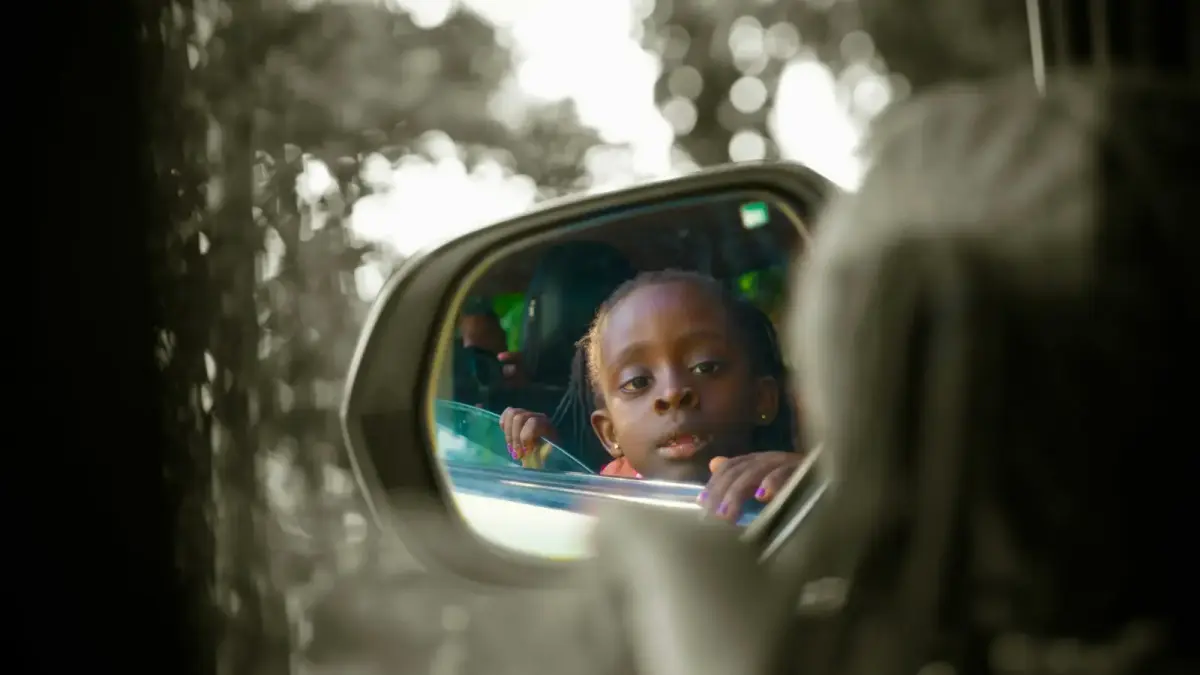
I was driving alone on a Tuesday morning - no passengers, no cargo, nothing in the back seat but a reusable grocery bag and a jacket I keep forgetting to bring inside - when I caught myself glancing at the rearview mirror for the fourth time in two minutes.
There was nothing to check on. Nobody behind me who needed monitoring. But my eyes went there anyway, the way a hand goes to a pocket to check for keys you already know are there. Automatic. Unquestioned. A reflex that has been running so long it no longer needs a reason.
I pulled into the parking lot at the university where I teach, turned off the engine, and sat there for a moment with my hands still on the wheel. Because I realized something I had never put into words before, despite spending twenty years studying developmental patterns for a living. I was not checking the mirror. I was checking on people who were not there. And I have been doing it my entire adult life - not just in cars, but in conversations, in relationships, in every room I have ever walked through. I look behind me before I look ahead. I always have.
And I know exactly where I learned it.
The geography of her attention
My mother drove a beige minivan that smelled like graham crackers and the lavender air freshener she clipped to the vent every spring. She was not a nervous driver. She did not grip the wheel or brake too early or gasp at yellow lights. She drove the way she did most things - steadily, without fanfare, with a competence so quiet you could mistake it for ease.
But her eyes told a different story.
If you sat in the passenger seat - which I did, starting around age ten when I graduated from the back - you could watch the pattern. Road, mirror, road, mirror. Every few seconds, her gaze would lift from the windshield to the small rectangle above the dashboard, and in that rectangle was not the traffic behind us but us. My brother with his seatbelt twisted. My sister asleep with her head at an angle that would give her a stiff neck. The baby in the car seat, quiet for once, which was somehow more alarming than crying.
She was not checking for cars. She was counting children.
I did not understand this then. I thought she was just being careful the way mothers are careful. It was not until decades later - until I sat in a graduate seminar on attachment behavior and heard the phrase “vigilance as a form of attunement” - that I understood what I had been watching for all those years.
My mother was not nervous. She was responsible for four human beings in a vehicle moving at sixty miles an hour, and the road ahead was just the mechanism. The rearview mirror was where the actual stakes lived.
What the child in the passenger seat was learning
A 2017 study published in Developmental Psychology examined how children internalize parental monitoring behaviors, and the findings were striking. Children who observed consistent, non-anxious parental vigilance - checking on them regularly but without panic - were significantly more likely to develop what the researchers called “other-oriented attentional habits” as adults. They became people whose first instinct in any situation was to assess others before assessing themselves.
This is not the same as anxiety. Anxiety scans for threats. What these children learned was something closer to a directional orientation - a default setting for which way your attention flows.
I watched my mother look backward a thousand times before I ever sat behind a steering wheel myself. And what I absorbed was not a driving technique. It was a philosophy of movement. You do not just go forward. You go forward while making sure everyone behind you is still okay.
The problem - if it is a problem, and I am not always sure it is - is that this orientation does not stay in the car.
How it followed me out of the minivan
I am forty-six years old, and I still check behind me before I move forward. Not literally, not always. But the pattern is unmistakable once you see it.
At work, I am the person who notices when a colleague has gone quiet in a meeting. Not because I am socially gifted but because something in my operating system flags silence the way a smoke detector flags heat. Someone was there and now they are not fully there, and before I can focus on the agenda in front of me, I need to understand why.
In friendships, I am the one who texts first. Not out of insecurity but out of something more structural than that. I orient toward the people behind me - the friend who just went through a divorce, the college roommate who mentioned her mother’s diagnosis in passing, the neighbor whose lights have been off for three evenings in a row. I track backward. I always have.
In my marriage, my husband once said - kindly, not as a complaint - “You always ask how I am before you tell me how you are.” He meant it as an observation. I heard it as a diagnosis. Because he was right. I do. Every single time. I check the rearview before I engage with the road.
The cost of backward-looking love
There is a word in developmental psychology for adults who learned early to monitor others: parentification. It usually refers to children who were forced into caretaking roles they were not developmentally ready for - managing a parent’s emotions, raising younger siblings, becoming the household diplomat at age nine.
A 2020 study in the Journal of Research in Personality found that adults who scored high on measures of childhood parentification were significantly more likely to report what the researchers called “self-neglect through other-focus” - a pattern where attending to others’ needs became so automatic that their own needs did not simply take second place but disappeared from the inventory entirely.
But here is where I want to be careful, because my mother did not parentify me. She did not ask me to watch the back seat. She did not make me her co-pilot or burden me with responsibilities I was not equipped to carry. She simply loved us in a way that was visible, and that visibility had a direction, and the direction was backward, toward us, always toward us.
What I internalized was not a burden. It was a blueprint. Love looks behind it. Love checks the mirror. Love does not assume everyone is fine just because no one is crying.
The cost is not that I care too much. The cost is that I sometimes forget to check the road ahead because I am so busy making sure no one behind me has fallen.
The mirror and the windshield
My mother is seventy-three now. She does not drive the minivan anymore. She drives a small sedan, and there is no one in the back seat, and when I ride with her I still watch her eyes. She still checks the mirror. Less often now, but the rhythm is there - road, mirror, road - like a song she cannot stop humming even after the music has ended.
I asked her about it once. Casually, the way you ask about something that has shaped your entire psychological architecture while pretending it is small talk.
“Mom, did you know you check the rearview mirror constantly? Even when nobody’s back there?”
She was quiet for a moment. Then she said, “I suppose I got used to making sure you were all okay. Hard habit to break when the reason for it lasted twenty-five years.”
Hard habit to break. She said it like it was a quirk. Like checking on the people she loved most in the world while navigating them through traffic was an idiosyncrasy and not the single most precise expression of love I have ever witnessed.
John Bowlby wrote that attachment is not a feeling but a behavioral system - a set of actions designed to maintain proximity to the people who matter. My mother’s rearview glance was that system in its purest form. Not a feeling. Not a worry. A behavior. A direction. A way of moving through the world that says: I am going forward, but I am not leaving anyone behind.
What I want you to know
If you are the person who always checks on others before you check on yourself - the one who texts first, who notices silence, who asks how everyone is doing before anyone thinks to ask you - I want you to know something.
You are not codependent. You are not anxious. You are not losing yourself in other people.
You are driving the way someone taught you to drive. Eyes on the road, yes. But a glance at the mirror every few seconds, because the people in the back seat are the whole reason you are making the trip.
The work, if there is work to be done, is not to stop checking the mirror. The work is to remember that you are also someone worth looking at. That the rearview glance can include you. That the inventory of people who need to be accounted for does not have to begin and end with everyone else.
You learned love as a backward glance. That is not a flaw. That is a woman in a beige minivan, driving four children home, her eyes lifting to the mirror every few seconds to make sure the whole world was still there.
It was. Because she was watching.