Children who watched a parent keep every key - to houses they no longer lived in, cars they no longer drove, locks they could no longer name - often become adults with a kitchen drawer full of keys that open nothing they can identify, not because they are disorganized but because a girl who once lost access to a door learned that a key is never just metal but proof she was once permitted to belong somewhere
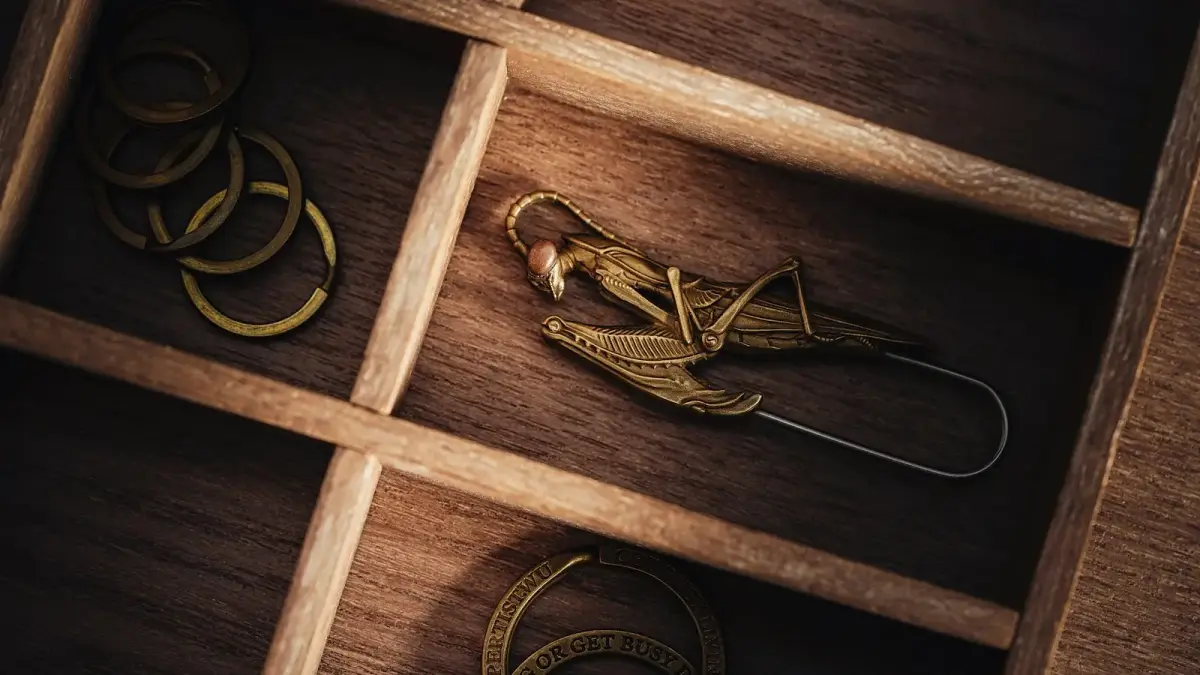
I found six keys in my kitchen drawer last Tuesday. Brass ones, silver ones, one with a faded green rubber grip that I remember buying at a hardware store but cannot place in any decade with certainty. I held each one and tried to feel which door it belonged to. Nothing came. Not a single lock in my current life matches any of them.
I almost threw them away. I got as far as holding them over the trash can.
Then I put them back in the drawer and closed it, and I stood there for a moment feeling something I could not name - something between relief and grief, as if I had just talked myself out of doing something reckless. As if throwing away a key to a door I can no longer find would somehow confirm that the door had never existed at all.
I am not a disorganized person. My house is reasonably tidy. My files are labeled. But that drawer of orphaned keys has followed me through four apartments and two houses, and I have never once been able to explain why getting rid of them feels like a kind of betrayal.
Until I started thinking about what keys meant to me when I was small. And then it made a very specific, very painful kind of sense.
A Key Is Never Just a Key
For most people, a key is a utility. You need it to get in. You copy it at the hardware store. When the lock changes, you toss the old one without a second thought.
But for a child who experienced a loss of access - a home that disappeared, a room that was suddenly off-limits, a front door that no longer opened with the key in her pocket - the object takes on a completely different weight.
A key becomes proof. Proof that you were once allowed in. Proof that someone trusted you enough to hand you the means of entry. Proof that a place existed where you had permission to arrive and be received.
Psychologist D.W. Winnicott wrote extensively about what he called “transitional objects” - physical things that carry emotional meaning far beyond their function. He was mostly talking about children and their blankets, their stuffed animals, the objects that stand in for the comfort of a caregiver when the caregiver is not present.
But I think keys operate the same way for adults who grew up with disrupted belonging. The key is not about the lock. The key is about the relationship between you and the place the lock protected. It is a small metal certificate of belonging, and once you have learned that belonging can be revoked without warning, you do not throw certificates away.
The Doors That Closed Without Explanation
I think about the specific kinds of childhood experiences that turn a key into something sacred.
The girl whose family moved every two years because of her father’s work, who accumulated house keys like stamps in a passport - each one the only physical evidence that an address had been real, that the bedroom with the yellow curtains had actually existed, that she had once lived somewhere long enough to memorize the way the front door stuck in humid weather.
The boy who came home from school and found the locks changed. His mother’s new boyfriend had decided he was not welcome anymore. He still had the old key in his backpack. It did not work, but he kept it for eleven years.
The child of divorce who had a key to Dad’s apartment and then Dad moved and did not immediately give her a new one. That gap - those three weeks of ringing the doorbell at her own father’s home like a visitor - rewired something in her understanding of what it means to have access to the people you love.
A 2019 study published in the Journal of Environmental Psychology found that our attachment to physical spaces operates through many of the same neural and emotional pathways as our attachment to people. When we lose a home - especially involuntarily, especially in childhood - the grief response mirrors interpersonal loss. The researchers called it “place attachment disruption,” and they found that people who experienced it often developed compensatory behaviors around objects associated with former homes.
Keys. Doorknobs. A piece of tile from a bathroom floor. Small, portable fragments of proof that a place had been real.
Why the Drawer Feels Like an Archive
If you are the person with the drawer of unidentified keys, I want you to notice something about how you keep them.
You do not throw them in loose. You do not scatter them randomly among the batteries and takeout menus. There is usually a container - a small bowl, a tin, a ziplock bag. Something that holds them together as a set. Something that says: these belong with each other, even if I cannot tell you what they belong to.
That is not disorganization. That is curation.
You are maintaining an archive. A physical record of every threshold you have ever been permitted to cross. Every door that opened for you. Every home that was, however briefly, yours.
Psychologist Gabor Mate has written about how early experiences of instability create what he calls “a hunger for proof” - a deep need to have tangible evidence that good things actually happened, because the emotional memory alone feels too fragile to trust. The body remembers loss more reliably than it remembers safety. So we collect evidence of safety and store it somewhere we can touch it.
A 2021 study in Frontiers in Psychology explored how adults with insecure attachment styles relate to personal possessions. The findings were striking. People with anxious attachment - the style most associated with early experiences of unpredictable access to caregivers - were significantly more likely to keep objects they described as “useless but important.” When asked why, the most common answer was not sentimentality. It was something closer to vigilance. They kept things because getting rid of them felt like agreeing to forget.
And that is the drawer of keys, exactly. Not clutter. Not hoarding. A refusal to forget that you were once allowed in.
The Weight of Access
I want to talk about what access means to a child, because I think we underestimate it.
For an adult, access is logistical. You have a key or you do not. You can get a copy made. You can call a locksmith. Access is a solvable problem.
For a child, access is existential. Access means: I am wanted here. Access means: I have a right to be in this space. Access means: someone decided I was important enough to trust with the means of entry.
When that access is disrupted - through moving, through divorce, through a parent’s instability, through any of the thousand quiet ways a child can lose their footing in a home - what the child learns is not “I need a new key.” What the child learns is “belonging is conditional. Doors close. Permission gets revoked. The place you thought was yours can stop being yours at any time, and no one will explain why.”
That child grows into an adult who keeps keys.
Not because she thinks she will ever use them. She knows she will not. She knows the locks have been changed, the houses sold, the cars junked. She knows that on a purely practical level, these keys are worthless.
But on the level where she actually lives - the level where a seven-year-old is still standing at a front door with a key that no longer works, trying to understand why the place she slept last night has suddenly decided she does not belong there - those keys are the most valuable things she owns.
They are proof that the doors existed. And proof that she was once on the right side of them.
The Woman at Fifty-Four
I have a friend who is fifty-four. She is brilliant, accomplished, the kind of person who runs a department and remembers everyone’s birthday. Her home is beautiful. Her life, by any external measure, is stable and full.
She has a mason jar in her kitchen with at least fifteen keys in it. She showed it to me once, almost shyly, like she was confessing something embarrassing.
“I know it’s ridiculous,” she said. “I don’t even know what half of them go to. My husband wants me to throw them out.”
I asked her to pick one up and tell me the first thing that came to mind.
She picked up a small brass key, turned it over in her fingers, and said, “This might be from the house on Elm Street. We lived there when I was nine. Before my parents split up.”
She was quiet for a moment.
“That was the last house where everyone was still together.”
She put the key back in the jar.
She is not cluttered. She is not disorganized. She is not irrational.
She is holding the only physical evidence that a version of her family once existed in a house where everyone was still together, and the key to that house is the closest thing she has to proof that it was real and not something she dreamed.
The Refusal to Declare a Door Permanently Closed
There is one more layer to this that I think matters.
Keeping a key is not just remembering a door. It is refusing to accept that the door is permanently closed.
As long as you have the key, some part of your brain can maintain the fiction that return is possible. That the house on Elm Street might still be there with the same locks. That the apartment you shared with your college roommate might still open with that silver key. That the life you lived at twenty-three, or nine, or thirty-seven, is not gone but merely locked - and you have the means to get back in, if you ever need to.
This is not delusion. This is a coping mechanism that served you beautifully when you were small and the world kept taking your homes away. The child who keeps the old key is the child who refuses to believe that loss is final. And that refusal - that stubborn, irrational, deeply human refusal to let go of the possibility of return - is what got her through.
A 2017 study in the Journal of Personality and Social Psychology found that people who maintain what the researchers called “symbolic continuity” with their past - through objects, rituals, or physical spaces - show greater psychological resilience and a stronger sense of identity coherence. Keeping the key is not a failure to move on. It is a strategy for staying whole.
You are not cluttered. You are continuous. You are a person who has lived in many places and loved some of them and lost some of them, and you have kept the only evidence that fits in a kitchen drawer.
If someone in your life is pressuring you to clean out that drawer, to be more practical, to stop holding onto things that serve no purpose - I want you to know that they are not wrong about the locks. Those keys probably do open nothing anymore.
But they are wrong about the purpose.
Every key in that drawer is a small, quiet monument to a door you once walked through. A place that was briefly yours. A version of your life that existed and mattered and deserves to be remembered, even if the only record of it is a piece of brass that no longer turns anything.
Keep the drawer. Keep every single key. You are not disorganized. You are the archivist of your own belonging, and that is one of the most faithful things a person can be.