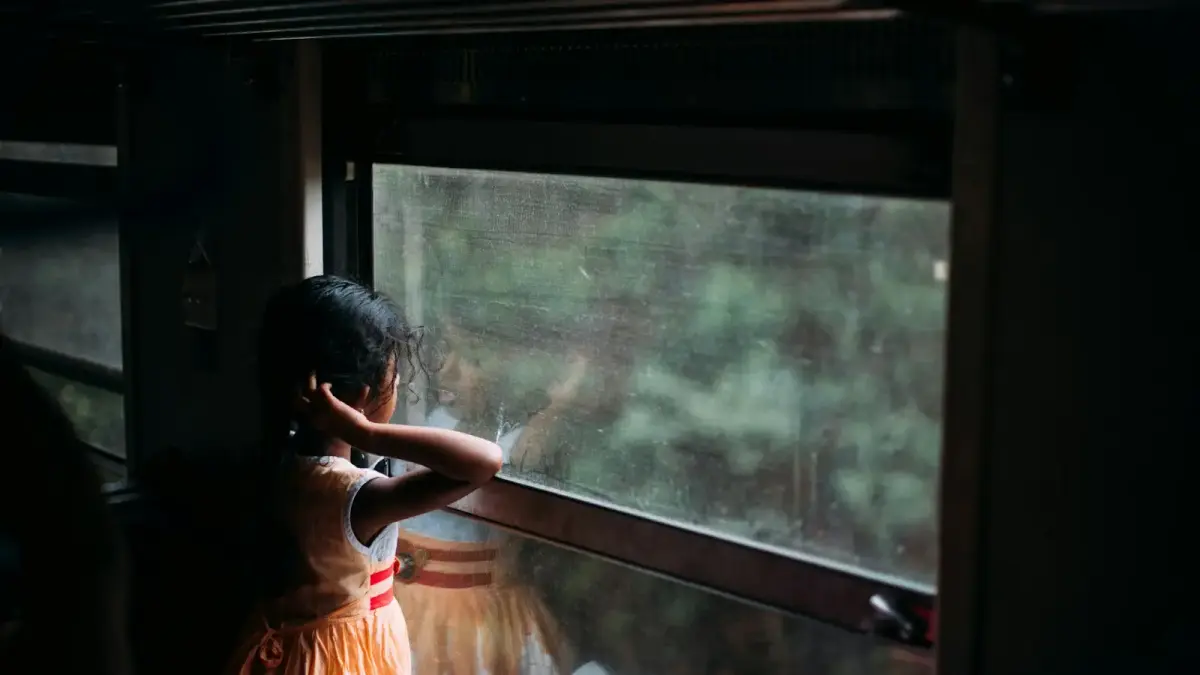
Children who always waved from the window until the car disappeared - who pressed their face against the glass and held up one hand and did not move until the street was empty again - often become adults who cannot end a phone call without saying 'love you' twice, because a child who understood that every departure contained the possibility of being the last one built a farewell ritual she was never willing to abbreviate
I was seven years old the first time I noticed myself doing it.
My grandmother had come for the weekend, and when my father drove her back to the train station on Sunday evening, I climbed onto the couch, pressed both palms flat against the living room window, and watched the car reverse down the driveway. I watched it pause at the end of our street. I watched it turn left, shrink into something small, and then vanish behind the Hendersons’ fence.
And I stayed there. Forehead against the glass, breath making a small fog circle that appeared and disappeared. I stayed until the street looked like it had never held a car at all.
My mother found me there a few minutes later and laughed softly. “She’ll be back next month, sweetheart.” But that wasn’t why I was standing there. I wasn’t sad. I was completing something. A ritual I had no name for but could not skip, the way you cannot leave the house without checking the lock one final time.
I didn’t know it then, but I was learning something about love that would shape every goodbye I’d ever say for the rest of my life.
If you were that child - the one at the window, the one who waved long after anyone could see you waving - you probably already know exactly what I mean. And you’ve probably noticed that the ritual never stopped. It just changed shape.
1. You say “love you” at the end of every phone call - even the ones where it almost doesn’t belong
You’ve said it to your dentist’s receptionist. You’ve caught yourself halfway through saying it to your insurance company. You’ve definitely said it to a coworker and then spent the next forty-five minutes wondering if that was strange.
But you cannot hang up a phone without those two words. It doesn’t matter if the conversation was three minutes long and entirely about scheduling. The phone going silent feels like a small door closing, and you need to leave something on the threshold before it shuts.
A 2013 study published in the Journal of Social and Personal Relationships found that verbal expressions of affection at the end of interactions serve a regulatory function - they’re not just social pleasantries but genuine anxiety-management tools. For people with heightened separation sensitivity, the “love you” isn’t decorative. It’s structural.
You’re not being awkward. You’re making sure the last sound between you and another person is the truest one you have.
2. You stand in the doorway and watch until the car is completely gone
Not until they pull out. Not until they reach the end of the street. Until the car rounds the corner and the road is empty and quiet and still, and only then do you step back inside and close the door.
Your partner has told you that you don’t need to do this. Your friends have waved you back in from behind their windshield. “Go inside, it’s cold.”
But going inside before they’re gone feels like turning your back on something that matters. You can’t explain it in a way that makes logical sense because it was never logical. It was a promise you made to yourself when you were small - that you would never be the one who looked away first.
3. You text “drive safe” within seconds of someone leaving your house
The door hasn’t fully closed and your phone is already in your hand. Drive safe. Text me when you get there. Let me know you made it.
You know these texts are functionally pointless. You know that the act of sending “drive safe” has no bearing on highway conditions. But the ritual was never about information. It was about extending the thread of connection past the moment of physical separation, keeping one thin wire of contact alive between your door and wherever they’re headed.
Developmental psychologist John Bowlby wrote extensively about what he called “proximity maintenance” - the instinct to keep attachment figures close or at least accounted for. In children, it looks like crying at daycare drop-off or following a parent from room to room. In adults, it looks like a text sent before you’ve even locked the front door.
4. You cannot end a conversation without a proper goodbye - you need the whole ritual
Quick goodbyes make your chest tight. When someone says “okay, gotta run” and just hangs up, you feel vaguely wounded. Not because they were rude, but because the ritual was incomplete.
You need the “okay, well.” You need the “alright, talk soon.” You need the softening, the tapering, the slow deceleration from conversation to silence. Anything abrupt feels like a sentence cut off mid-word.
This is because goodbye, for you, was never a single moment. It was a sequence. A choreography. And every step of that choreography carried weight because you learned very early that the space between “I’m leaving” and actually being gone was where love either got confirmed or left uncertain.
5. You always walk people to their car, never just to the door
The door is not far enough. You need to walk them all the way to the driver’s side, stand there while they get in, and then - only then - begin the real goodbye. The one that happens through a rolled-down window with the engine already running.
People have told you this is charming. Old-fashioned. Sweet.
It’s not a performance. It’s that the threshold of your home doesn’t feel like a real edge. The real edge is the car door, because that’s the last physical boundary before someone stops being present and starts being absent. You need to accompany them all the way to that edge because every step between the front door and the car is a step you still share.
6. You replay the last thing you said to someone and worry it wasn’t enough
After a phone call, after a visit, after walking someone to their car and watching them drive away, there’s a moment - sometimes it lasts hours - when you rewind the conversation and land on the last thing you said.
Was it warm enough? Did I sound distracted? Should I have said something more meaningful instead of “okay, see you later”?
A 2019 study in Frontiers in Psychology found that individuals with anxious attachment styles engage in significantly more post-interaction rumination, particularly around whether they adequately communicated care. The study described it as “relational rehearsal” - mentally replaying exchanges not out of regret, but out of a deep need to ensure that love was properly transmitted before the window closed.
You’re not overthinking. You’re reviewing the transcript of a farewell to make sure nothing important was left unsaid.
7. You feel genuine distress when someone leaves without saying goodbye properly
When someone slips out of a party without saying goodbye to you. When a friend ends a visit by just walking out the door mid-conversation. When your kid leaves for school with a mumbled “bye” instead of making eye contact.
It hits you differently than it hits other people.
There’s a pang - something physical, somewhere between your ribs - that is entirely disproportionate to the moment. You know this. You know a teenager muttering “bye” while staring at their phone is not an act of abandonment. But the child in you, the one who stood at the window and didn’t blink, processes it as something unfinished. An open loop. A thread left dangling where it should have been tied.
You don’t need a grand farewell every time. But you need acknowledgment that someone is about to not be here anymore. You need the transition to be marked. Named. Honored.
8. You are the last to leave every gathering - not because you’re having fun, but because leaving first feels like a small betrayal
You’ve noticed this about yourself. You’re always the one still sitting at the restaurant table, still standing in the host’s kitchen, still lingering in the parking lot.
Part of it is genuine enjoyment. But a deeper part is that you cannot be the one who goes first. Being the one who leaves means being the one who initiates the separation, and the child who stood at the window was never the one who left. She was the one who stayed. The one who watched. The one whose entire role in the ritual of departure was to remain.
Leaving first would mean becoming the person in the car instead of the person at the glass. And even now, even decades later, you don’t entirely know how to be the one who drives away while someone else watches.
Here is what I want you to understand about yourself, if any of this made your throat tighten.
You were not a clingy child. You were a perceptive one. You understood something that most children are protected from understanding - that people leave, and sometimes they leave for longer than a car ride, and there is nothing you can do to control that except stay at the window and watch and keep watching and not look away until the very last moment.
That was not anxiety. That was devotion. The first and purest form of it you ever practiced.
Psychologist and author Susan Cain has written about the way certain children process emotional intensity - not as a disorder but as a form of perception. They feel the weight of transitions that other children walk through without noticing. They register the shift in a room when someone picks up their coat. They grieve small goodbyes because they understand, instinctively, that every goodbye is a rehearsal for the ones that won’t have a return.
The adult you became - the one who says “love you” too many times, who stands in the cold watching taillights, who texts “drive safe” before the car has even started - is not performing some anxious compulsion.
She is honoring a promise she made to herself at a window a long time ago.
That no one she loves will ever leave without knowing, completely, that they were watched over until the very last second. That the farewell was never abbreviated. That someone stayed.
And that is not something to fix. That is something to be proud of.