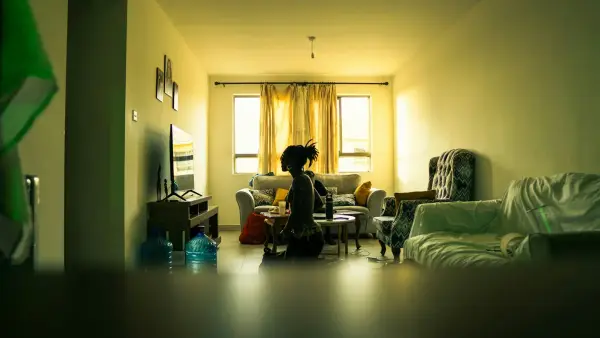
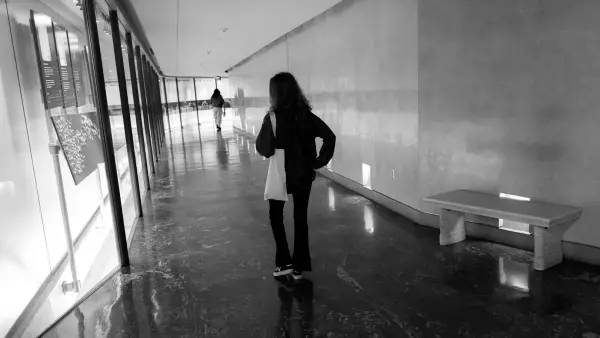
Children who always brought a book everywhere they went - to the grocery store, the family reunion, the backseat of every car ride, who could not leave the house without something to read tucked under their arm like a shield they never had to explain - often become adults who feel a quiet panic when caught somewhere without their phone, who carry a novel in their bag they haven't opened in months but cannot bring themselves to remove, because a child who discovered that a book was a portable room with a door only she could close never stopped needing something between herself and the unfiltered world
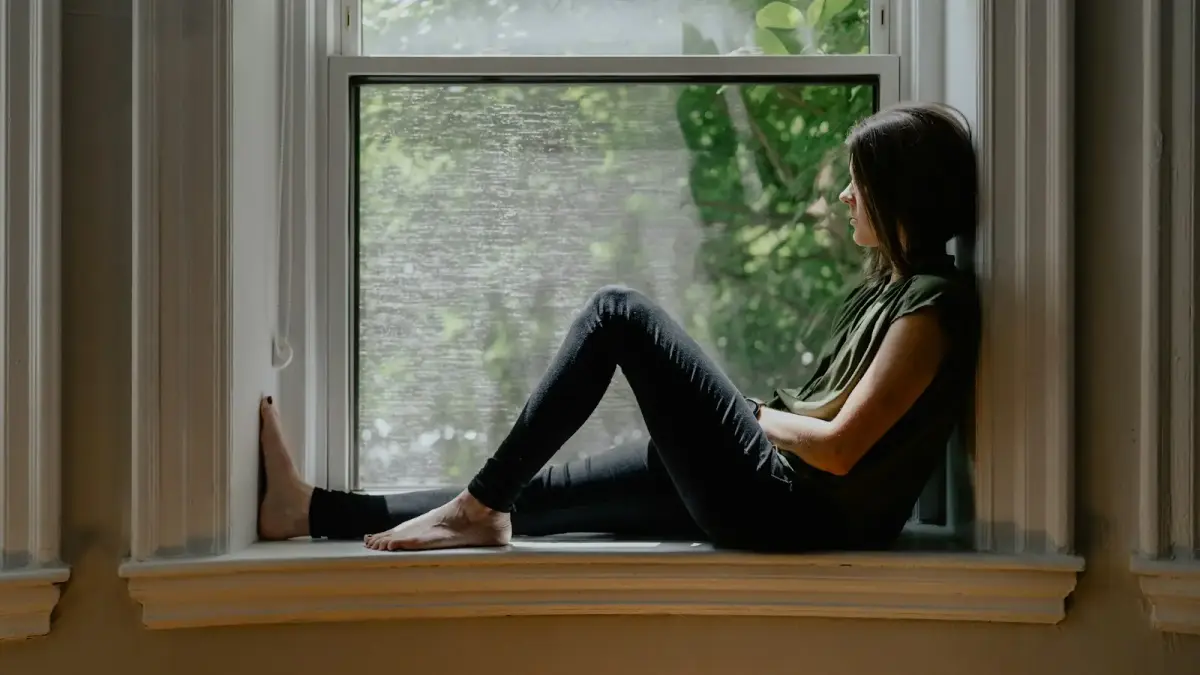
I was nine years old, sitting on the floor of a Sears while my mother tried on coats, and I had my nose so deep in a copy of Bridge to Terabithia that a store employee asked if I was lost. I wasn’t lost. I was the opposite of lost. I was the most found I’d been all day.
That book went everywhere with me. It rode in the backseat like a seatbelt I chose for myself. It sat on my lap at my grandmother’s kitchen table while adults talked about people I didn’t know in voices that filled every corner of the room. It came to the dentist, the grocery store, the Sunday school classroom where I was supposed to be socializing but instead sat cross-legged in the corner, turning pages like someone feeding coins into a parking meter - buying myself another few minutes of peace.
I wasn’t antisocial. I wasn’t even particularly shy. I just needed something between me and the full volume of the world. And a book - any book, even a bad one - gave me that. It gave me a door I could close without anyone noticing I’d left the room.
If you were that child, I want you to know something. That habit wasn’t a quirk. It was intelligence. And the version of it you carry now - the phone you reach for in every waiting room, the podcast you press play on the moment you’re alone in the car, the novel sitting in your bag like a talisman you haven’t opened in weeks but refuse to take out - that’s the same architecture. You just stopped calling it reading.
1. You learned early that the world was louder than you were
Some children are born with a nervous system that registers more. Not more emotion, necessarily - more everything. The fluorescent lights in the grocery store. The overlapping conversations at the family cookout. The particular tension in a room when two adults were about to argue but hadn’t started yet.
A 2014 study published in Molecular Psychiatry found that individuals with higher sensory processing sensitivity - roughly 20 to 30 percent of the population - show greater activation in brain regions associated with awareness, empathy, and depth of processing. These aren’t people who are “too sensitive.” They’re people whose brains are taking in more data per second than the average person.
You didn’t have the language for that at seven. You just knew that birthday parties were exhausting and that opening a book made the noise shrink to the size of a page.
2. The book was never about the story
This is the part most people get wrong. They think you were a bookworm because you loved reading. And maybe you did. But the book wasn’t really about the plot or the characters or the world inside the pages.
The book was a boundary.
It was the only socially acceptable way a child could say “I need to not be here right now” without anyone getting offended. You couldn’t leave the room. You couldn’t say “this is too much for me.” You couldn’t close your eyes and sit in silence without someone asking what was wrong.
But you could open a book. And suddenly, you were invisible in the best possible way. Present enough to not cause concern, gone enough to breathe.
3. You built a portable room and carried it everywhere
Think about what that book actually was, structurally. It was a space with walls. It had a beginning and an end. It had its own internal logic. It was predictable in a way that human interaction often wasn’t.
Psychologist Donald Winnicott wrote about what he called “transitional objects” - things a child uses to bridge the gap between their inner world and the external one. A blanket. A stuffed animal. Something that belongs to both realities at once.
Your book was that. It was a transitional object that happened to have chapters. It let you stay in the room without being consumed by it. It gave you a place to put your attention that wasn’t the overwhelming thing happening right in front of you.
4. You became an adult who cannot be caught empty-handed
Here’s where this gets interesting. You grew up. You stopped carrying a paperback under your arm everywhere. But you didn’t stop carrying the need for one.
Now it’s your phone. It’s the Kindle app you open the second you sit down in a waiting room. It’s the podcast you queue up before you’ve even turned the car on. It’s the novel in your bag - the one you bought three months ago, the one you’ve read maybe forty pages of, the one you will absolutely not remove because the thought of being somewhere with nothing to hold onto makes your chest tighten in a way you can’t quite name.
A 2021 study in Computers in Human Behavior found that individuals with higher sensitivity to environmental stimuli were significantly more likely to engage in what researchers called “digital refuge-seeking” - using devices not for connection or entertainment but for sensory regulation. The phone isn’t a distraction. It’s the same door you’ve been reaching for since you were six.
5. People called you a good kid when really you were an overwhelmed kid
This one still stings. Because the adults in your life praised you for being “easy.” For being the child who never caused problems at restaurants. For sitting quietly while everyone else ran around screaming at the family reunion.
They said you were mature. Well-behaved. An old soul.
What you actually were was a child managing an overstimulated nervous system with the only tool available to her. And because that tool looked like good behavior, nobody ever thought to ask if you were okay. Nobody thought to wonder whether the kid who always had her nose in a book might be a kid who found the real world a little too sharp, a little too fast, a little too much.
You weren’t easy. You were coping elegantly.
6. You still instinctively create barriers between yourself and unstructured social space
Watch yourself at a party sometime. Really watch. You’ll gravitate toward the kitchen counter, where there’s a task to anchor you. You’ll offer to help with dishes, not because you’re generous, but because washing a plate gives your hands something to do and your eyes somewhere safe to land.
Or you’ll pull out your phone. You’ll scroll through nothing - not even reading, just moving your thumb across the screen like a rosary. You’ll check the weather. You’ll open an app and close it. You’ll look at a text you already read.
You’re not bored. You’re building a room. The same room you built with a book in 1987, in the back of your dad’s station wagon, while your siblings fought over the radio and you turned pages like someone laying bricks, one by one, around a space only you could enter.
7. Silence without a prop feels dangerous to you
There’s a specific kind of panic that people like you know. It’s the feeling of being in a public place with absolutely nothing in your hands. No phone. No book. No magazine. Just you, sitting there, with nothing between your inner world and the room.
It’s not boredom. It’s exposure.
Susan Cain, in her work on introversion, described how many introverts experience social environments as neurologically overstimulating - not emotionally unpleasant, but physiologically taxing. Your nervous system is doing more processing per minute than the extrovert next to you. Without a buffer, that processing has nowhere to go.
The book was the buffer. It always was. And the panic you feel without one isn’t weakness. It’s your body remembering that the world is loud and you need something to hold.
8. You’re not addicted to your phone - you’re addicted to having a door
Let me separate these two things, because the culture wants to collapse them. Everyone talks about phone addiction like it’s a moral failing. Like you’re weak for reaching for a screen.
But you know the difference. You know that when you open your phone in a crowded room, you’re not looking for content. You’re looking for the same thing you looked for when you were eight years old and opened Charlotte’s Web in the back pew of your aunt’s church while the sermon went on and on and on.
You’re looking for a door. A way to be somewhere else without leaving. A portable room with walls only you can see.
That’s not addiction. That’s a survival strategy you developed before you could drive, and it served you well, and it still serves you - just with a different cover on it.
9. The book in your bag is not about reading - it’s about knowing the door is there
I want to talk about that novel. The one in your tote bag right now. The one with the bookmark still on page thirty-two. The one you keep meaning to finish, the one you feel vaguely guilty about not reading, but that you also refuse - absolutely refuse - to take out of the bag and leave at home.
You don’t need to read it. You need to know it’s there.
Because knowing it’s there means you’re never truly trapped. It means that if the meeting runs long or the dinner party gets overwhelming or the doctor’s office is too bright and too loud and there’s a toddler screaming two chairs over, you have somewhere to go. You have a room in your bag. A door in your pocket.
That’s not silly. That’s a child who learned that the world doesn’t always come with exits - so she started carrying her own.
If you recognized yourself anywhere in this - in the child on the floor of the department store, in the adult scrolling through nothing in a crowded room, in the person who keeps a book in their bag the way other people keep an umbrella - I want to tell you what nobody told you when you were small.
You were never hiding. You were regulating. You were doing something remarkably sophisticated with the only tools a child has. You were building yourself a room in a world that didn’t come with enough quiet corners, and you carried that room with you because you understood, even then, that you would need it again.
You still need it. That’s okay.
The room still fits in your bag. The door still opens. And the child who built it - the one with the book under her arm, walking into every loud, bright, overwhelming place with something to hold onto - she was never the weird kid.
She was the wisest person in the building.