Children who always chose the chair closest to the door, who sat at the edge of every gathering and positioned themselves near exits, often become adults who still cannot sit with their back to an entrance and scan every restaurant for the seat facing the door
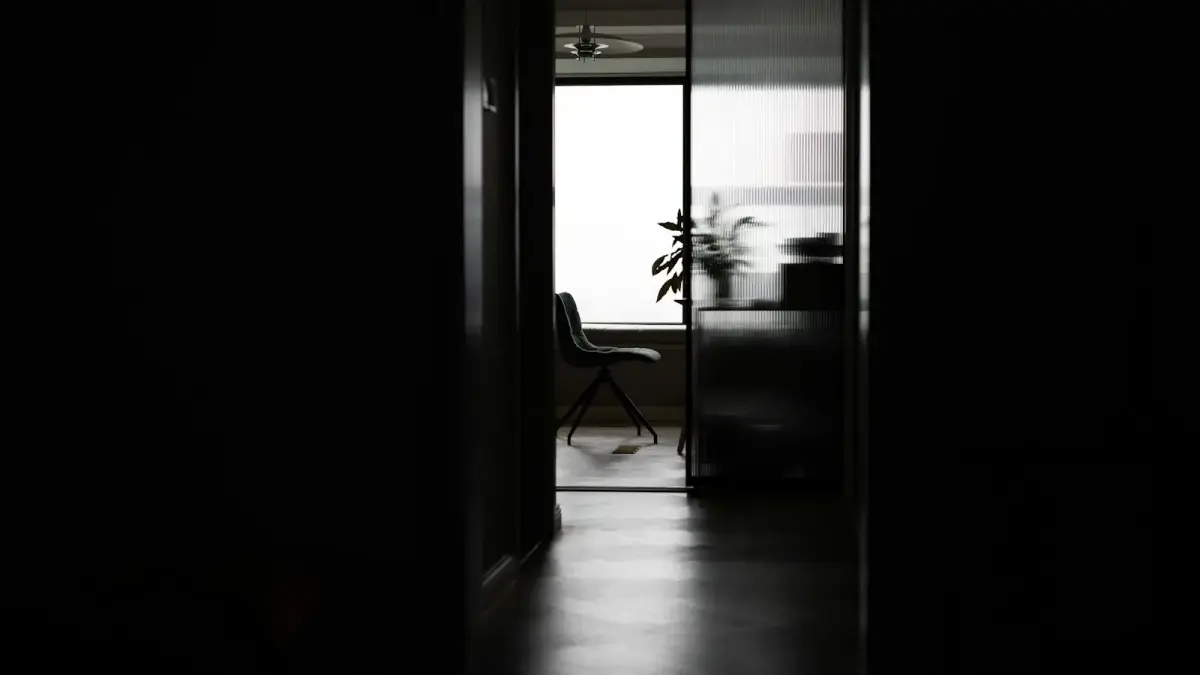
The chair by the door was never a preference
I was nine years old when I realized I had a system. Not a conscious one - nothing I could have explained if someone had asked. But every time my family went to a restaurant, every time we entered a room full of relatives, every time I was placed somewhere new, my body conducted a quiet survey before I could even think.
Where is the door. How far am I from it. Can I get there without climbing over anyone.
I thought I was just fidgety. My mother thought I was shy. But what was actually happening was far more precise than shyness. My nervous system was running a calculation that had nothing to do with preference and everything to do with survival.
If you grew up choosing the chair closest to the exit - not once, not occasionally, but as a pattern so consistent it became invisible to you - then you already know what I am describing. You know it in your shoulders. You know it in the way you still, decades later, feel something tighten when someone seats you in the middle of a crowded booth with no clear path out.
The childhood geometry of safety
Children who position themselves near exits are not being difficult. They are solving an equation that the adults around them often cannot see.
The equation is simple: if something goes wrong, how quickly can I disappear?
This is not the same as wanting to leave. It is wanting to know that leaving is possible. There is an enormous difference between those two things, and children who grow up in unpredictable homes learn that difference in their bones.
Maybe the unpredictability was loud - arguments that erupted without warning, moods that shifted between rooms. Maybe it was quieter - a parent whose emotional weather changed so subtly that the child learned to read atmospheric pressure like a sailor watching the horizon.
Either way, the child’s body arrived at the same conclusion: the safest place in any room is the one closest to an exit.
A 2017 study published in the Journal of Research in Personality found that children who grew up in high-conflict or emotionally volatile households developed significantly heightened spatial awareness - a sensitivity to physical positioning that persisted well into adulthood, long after the original environment had changed.
These children were not anxious in the way we typically imagine anxiety. They were strategic. Their bodies had learned, through repetition, that proximity to an exit was a form of insurance. Not because they always needed to flee - but because knowing they could changed everything about how safe it was to stay.
How exit-mapping becomes invisible
Here is what happens to that child when they grow up: the behavior stays, but the story around it changes.
The adult version sounds like this: I just prefer the corner booth. I like aisle seats. I feel more comfortable facing the door. I don’t love sitting in the middle of a row.
These sound like preferences. They sound like the kind of minor quirks everyone has - the way some people prefer window seats or always choose the same side of the bed. Unremarkable. Barely worth mentioning.
But if you pay attention to the feeling underneath - not the explanation, but the actual physical sensation when someone puts you in a middle seat with your back to the room - you will notice it is not mild. It is not a preference being unmet. It is something closer to alarm.
Your chest tightens. Your attention splits. Part of you is in the conversation, and part of you is tracking movement behind you, monitoring sound, keeping a constant low-level awareness of what you cannot see.
This is not a quirk. This is your oldest protection still running.
The body’s background calculation
What most people do not realize about hypervigilance expressed through spatial positioning is that it never fully turns off. It just gets quieter.
Dr. Gabor Mate has written extensively about how the body stores early survival adaptations as permanent firmware - not software that can be easily updated, but deep programming that runs beneath conscious awareness. The child who needed to map exits does not stop mapping exits just because they are now forty-three and sitting in a safe restaurant with people who love them.
The body does not update its threat assessment based on logic. It updates based on repetition. And if you spent years - the most formative years - training your nervous system to calculate distance-to-door, that calculation continues running as a background process.
You might notice it as the way you always arrive early to choose your seat. The way you feel inexplicably agitated when a restaurant is too crowded to move through easily. The way you avoid concert halls, or middle airplane seats, or any physical configuration where your body registers: you are contained.
A 2021 study in Frontiers in Psychology found that adults with early childhood experiences of emotional unpredictability showed persistent activation in brain regions associated with spatial navigation and threat detection - even in objectively safe environments. Their brains were not malfunctioning. They were doing exactly what they had been trained to do, with extraordinary efficiency.
The difference between scanning and living
There is a cost to this, and it is worth naming honestly.
When part of your attention is always allocated to monitoring your physical environment - where the door is, how many people are between you and it, whether the path is clear - that attention is being borrowed from somewhere else.
It is borrowed from the conversation you are in. From the meal you are eating. From the person sitting across from you who is trying to connect.
You are present, but not entirely. Part of you is always standing near the door, even when your body is seated. Part of you never fully arrives anywhere because arriving means committing to staying, and committing to staying means surrendering the option to leave, and surrendering that option still feels - in some wordless, ancient part of you - like a risk your system is not willing to take.
This does not make you broken. But it does mean you are living with a divided attention that you probably stopped noticing years ago, the way you stop noticing the sound of a refrigerator until someone unplugs it.
What the door really meant
When you were small, the door was not just an exit. It was the entire concept of agency compressed into a physical object.
In a world where you could not control the emotional weather - where you could not make the yelling stop or the tension dissolve or the mood stabilize - the one thing you could control was your distance from it. The door meant: I can remove myself. I can choose to not be here. I have at least this one power.
That is not damage. That is intelligence.
A child who learns to position themselves near exits is a child who found the one variable they could control in an environment full of uncontrollable ones. They did not develop a disorder. They developed a strategy - one that was perfectly calibrated to the conditions they were living in.
The problem is not that the strategy existed. The problem is that it never received a retirement notice. The conditions changed - you grew up, you left, you built a different life - but nobody told your nervous system. Nobody sent the memo that said: you can sit in the middle now. You can put your back to the door. You can stay.
The slow practice of staying
I want to be careful here, because I am not going to tell you to stop scanning. I am not going to suggest that you force yourself into the middle seat as an act of therapeutic rebellion.
What I am going to say is this: the next time you feel that pull toward the chair closest to the door - the next time your body conducts its quiet survey of exits and distances and sight lines - notice it with something other than judgment.
Notice it with recognition. With respect.
That is your nine-year-old self, still keeping watch. Still running the protocol that kept you safe when safe was not guaranteed. They are not broken. They are not anxious. They are loyal - loyal to a version of you that needed them desperately.
Susan Cain, in her work on introversion and sensitivity, has noted that many traits we pathologize in adulthood - the need for positioning, the vigilance, the constant environmental awareness - are actually markers of a nervous system that was built for perception. Built for noticing what others miss. Built for a depth of environmental reading that most people never develop.
You did not choose to become someone who maps exits. But you can choose what you make that mean.
It can mean you are damaged, a person permanently marked by an unsafe childhood. Or it can mean you are someone whose body learned to be extraordinarily intelligent about space and safety - and now, from the stable ground of your adult life, you get to decide how much of that intelligence you still need.
You were never just fidgety
The child who chose the chair by the door was never just restless. Never just shy. Never just difficult about seating arrangements.
They were a small person solving an impossible problem with the only tool they had - their body’s position in space. And they solved it brilliantly.
If you are still that person - still scanning, still calculating, still feeling that unnamed electricity when you cannot see the exit - I want you to know something. Your body is not betraying you. It is still trying to protect the child who needed protecting. It just has not learned yet that the child grew up, got out, and is now the one who gets to decide where to sit.
You are not your vigilance. But your vigilance is part of you - the part that kept you here long enough to read this, in whatever seat you chose, however close to the door.