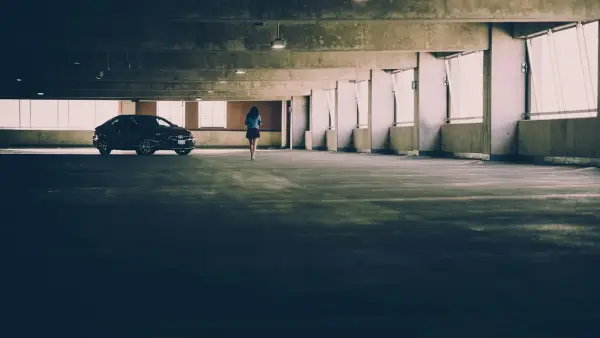
Children who always drew the same picture over and over - the same house, the same tree, the same sun with the same triangular rays, the same family standing in the same green yard - often become adults who cannot rest until every object in their home is exactly where they placed it, because a child who grew up in a house where nothing stayed the same learned that the only world she could keep still was the one she drew with her own hands
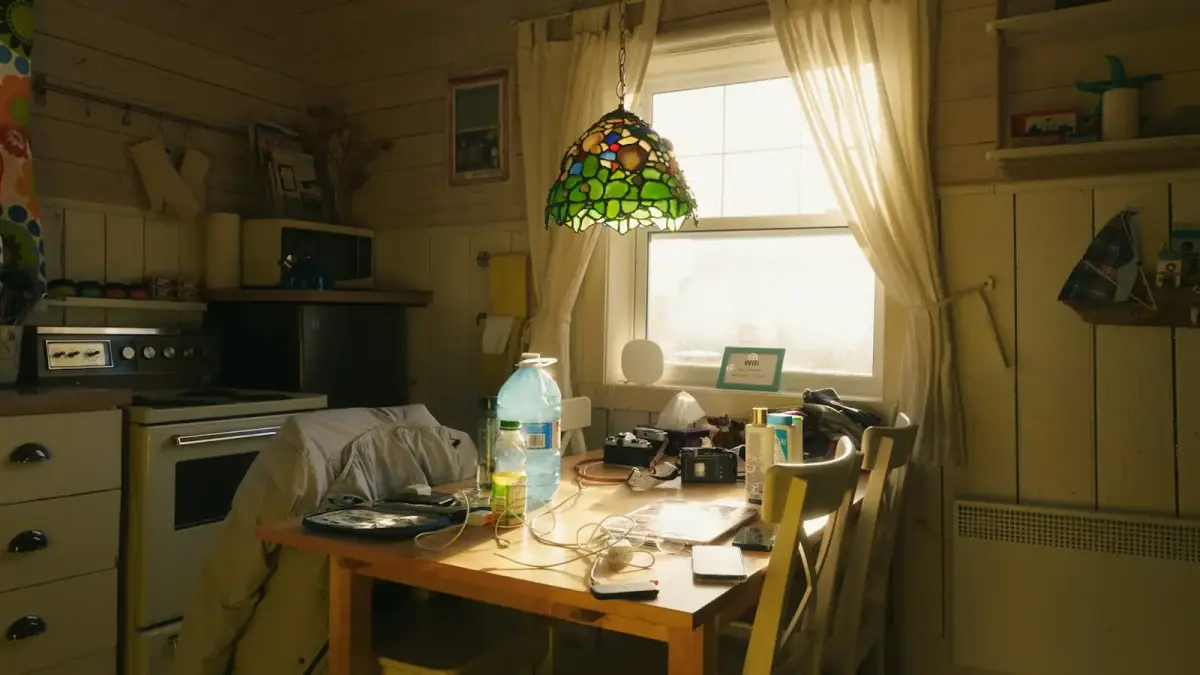
I found the drawing in a box I hadn’t opened in twenty years.
A house with four square windows. A triangle roof. A tree with a perfectly round canopy standing to the left of the front door.
A sun in the upper right corner with exactly six triangular rays. Four stick figures arranged in a row on a clean strip of green grass - two tall, two small, all holding hands, all smiling.
I had drawn this same picture hundreds of times.
Not variations of it. Not loosely similar versions. The same picture. The house always had four windows arranged in a grid. The tree was always on the left.
The sun always had six rays - never five, never seven. The grass was always a single unbroken stripe of green across the bottom of the page.
Other children in my class drew dinosaurs one day and spaceships the next. They drew their dog, their teacher, a castle with a drawbridge, a princess riding a horse across a rainbow. Their drawings were wild, unpredictable, gloriously different every time.
Mine were blueprints.
And I didn’t understand why until I was well into my thirties, sitting in a therapist’s office, describing the apartment where I grew up - and realizing I had never once drawn it.
The House That Didn’t Exist
The house in my drawings had a red door.
Our apartment didn’t have a red door. Our apartment had a door that was sometimes locked from the inside and sometimes left wide open at two in the morning.
Our apartment had rooms that rearranged themselves depending on my mother’s mood. Furniture dragged from one wall to another in the middle of the night. The couch suddenly facing the wrong direction when I came home from school.
My bedroom was sometimes occupied by a stranger who was staying “just for a few days.” The kitchen table moved so often that I stopped looking for it and started scanning.
The house in my drawing had no inside. That was the point. It was all exterior - solid, symmetrical, unchanging.
A structure that existed only as a surface, because surfaces were the only things I knew how to hold in place.
Children’s drawings are sometimes treated as creative expression, and they are. But for some children, the drawing isn’t expression at all. It’s construction.
The child isn’t imagining a world. She’s engineering one.
A 2019 study published in Child Development found that children exposed to household instability - frequent moves, inconsistent routines, unpredictable caregiving - showed markedly higher preferences for repetition and sameness in both play and creative tasks. The researchers noted that this wasn’t a failure of imagination. It was an adaptive response.
The repetition served as a self-generated source of the predictability their environment failed to provide.
I didn’t know any of that when I was seven, drawing my six-rayed sun for the four hundredth time. I just knew it felt safe.
What the Other Children Drew
My friend Katie drew a different picture every day.
Monday it was a horse with wings. Tuesday it was her family at the beach, everyone sunburned and laughing. Wednesday it was an elaborate battle scene between robots and what appeared to be very large cats.
I envied her. Not her artistic skill - we were both terrible - but her willingness to let the picture be different every time. To not know what it would look like before she started.
That kind of openness requires something I didn’t have. It requires a baseline expectation that the world is stable enough to experiment with. That if you draw something wild and it doesn’t work out, you can crumple it up and try again, because the ground beneath you isn’t going anywhere.
Katie’s house was the same house every day. Her parents sat in the same chairs. Dinner happened at the same time.
She could afford to draw chaos because she lived in order.
I couldn’t afford that luxury. My creative energy wasn’t available for exploration because it was already fully employed. Every crayon stroke was load-bearing.
Every repeated element - the four windows, the six rays, the green stripe of grass - was a structural beam in the only architecture I controlled.
Some children draw to discover. Some children draw to stabilize. From the outside, the pictures might look similar - bright colors, simple shapes, proud little signatures in the corner.
But the function is entirely different. One is play. The other is survival.
The Blueprint of a Stable World
Here is what I think was happening, though I couldn’t have articulated it at the time.
My nervous system was overwhelmed by unpredictability. Not dramatic, movie-style chaos - no one was throwing dishes or screaming most of the time. It was subtler than that.
It was not knowing which version of my mother would be home when I got off the bus. It was plans that evaporated without explanation. It was emotional weather that changed by the hour.
For a child, this kind of inconsistency is disorienting in a way that’s hard to describe to someone who didn’t experience it. You don’t develop a fear of specific things. You develop a fear of things changing.
And so you build a world where nothing changes.
The drawing was that world. Every time I sat down with my box of crayons and drew the same house, the same tree, the same sun, I was performing an act of radical stability. I was proving to myself that at least one thing in the universe would be exactly the same today as it was yesterday.
Psychologist Arie Kruglanski’s research on the need for cognitive closure - published across decades of work in the Journal of Personality and Social Psychology - describes this drive precisely. People raised in environments of high ambiguity develop a stronger need for definitive answers, predictable structures, and stable categories.
They don’t just prefer order. They need it the way other people need air. The uncertainty isn’t uncomfortable for them - it’s genuinely threatening.
That six-year-old with her crayons wasn’t making art. She was closing the loop. She was taking the open, unresolved, terrifying question of “what will today look like?” and answering it herself, on paper, in green and yellow and blue.
The Adult She Becomes
If you were that child - or if you recognize someone you love in this description - you probably already know what she grows into.
She becomes the woman whose spice rack is alphabetized. Whose morning routine hasn’t varied in eleven years. Who feels a low hum of anxiety when someone moves the furniture without asking.
When a meeting gets rescheduled at the last minute, something tightens in her chest. When her partner spontaneously suggests they try a new restaurant instead of the one they always go to on Fridays, she hesitates in a way she can’t quite explain.
She is meticulous. Consistent. Reliable to a degree that impresses some people and quietly exhausts others.
She may have been called “controlling.” She may have been told she’s “too rigid” or “afraid of change” or that she “needs to learn to go with the flow.”
These words land on her like small punches, because they reduce something that kept her alive to a personality flaw.
Her routines aren’t preferences. They’re architecture. They’re the adult version of that same drawing - the same house, the same tree, the same sun - rebuilt every morning in meal plans and calendar blocks and precisely folded towels.
She is still building the stable world she needed as a child. The medium has changed. The function hasn’t.
A 2021 study in Frontiers in Psychology found that adults who reported high levels of childhood unpredictability scored significantly higher on measures of need for routine and environmental control in adulthood. The researchers described these behaviors not as pathology but as “persistent self-regulatory strategies” - coping mechanisms that originally served an essential protective function and continued operating long after the original threat had passed.
She isn’t rigid. She’s an architect who never stopped building.
The Drawing Was Never Art
I want to be careful here, because I’m not suggesting that every child who draws the same picture is signaling distress. Children love repetition. They watch the same movie forty times. They want the same bedtime story every night.
Repetition is a normal and healthy part of development.
But there’s a difference between a child who repeats because repetition is fun and a child who repeats because repetition is the only thing that feels safe. The first child is playing. The second child is regulating.
And the second child often grows into an adult who doesn’t understand why she can’t just “relax” the way other people seem to. Why a surprise party feels more like an ambush than a gift. Why she needs to know the plan, why she makes the plan, why she is always, always making the plan.
She may not remember the drawing. She may not connect her need for order to anything in her childhood at all.
She may simply think of herself as someone who “likes things a certain way” - as though it were a quirk, a personality trait, a mildly amusing detail about her character.
But if you showed her a picture of a house with four square windows, a tree on the left, a sun with six triangular rays, and four figures standing in a row on green grass - something in her chest would tighten. Not because she’d remember drawing it.
Because she’d recognize it.
If you were that child - if you are that adult - I want you to know something.
You are not rigid. You are not controlling. You are not broken for needing the world to hold still.
You learned, very young, that the people and places around you could rearrange themselves without warning. And instead of collapsing under that weight, you picked up a crayon and drew a world that stayed. You drew it again the next day. And the next. And the next.
Each time identical. Each time a promise you were making to yourself - that at least this much would remain.
That’s not a limitation. That’s an extraordinary act of self-preservation performed by someone who was barely tall enough to reach the kitchen table.
The routines you keep now, the order you maintain, the plans you make and remake - they are the same drawing. The same house. The same tree. The same sun with the same six rays.
They are your hand on the crayon, still steady, still building.
And the fact that you’re still here - still organized, still planning, still holding the world in place with your own two hands - doesn’t mean you’re afraid of change.
It means you survived it.