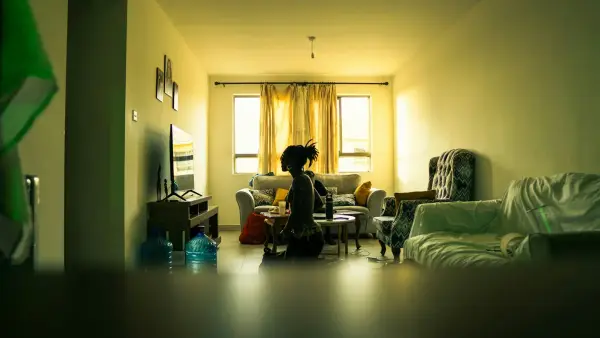
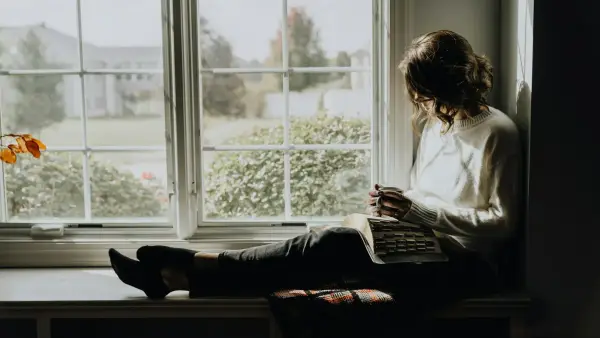
Children who always lowered their voice when other people in the house were sleeping - who tiptoed past closed doors, who learned to pour cereal without the box rustling, who figured out which stair creaked and stepped over it every single time - often become adults who instinctively lower their volume in any shared space, not because they are naturally quiet but because a child who learned that her presence could wake something unpredictable taught herself that the safest version of her body was the quietest one
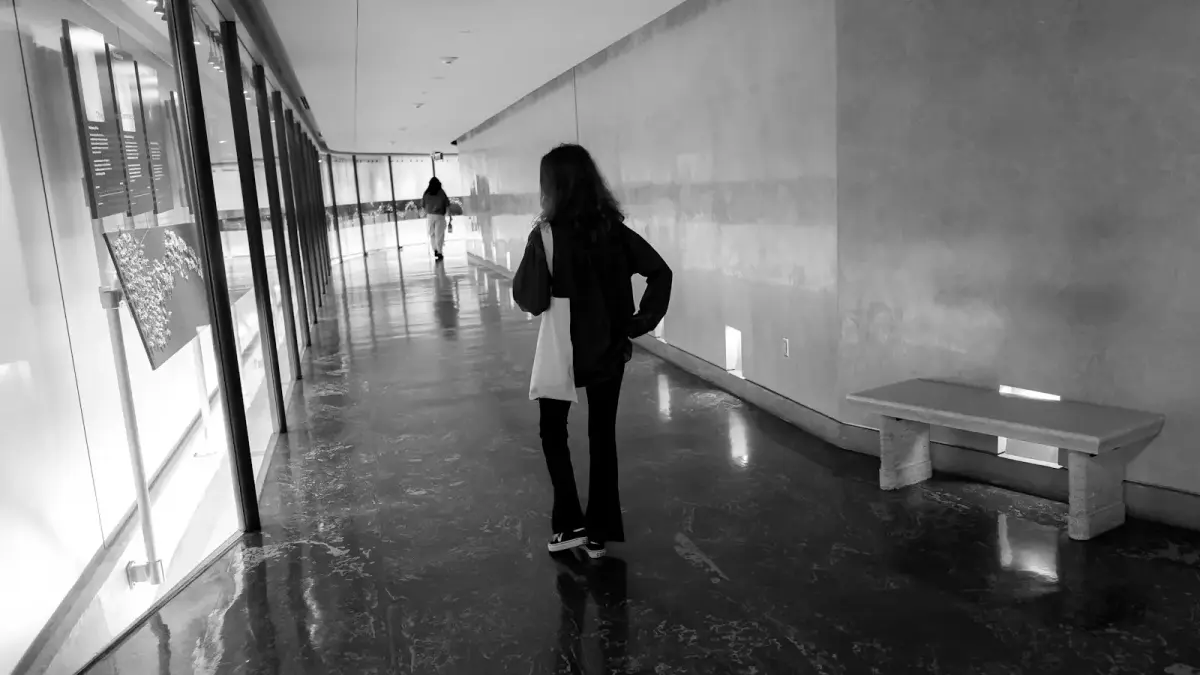
I knew which stair creaked before I knew my multiplication tables.
Third from the top, slightly left of center. If you placed your foot on the right edge and shifted your weight slowly, you could pass over it without a sound. I practiced it the way other kids practiced free throws - with focus, repetition, and the understanding that getting it wrong had consequences.
I also knew how to open the refrigerator without the seal making that soft popping noise. I knew how to run water from the tap at exactly the angle where it hit the basin silently instead of splashing. I knew that the cereal box had to be tilted, not shaken, and that the cabinet door needed to be lifted slightly on its hinge before closing or it would click.
I didn’t learn these things because I was a considerate child. I learned them because our house had a weather system, and the forecast depended on who was sleeping and how they woke up.
If you grew up mapping the acoustics of your own home the way a sailor reads the wind, this is probably going to feel familiar. And I want to be honest about what that knowledge actually was - not politeness, not thoughtfulness, but something closer to architecture. A blueprint for moving through space without being detected.
1. You learned the sound map of your house before you learned to read it
Every home has an acoustic signature. Most children never notice it. But some children learn it the way a musician learns an instrument - through consequence.
You knew which door hinges squeaked. You knew that the bathroom fan covered the sound of crying. You knew that the hallway carried sound differently than the kitchen, and that voices traveled through vents in ways that walls couldn’t stop.
A 2014 study published in Development and Psychopathology found that children raised in unpredictable home environments develop heightened perceptual sensitivity to auditory cues - their brains literally process sound differently than children from stable homes. This isn’t metaphor. Your nervous system was rewired to treat sound as information about safety.
You weren’t being careful. You were conducting surveillance on your own house, using your ears.
2. Your body became a volume dial you were always turning down
It started with footsteps. Then it was your voice. Then it was the way you breathed when you walked past a closed bedroom door.
You learned to modulate everything. The weight of your step. The speed of your chewing. The force with which you set a glass on the counter. Some children develop this as young as four or five - not because anyone explicitly told them to be quiet, but because the relationship between noise and emotional eruption was obvious enough that the lesson taught itself.
You weren’t born quiet. You were shaped quiet. Your body learned that taking up less auditory space meant taking up less emotional space, and emotional space was where the danger lived.
3. You monitored sleeping people the way other kids monitored weather
There was a particular kind of listening you did. Not eavesdropping - something more primal. You tracked the breathing patterns of the adults in your house. Deep and steady meant safe. A shift in rhythm meant danger. A cough or a groan meant the window was closing.
You timed your movements around those rhythms. You waited for the deep exhale before opening a door. You paused at the top of the stairs and listened for thirty seconds before committing to the descent.
Gabor Mate has written extensively about how children in chaotic homes develop a kind of emotional radar - a constant, unconscious scanning of the environment for threats. What he describes in psychological terms, you experienced as a physical practice. Your body was the instrument. Silence was the technique.
4. You confused hypervigilance with consideration
Here is where it gets tricky, because the behavior looked virtuous from the outside.
Adults praised you for being thoughtful. Teachers said you were mature. Relatives called you “the easy one.” And part of you believed them - believed that your quietness was a personality trait rather than a protection strategy.
But thoughtful children choose to be quiet. Hypervigilant children have to be. The difference isn’t visible, but it lives in the body. Thoughtful quiet feels like generosity. Survival quiet feels like holding your breath and hoping nobody notices you’re in the room.
A 2019 study in Psychological Science found that adults who scored high on childhood emotional unpredictability measures also scored significantly higher on interpersonal vigilance - the tendency to constantly monitor others’ emotional states. The researchers noted that this vigilance often presents as social sensitivity or empathy, masking its origins in threat detection.
You weren’t empathetic because you were gifted. You were empathetic because you had to be.
5. You still apologize for sounds your body makes
You say sorry when you laugh too loudly. You wince when you drop something. You turn the music down before you open the car door, not for the neighbors but because something in you flinches at the idea of unexpected sound entering a shared space.
You lower your voice in restaurants without being asked. You close cabinets so softly that people don’t hear them shut. You set your phone to vibrate and then feel anxious about the vibration being too loud.
These aren’t quirks. They’re the residue of a childhood spent managing the acoustic environment of an unpredictable home. Your body still believes that volume is a variable you need to control, because once upon a time, it was the only variable you could control.
6. Shared spaces still feel like someone else’s territory
When you moved in with a roommate, a partner, a friend - you defaulted to minimizing. You used headphones even when no one asked. You cooked quietly. You ran the shower at lower pressure. You existed at a volume calibrated for someone else’s comfort, because that’s the only volume you know.
You never quite learned to take up space in a home as if it were yours. The house always belongs to whoever has the most unpredictable mood, and your job is to not disturb that mood. Even now, in a home you pay rent on. Even now, in a home where no one is sleeping behind a closed door with a temper on the other side of it.
Susan Cain’s research on introversion has illuminated how quiet people are often celebrated for their restraint. But there is a difference between a person who is quiet because they prefer stillness and a person who is quiet because stillness was once the only safe thing to be. One is a preference. The other is a posture the body assumed and never released.
7. You read rooms before you enter them
You pause at doorways. You assess the energy before you contribute to it. You notice who seems tense, who seems tired, who might not want to be spoken to right now.
People call this emotional intelligence, and maybe it is. But it was trained in a very specific classroom - a hallway at 6 a.m., a kitchen where the wrong sound could change the entire morning, a living room where you had to decide within seconds whether this was a good day or a dangerous one.
Your ability to read a room isn’t a gift. It’s data you started collecting before you were old enough to understand what the data meant.
8. You feel safest when you are the least noticeable person in the room
There is a particular kind of comfort that comes from being overlooked. Not ignored - overlooked. Invisible in the way that means no one is monitoring you, no one is reacting to you, no one is about to be activated by your presence.
You feel most relaxed when you are not the center of anything. When attention slides past you. When you can observe without being observed.
This isn’t introversion. This is the ghost of a child who learned that being noticed was the first step in a sequence that ended badly. The child figured out that if she could get from her bedroom to the kitchen and back without anyone registering her presence, the morning might stay calm. That logic is still running in your body. It just doesn’t announce itself anymore.
9. Your quietness is not your personality - it is your architecture
This is the part I want you to sit with.
You may have spent decades believing that you are simply a quiet person. That you prefer low volume, small gatherings, soft voices, and still spaces because that is who you are at your core.
And maybe some of that is true. But some of it - maybe more than you’ve admitted - is structural. It was built in response to conditions that no longer exist, by a child who didn’t have the language to say “I am afraid of what happens when I’m too loud” and so instead just became someone who was never too loud.
A 2021 study in Frontiers in Psychology found that adults who reported high levels of childhood household unpredictability showed lasting differences in autonomic nervous system regulation - specifically, a heightened startle response to sudden auditory stimuli. Your body still jumps at unexpected sounds. Not because you’re anxious by nature, but because your nervous system was calibrated in an environment where sudden sound meant something was about to go wrong.
10. You are allowed to be loud now
I say this knowing it won’t land all at once. It might not land today.
But the house you live in now is not that house. The people you share space with are not those people. The stair can creak. The cabinet can close at full volume. You can laugh without checking the room first.
The child who learned to pour cereal without rustling the bag was brilliant. She was resourceful and observant and she kept herself safe in the only way she knew how. That strategy deserves respect, not shame.
But she also deserves to know that the emergency is over. That she is allowed to take up auditory space. That her presence in a room does not need to be managed, minimized, or muted.
You are not a naturally quiet person who happens to have strong spatial awareness. You are someone who learned, very young, that the volume of your body was directly connected to the emotional safety of your world. And you responded with extraordinary precision.
That precision kept you safe. It doesn’t have to keep you small.
The stair creaks now, and nothing bad happens. Let yourself hear that. Let your body learn the new sound of what safety actually is - not silence, but the freedom to make noise and have it mean nothing at all.