Children who grew up in homes where asking 'why' was treated as talking back often become adults who rehearse every sentence in their head before speaking it, not because they doubt what they want to say but because they learned before they had language for it that a wrong word at the wrong moment could make the safest person in the room become unrecognizable

I used to practice ordering coffee.
Not because I didn’t know what I wanted. I always knew. But somewhere between thinking the words and saying them out loud, a filter would kick in - this quiet, automatic scan that checked my sentence for anything that might land wrong. Too demanding. Too uncertain. Too much.
I’d rehearse “Can I get a medium latte?” in my head two or three times before I reached the counter. Adjusting the tone. Softening the edges. Making sure nothing about the way I asked could be mistaken for rudeness, for entitlement, for taking up more space than I was allowed.
It took me years to understand where that came from. It wasn’t shyness. It wasn’t social anxiety in the clinical sense. It was something far more specific - a learned behavior from a home where language was never just language. Where every question had a second meaning that the adults assigned without telling you, and where the word “why” could turn a Tuesday evening into something you spent the rest of the week recovering from.
When curiosity became defiance
In some homes, children learn that questions are welcome. “Why is the sky blue?” gets a patient explanation or a cheerful “let’s find out together.” Curiosity is treated as a sign of intelligence, something to be nurtured.
In other homes, “why” is a grenade.
Not every time. That’s what makes it so disorienting. Sometimes the question lands fine. Sometimes your parent answers casually, and the evening stays calm. But other times - and you never know which times until it’s too late - “why” is heard as something else entirely. As a challenge. As disrespect. As a child who doesn’t know their place.
“Why do I have to go to bed now?” becomes “Are you talking back to me?”
“Why can’t I go to the party?” becomes a lecture about gratitude, about how much they sacrifice, about how you never appreciate anything.
The content of the question doesn’t matter. The act of questioning is the offense.
A child in this environment learns something devastating before they have the vocabulary to name it: the people who are supposed to make you safe can become unsafe without warning, and the trigger is your voice. Your words. The simple, human act of trying to understand.
So you stop trying to understand out loud. You take your curiosity underground. And you develop a system - intricate, exhausting, invisible to everyone else - for scanning every sentence before it leaves your mouth.
The architecture of verbal rehearsal
If you grew up this way, you probably don’t even notice you’re doing it anymore. It’s become so automatic it feels like thinking.
But it’s not just thinking. It’s editing. It’s running every potential sentence through a filter that asks: Could this be heard as criticism? Could this sound ungrateful? Is there any version of this that might make someone’s face change?
A 2019 study published in the Journal of Personality and Social Psychology found that adults who experienced unpredictable parental responses in childhood develop heightened sensitivity to social threat cues - their brains learn to scan for danger in interpersonal interactions the way other people’s brains scan for traffic before crossing a street. It becomes reflexive. Pre-conscious. You don’t choose to do it any more than you choose to flinch.
This is what verbal rehearsal actually is. It’s not indecisiveness. It’s not a lack of confidence in your own thoughts. It’s a threat-detection system that was built by a child who figured out, through painful trial and error, that certain combinations of words in certain tones at certain moments could turn safety into chaos.
And the system works. That’s the thing nobody talks about. You rarely say the wrong thing. You rarely trigger the explosion. You become the person everyone describes as “thoughtful” or “careful with their words” or “such a good listener.”
What they don’t see is the cost - the constant low-level labor of translating yourself for safety before you speak.
What it looks like in an adult life
You’re in a meeting and your boss says something factually incorrect. You know the right answer. You’ve known it for thirty seconds. But instead of saying it, you’re running scenarios. If I correct them directly, will they feel challenged? Should I phrase it as a question instead? Should I wait until after and mention it privately?
By the time you’ve finished rehearsing the safest possible version, someone else has said it. Casually. Without agonizing. And the boss just nods and says, “Good catch.”
You watch that interaction and feel something you can’t quite name. Not jealousy, exactly. More like bewilderment. How do people just say things?
It shows up in relationships, too. Your partner asks, “What’s wrong?” and you know what’s wrong. You could articulate it clearly. But the filter kicks in. You start editing. You soften “I felt hurt when you forgot” into “It’s fine, I was just being silly.” You round off every sharp edge until what comes out barely resembles what you feel.
Dr. Gabor Mate has written extensively about how children in emotionally volatile homes learn to suppress their authentic expression as a survival strategy - not because they’re weak, but because they’re adaptive. The child who edits themselves is the child who figured out how to stay safe. The problem is that the strategy outlives the danger.
You’re forty-seven years old, sitting across from someone who loves you, and you’re still running your sentences through the same filter you built when you were eight.
The exhaustion nobody sees
Here’s what people don’t understand about chronic verbal rehearsal: it’s not just a habit. It’s a full-time job you never clocked into.
Every conversation requires double the processing. There’s what you want to say, and then there’s the work of making what you want to say land safely. You’re simultaneously participating in the conversation and monitoring it from above, watching for shifts in tone, micro-expressions, any sign that the atmosphere is turning.
This is why you’re tired in ways that don’t match your schedule. You slept eight hours but you’re exhausted by noon, because you’ve already had six conversations and each one required the cognitive load of a negotiation.
Research from the journal Psychological Science has shown that the effort of self-monitoring during social interactions depletes the same cognitive resources used for complex problem-solving. People who habitually edit their speech show measurable reductions in working memory and creative thinking - not because they’re less intelligent, but because a significant portion of their mental bandwidth is permanently allocated to surveillance.
You’re not overthinking. You’re running a security system that never shuts off.
And the loneliest part is that nobody knows. Because the whole point of the system is to be invisible. You appear calm, measured, easy to be around. Nobody sees the work happening behind your face. Nobody knows that the pause before you answer isn’t you gathering your thoughts - it’s you disarming your thoughts, removing anything that might be heard as too direct, too honest, too much.
The moment you realize what you lost
There’s usually a moment - sometimes in therapy, sometimes in the middle of an ordinary Tuesday - when you realize what this pattern actually cost you.
It’s not just that you’ve spent decades editing yourself. It’s that you don’t fully know what you sound like unedited.
You’ve been rehearsing for so long that the rehearsal feels like your real voice. The filtered version became the only version. And somewhere beneath it, there’s a person who had opinions and reactions and instincts and the kind of raw, unpolished thoughts that just come out of people’s mouths without a security check.
You lost access to that person. Not because they died, but because they learned very early that being unfiltered wasn’t safe.
A 2021 study in Frontiers in Psychology found that adults who grew up in homes with unpredictable emotional climates reported significantly lower “self-concept clarity” - they had difficulty distinguishing their authentic preferences and opinions from the adapted versions they’d created for survival. It’s not that they didn’t have a self. It’s that the self got buried under so many layers of protective editing that finding it again requires excavation.
This is the grief that catches you off guard. Not grief for what happened to you, but grief for the person you might have been if “why” had been met with patience instead of punishment. The version of you that speaks freely. The one who says “I disagree” without her heart rate spiking. The one who asks questions because she’s curious, not because she’s already calculated every possible response.
What your rehearsal actually proves about you
I want to tell you something that might be hard to hear, only because it contradicts the story you’ve been telling yourself for decades.
The fact that you rehearse your sentences doesn’t mean something is wrong with you. It means something was wrong around you, and you were smart enough - perceptive enough, emotionally sophisticated enough - to figure out a way to survive it.
A child who learns to edit their speech in real time is a child with extraordinary emotional intelligence. They’re reading the room at a level most adults never develop. They’re processing tone, context, body language, and emotional history simultaneously, running all of it through a predictive model to determine the safest output.
That’s not a disorder. That’s an adaptation built by someone who had to grow up faster than they should have.
The work now isn’t to get rid of the filter. You probably can’t, and that’s okay. The work is to notice when it’s running and to ask yourself a gentle question: Am I editing for safety because there’s an actual threat here, or am I editing out of habit, running an old program in a new environment?
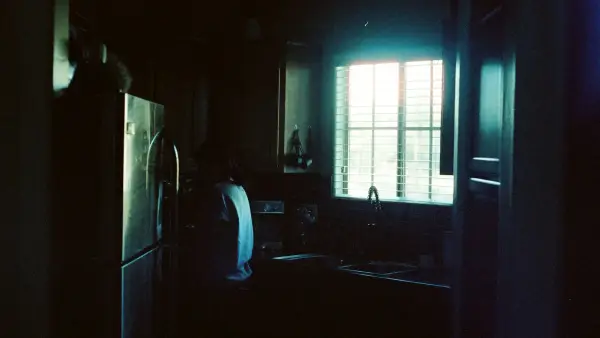
Because the meeting where you stay quiet isn’t your childhood kitchen. Your partner asking “what’s wrong” isn’t the same as a parent whose face used to change. The barista doesn’t care how you phrase your order.
You already know this intellectually. The practice is letting your body learn it too. Slowly. In small moments. Saying the first draft of a sentence instead of the fourth, and letting the silence afterward be proof that you survived it.
You were never overthinking. You were protecting yourself with the only tools you had. And the fact that you’re reading this - that you’re starting to see the pattern - means you’re ready to let some of those tools rest.
Not all at once. Not today. But one unrehearsed sentence at a time.