Children who grew up listening for the sound of the front door at night to decide what kind of evening the family was going to have often become adults who cannot fall asleep until every person they love has texted back, because a nervous system that learned at seven to measure safety by the sound of a lock has never been told that the doors stopped mattering
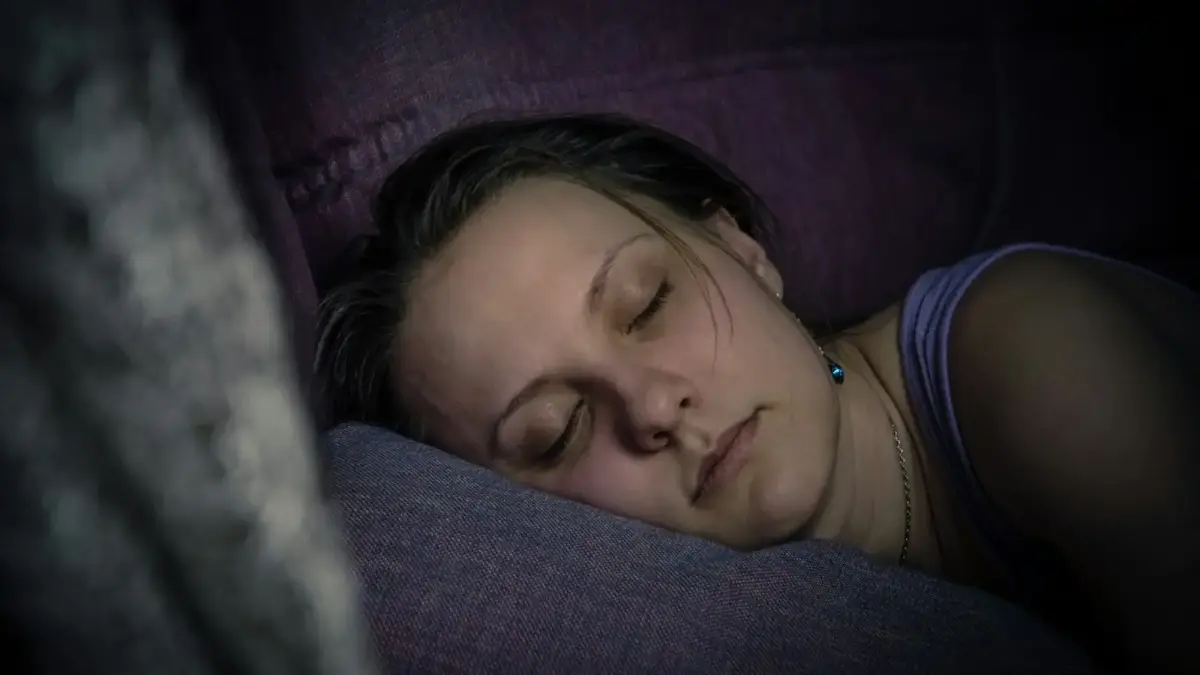
I used to know the difference between my father’s good-night key and his bad-night key before he’d even opened the door.
The good-night key was quick. One twist, one click, a sigh as his keys hit the bowl. The bad-night key was slower. It missed the lock once, then twice, then landed. That second sound - the brief scrape of metal against a place it wasn’t supposed to be - was all the information a child needed to decide whether to get out of bed or stay very, very still.
I was seven. I did not know I was doing this. I only knew that I could not fall asleep until I’d heard the right kind of key.
Decades later, I’m forty-six and lying in bed with my phone on the pillow beside me. My sister’s last text came in at 9:47. My best friend’s at 10:12. My grown son’s at 10:34. My mother hasn’t texted back yet, and it is 11:09, and I know she is fine, and I also cannot close my eyes.
If this is you, I want to tell you something gently. You are not anxious. You are not broken. You are not too much. You are a person whose nervous system learned, very early, to treat the sound of the people you love as proof of life. And nobody ever came back to tell it the doors stopped mattering.
1. You fall asleep only after the last text comes in, and the first one to go silent becomes the one your mind tracks all night
There is a specific moment, somewhere around eleven, when you realize you’re waiting. Your hand reaches for the phone before your brain has a reason. You check the thread. Two people have responded. One hasn’t. That one is now the shape of your evening.
This isn’t because you love them more. It’s because, at seven, you learned that the person who wasn’t home yet was the person whose absence you had to account for. You kept a mental tally of who was where. The family’s mood depended on it, which meant your body’s settling depended on it too.
A 2014 study in Development and Psychopathology found that children raised in unpredictable home environments develop what researchers call anticipatory threat monitoring, a kind of background scanning that persists long after the threat is gone. Your scanning didn’t stop when you grew up. It just found phones.
2. You wake up at 3am when someone you love is traveling, not because anything is wrong but because your body expects to
You open your eyes at 3:14am on the night your daughter is flying home. You are not worried, exactly. You are just awake. Fully awake. The way you used to be awake when you were a child and something in the house shifted - a floorboard, a voice raised two rooms over, a car door closing in the driveway at an hour when cars did not usually close.
Your body is not making you wake up. Your body is keeping an appointment it scheduled in 1985.
Dr. Bruce Perry’s work on neurosequential development has shown that early experiences of unpredictable caregiving literally shape the timing of the nervous system’s arousal patterns. The brainstem learns when to be alert. And once that pattern is laid down in childhood, it runs on its own internal clock, often for decades. You are not imagining this. Your body is doing exactly what it was taught to do, on the schedule it was taught to do it.
The reframe isn’t to force yourself back to sleep. It’s to notice, with warmth, that a small version of you is checking the hallway. And then to tell her, softly, that everyone made it home.
3. You can tell from the first three words on the phone which kind of night it’s about to be, a skill you did not choose to develop
Your mother says hello. Your spouse says hello. Your oldest friend says hello. And somewhere in the micro-intonation of that single word, you already know. You know if she’s been crying. You know if he’s had a bad day. You know if the conversation is going to require you to be the steady one or the quiet one or the one who pretends not to notice.
You did not decide to become this sensitive. You became this sensitive because, at some point, someone’s mood governed the temperature of your entire household, and you were too small to influence the temperature any other way than by reading it first.
Stephen Porges’s polyvagal theory describes this capacity as neuroception - the nervous system’s ability to detect safety or threat below the level of conscious awareness. In children of emotionally volatile caregivers, neuroception gets finely tuned. You became, in a sense, a three-word polygraph.
This is not a flaw. It is a gift that came at a cost. The cost is that you are always reading. The gift is that the people you love almost never feel unseen.
4. You volunteer to be the last one up at gatherings, because the person who notices how everyone is feeling cannot leave before they’ve been counted
Everyone else has drifted off to bed. You are the one rinsing the last wineglass, folding the throw blanket, checking that the back door is locked even though you know it is. This is not because you are more responsible. It is because, somewhere inside you, a small girl is still waiting for the last person to come home before she can rest.
You tell yourself you’re just a night owl. You tell yourself you like the quiet. Both things are true. But underneath, there’s a census happening. You are counting. You will count until everyone is accounted for.
Research on parentified children, including work published in the Journal of Child Psychology and Psychiatry, has found that kids who took on emotional caretaking roles early often carry those roles into adulthood as hosting behaviors, caretaking rituals, and a deep difficulty being the first one to go to bed. If you’ve ever cried a little, unexpectedly, while wiping down a kitchen counter at midnight, you know what this is.
5. You interpret a dropped call or an unanswered text through a lens that assumes something has gone wrong
Your friend doesn’t answer. It’s been forty minutes. You know, rationally, that she’s probably driving or in the shower or charging her phone in the other room. But a small hot thread of certainty has already begun to pull at you. Something’s happened. Something’s wrong. Someone has left the house and not come back.
This isn’t catastrophizing in the clinical sense. It’s a childhood operating system interpreting silence the only way it was ever taught to. Silence, when you were seven, was not neutral. Silence was the pause before you found out.
A 2019 study in Attachment and Human Development found that adults who grew up with unpredictable caregivers were significantly more likely to interpret ambiguous relational cues as negative, not because they were pessimistic, but because ambiguity itself had once been dangerous. Their systems had learned to resolve ambiguity quickly, and the fastest resolution is always the worst one.
You are not paranoid. You are precise. You were trained to be precise about exactly this.
6. You mistake this vigilance for love, and it is love-adjacent, but it originated somewhere else
Here is the part that’s hard to hear, and I will say it gently because I had to hear it too.
The tracking is not the love. The tracking is the condition your love learned to exist inside. You grew up believing that paying this much attention to someone was what caring looked like. That if you stopped scanning, stopped counting, stopped staying up, you would be abandoning them.
You wouldn’t. The people you love do not need to be tracked to be loved. They are loved already. The tracking is a separate thing, a thing your seven-year-old self developed because she believed, correctly, that somebody in the house needed to be watching.
She doesn’t have to be the one watching anymore.
It can take years to separate the love from the vigilance, because they arrived together and were braided into each other before you had words. But the day you notice the difference - the day you realize your mother is still your mother whether or not you know where she is at 11pm - is the day something loosens. It is a small, quiet loosening. It does not feel like a breakthrough. It feels like being allowed to sit down.
7. You cannot take a proper vacation without doing a mental roll call of everyone in your life
You are on a beach. You have earned this beach. You paid for it, you planned it, you packed sunscreen for it. And at some point on the second afternoon, you realize you are mentally reviewing the status of nine different people, none of whom are on this trip with you.
Your sister’s work thing. Your friend’s medical appointment. Your son’s new apartment. Your mother’s upcoming drive. You are not on vacation. You are just doing the census from a different chair.
This is what happens when rest was never safe. When the only time the house was quiet was the time before something happened, rest itself becomes a kind of pre-event. Your body associates stillness with the approach of news. So you fill the stillness with tracking, because tracking feels like prevention, and prevention feels like love.
What helped me, and what I wish someone had told my seven-year-old self, is this. Rest is not what you earn after everyone is safe. Rest is what you are allowed to have because you, too, are one of the people who deserve to be counted.
If you’ve read this far, I want you to know something.
The little girl who learned to listen for the lock was not paranoid. She was not dramatic. She was not too sensitive. She was a child who loved her family and used the only tool she had to keep track of them, and that tool was her own small body.
She grew up into you. She got taller. She got smarter. She got a phone. And the tool she used to keep everyone safe simply upgraded itself, because nobody ever came downstairs and said, sweetheart, you can stop listening now. The doors don’t mean what they used to mean.
So let me be the one to say it, softly, through a screen. You can stop listening now. The doors don’t mean what they used to mean. The people you love are not disappearing when they don’t text back. They are just living, in the way that living people do, with charged phones and dead phones and phones left on counters.
Your body learned something beautiful and painful at seven. It learned that love, for you, would always come with listening. You can keep the listening, if you want. You can also, slowly and without any hurry, teach it that it’s allowed to rest.
You are not broken. You were never broken. You were only very, very good at your job, and your job is over.