He's 57 and has just realized that not a single piece of furniture in his house was chosen because it was beautiful - every chair was chosen because it was sturdy, every surface because it would not show marks, every fabric because it was practical - and the man who has spent thirty years building a home that functions perfectly but delights him not at all is not sensible but still the boy who watched his father measure every object against how long it would last and learned before ten that beauty was something other people's families were allowed to want
The Grey Couch
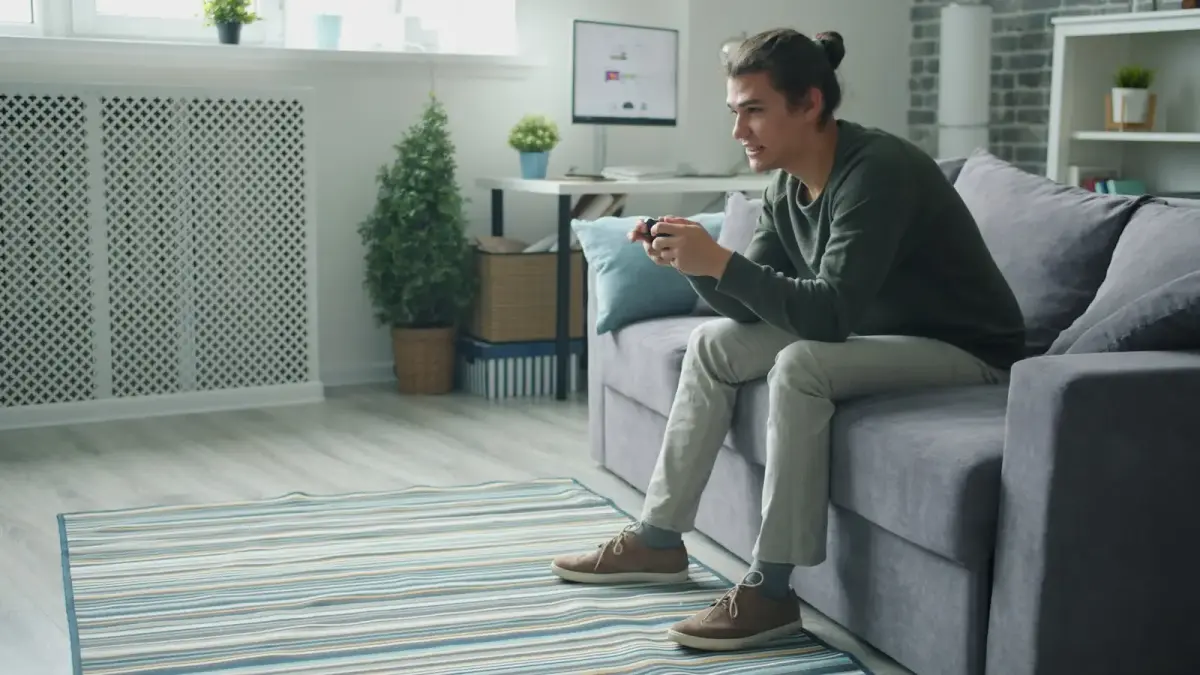
I was standing in my living room last Tuesday - the same living room I’ve stood in for nineteen years - when it hit me with a force that made me put my hand on the wall. I was looking at the couch. Grey. Microfiber. We bought it in 2014 because the salesman said it was stain-resistant and the frame was solid oak underneath.
I looked at the coffee table. Oak veneer, rounded corners, chosen because our youngest was still small and we didn’t want sharp edges. I looked at the carpet. Beige. Because it wouldn’t show footprints and could handle high traffic.
I turned in a slow circle in my own home and realized that not a single object in that room - not one lamp, not one cushion, not one frame on the wall - was there because it was beautiful. Everything was there because it was sensible.
I am fifty-seven years old. I have owned this home for nearly two decades. And I have never once bought something for a room simply because it caught my eye and made me feel something.
The Calculation
My father had a phrase he used every time we were in a shop. Every single time. He would pick something up, turn it over in his hands, and ask two questions. “How long will it last?” and “What’s it good for?”
Those were the only two questions that mattered.
If something couldn’t answer both convincingly, it went back on the shelf. There was no third question. There was no “Do you like how it looks?” or “Does it make you feel anything?” Those questions did not exist in our household’s purchasing vocabulary.
I remember being nine and pointing at a blue lamp in a department store. It had a ceramic base shaped like waves, and something about the color - this deep ocean blue - made my chest feel warm. My father looked at it, looked at the price, and said, “What do you need that for? We’ve got lamps.”
He wasn’t cruel about it. That’s the thing people miss when I tell this story. He wasn’t harsh or cold. He was genuinely confused. The idea that you might want a lamp because it was blue - because the blue made you feel something - was as foreign to him as wanting to eat a photograph.
The Inheritance Nobody Names
Here’s what I’ve come to understand at fifty-seven that I could not have articulated at thirty or even forty-five: my father wasn’t being cheap. He was being loyal. Loyal to a set of rules that had kept his family fed and housed through decades when neither was guaranteed.
A 2019 study published in the Journal of Consumer Research found that people raised in economic scarcity develop what researchers call “functional acquisition patterns” - a deep, often unconscious tendency to evaluate every purchase through a lens of utility and longevity rather than pleasure or aesthetics. The pattern persists long after the scarcity itself has resolved.
My father grew up in a house where furniture was inherited, repaired, inherited again. You did not choose furniture. Furniture happened to you. And if you were fortunate enough to buy something new, you bought it once and it had better last until you were carried out of the house feet first.
Beauty was what happened in other people’s homes. People who could afford to replace things when they got tired of looking at them. People whose couches weren’t investments but expressions.
I absorbed this completely. Not through lectures or punishments but through a thousand tiny moments of watching my father’s hands weigh objects against their longevity, watching his eyes skip past color and texture to find the structural joint, the material composition, the warranty card.
What I Built Without Knowing
When my wife and I bought our first home in 2007, I thought I was free. I had a good job, a solid income, no debt. I could have bought anything.
I bought a grey couch because it wouldn’t show stains.
I bought a wooden dining table because it was solid and could be sanded down if the kids scratched it. I bought curtains in a neutral tone because they would “go with anything” - which really meant they would commit to nothing.
Every decision I made felt responsible and correct. I was being practical. I was being smart. I was doing what a man does - he provides function. He creates a space that works. He doesn’t waste money on things that are merely pleasing.
But here’s what I know now that I could not see then: I wasn’t making choices. I was running my father’s calculation. Every time I walked into a furniture store, a version of my father materialized beside me, turning things over, checking joints, asking those two questions. And beauty never survived the audit.
A 2022 study in Frontiers in Psychology found that aesthetic deprivation - living in environments stripped of visual pleasure - correlates significantly with lower emotional wellbeing and a diminished sense of home attachment. The researchers noted that people who rated their homes as “functional but not beautiful” reported feeling less emotionally connected to their living spaces, even after controlling for income and square footage.
I read that and felt it in my bones. I live in my house. But I have never felt nourished by it.
The Class Line Nobody Talks About
There’s a line that runs through working-class homes, and it’s drawn in fabric choices and wall colors. On one side: practical, durable, neutral, sensible. On the other: expressive, bold, pleasurable, alive.
And the men I grew up around - the men like my father and his friends and their fathers - they lived firmly on the practical side. Not because they lacked taste but because taste itself was suspect. Wanting something because it was beautiful was dangerously close to wanting something you didn’t need. And wanting things you didn’t need was how families ended up in trouble.
This is the inheritance nobody names. It’s not trauma in the clinical sense. It’s not abuse. It’s a quiet narrowing of what you’re allowed to want. A slow erosion of the permission to find pleasure in your surroundings.
I know men my age - dozens of them - who live in homes that function beautifully and feel like nothing. Whose walls are painted in colors chosen to not offend resale value. Whose furniture was selected from a mental catalog of “sensible options” that excluded anything that might simply bring joy.
We are not minimalists. Minimalism is a choice made from abundance. We are men who learned, before we had language for it, that beauty was an indulgence our kind of people had not earned.
The Boy in the Furniture Store
Brene Brown writes about how vulnerability requires us to show up without controlling the outcome. I think about that in terms of aesthetics now. Choosing something beautiful is vulnerable. It says: this pleases me. It says: I have preferences that exist beyond function. It says: I am the kind of person who wants things to be lovely, not just useful.
For a boy raised in a home where utility was the only acceptable justification for ownership, admitting that you find something beautiful - and that the beauty alone is reason enough to bring it into your life - feels like a confession.
I am fifty-seven years old, and I am telling you: last month I bought a ceramic bowl. It is blue. A deep, ocean blue that reminds me of that lamp from when I was nine. It holds nothing. It serves no function. It sits on my kitchen windowsill where the morning light hits it, and every time I see it, I feel something warm settle in my chest.
It cost twelve dollars. It is the most radical purchase I have ever made.
What the Boy Needed to Hear
If you recognize yourself in any of this - if you are sitting in a living room that works perfectly but gives you nothing - I want you to know something.
You are not impractical for wanting beauty. You are not wasteful for wanting your home to make you feel something when you walk through the door. The voice that runs the calculation every time you reach for something lovely is not your voice. It’s inherited. It was given to you by people who were doing their best with what they had.
But you are allowed to update the rules now.
A 2021 study in the Journal of Positive Psychology found that people who intentionally introduced aesthetic objects into their daily environments - even small ones, even inexpensive ones - reported measurable increases in daily positive affect over a twelve-week period. The beauty didn’t need to be expensive. It needed to be chosen. Deliberately. For no other reason than that it pleased you.
You have earned the right to want things that are simply beautiful. Not because they last forever. Not because they serve a purpose. But because you look at them and feel alive in a way that grey and beige and “it’ll do” never once made you feel.
The boy who learned that beauty was for other families grew into a man who can finally choose for himself. And the twelve-dollar blue bowl on the windowsill is not frivolous.
It is the first honest thing in the room.