He is 57 and has just realized that every time his wife says 'we need to talk,' his body goes cold before a single word of the conversation has been spoken - not because his wife is unkind but because a boy who only heard those four words when something was about to fall apart never learned they could also mean 'let's figure this out together'

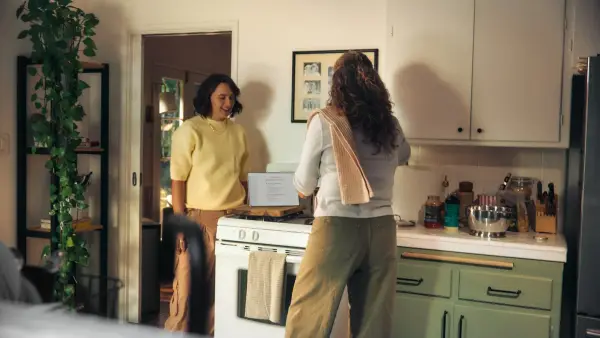
It happened on a Tuesday. My wife walked into the living room where I was reading, and she said four words: “We need to talk.”
And before she could say another syllable - before I knew whether this was about the gutters or the grandkids or what we were doing for Thanksgiving - my hands went cold. My stomach dropped the way it does when you miss a step on the stairs. Something in my chest pulled tight, like a rope being yanked from the inside.
She wanted to talk about replacing the washing machine.
That was it. A broken spin cycle. A trip to Lowe’s. And there I was, sitting in the chair with my pulse hammering, my jaw clenched, already composing some kind of defense for a trial that was never going to happen.
I am 57 years old. I have been married for 31 years to a woman who has never once used those words to deliver a catastrophe. And yet every single time she says them, my body responds as though I am about to lose something I cannot get back.
It took me most of my adult life to understand why. And when I finally did, the answer had nothing to do with my marriage at all.
The four words that rewired a boy’s nervous system
When I was eleven, “we need to talk” meant my father was leaving. Not the first time - the last time. The time he actually packed the brown suitcase and didn’t come back for it.
Before that, those same four words had meant my mother was going to tell me about another move, another school, another neighborhood where I would have to start over. They meant someone was sick. They meant money was gone. They meant the version of normal I had just gotten used to was about to be dismantled.
I never heard “we need to talk” followed by good news. Not once. Not in my entire childhood.
And here is what nobody tells you about growing up in a house like that: your body keeps score long after your mind has moved on. You can build a beautiful life. You can marry someone steady and kind. You can live in the same house for two decades and never once face the kind of chaos you grew up in.
But the boy is still in there. And he still flinches at the opening notes of a song he heard too many times.
Your body hears the sentence before you do
There is real science behind this, and understanding it changed how I think about myself.
A 2005 study published in Psychological Science found that the human brain can process emotionally charged language in as little as 200 milliseconds - faster than conscious thought. Your amygdala, the part of your brain responsible for threat detection, reacts to certain word patterns before your prefrontal cortex has time to evaluate context.
What that means in plain terms is this: when my wife says “we need to talk,” my body has already decided what those words mean before my mind has a chance to remind me that I am safe. That I am home. That nobody is leaving.
Bessel van der Kolk, the trauma researcher who wrote The Body Keeps the Score, describes this as the body’s tendency to respond to the past as though it is still happening. Not because we are broken. Not because we are weak. But because we were children once, and children are magnificent learners. They learn what sounds precede danger the way animals learn what rustling in the grass precedes a predator.
The problem is that the lesson never expires. Your nervous system does not update its files automatically. It does not check whether the person saying those words now is the same person who said them then.
Forty years of bracing for impact
If you grew up in a home where language was unpredictable - where tone shifts were weather systems you had to track for survival - then you know what I am about to describe.
You learned to read rooms before you learned to read books. You learned that silence could be a weapon. You learned that certain phrases, certain throat-clearings, certain shifts in how someone said your name were early warning systems for something bad.
And you carried those systems into adulthood like invisible luggage.
I spent decades thinking I was just “not great at difficult conversations.” That I was avoidant. That I was the kind of man who shut down when things got real. My wife thought so too, for a while. She would say “we need to talk” and I would nod, but she could see it - the way my face went neutral, the way I crossed my arms, the way I became someone slightly less present in the room.
She once told me it felt like I left. Like she was sitting across from a man who had already decided this conversation was going to end badly, and no amount of kindness on her part could change the verdict my body had already delivered.
She was right. But the verdict was never about her.
A 2019 study in Frontiers in Psychology examined how early relational trauma shapes what researchers call “implicit memory” - the body’s unconscious record of experiences that never gets filed into narrative. It found that adults who experienced unpredictable emotional environments in childhood showed heightened physiological responses to neutral social cues that resembled the structure of past threats.
In other words, my body was not reacting to my wife. It was reacting to a pattern. A four-word pattern that a boy recorded as meaning: something you love is about to be taken away.
The cruelest part is what it costs the people who love you
Here is what I wish I had understood twenty years ago: the people closest to you pay a tax for the lessons you learned before you met them.
My wife spent years softening her language, choosing her moments, tiptoeing around a phrase that should be the most ordinary thing in a marriage. She learned not to say it at night. She learned to open with “it’s nothing bad” - a preamble she should never have needed.
She was accommodating a wound she did not cause. And she did it quietly, without resentment, because she loved a man whose body still carried the architectural plans of a house that fell down when he was eleven.
That is the cost nobody talks about. Not just what it does to you - but what it asks of the person who chose you. The emotional labor of loving someone whose nervous system is still running old code.
And if you are that person - if you are the one who flinches, the one who braces, the one whose body goes cold at a phrase your partner uses to mean “I want to be closer to you” - I want you to know something.
You are not broken. You are not avoidant. You are not bad at love.
You are someone who learned, at an age when you had no choice, that words could be the sound a life makes just before it splits open. And your body, in its clumsy and devoted way, has been trying to protect you ever since.
Learning to hear the sentence differently
I started therapy at 54. Late, I know. But some of us take the scenic route to self-awareness.
My therapist introduced me to something called “neuroception” - a term coined by Stephen Porges in his polyvagal theory. It describes the way your nervous system evaluates safety and threat below the level of conscious awareness. Not perception - neuroception. Your body deciding whether you are safe before you have a single thought about it.
What that meant for me was simple and staggering: the cold feeling was not a choice. I was not choosing to shut down. My nervous system was making a decision on my behalf, based on data it collected when I was a child. Data that was accurate then. Data that had no business running the show in a kitchen with good lighting and a woman who wanted to talk about the washing machine.
The work - and it is work - is not about silencing that response. You cannot will your amygdala into retirement. The work is about building a new layer on top of the old one. Teaching your body, slowly and with patience, that “we need to talk” can also mean: I trust you enough to figure this out together.
It does not happen overnight. Some Tuesdays, my hands still go cold.
But now I can name it. I can feel the chill start in my fingertips and say to myself, with something close to tenderness: that is the boy. He heard the words. He is doing his job. But we are safe here.
And then I stay in the room.
What the boy needed to hear
If you are reading this and something in your chest is tightening - if you recognize the cold hands, the dropped stomach, the way your body has been answering a question nobody asked - then I want to say this to you directly.
The phrases that frightened you as a child were not your fault. The fact that your body still responds to them is not a flaw in your character. It is evidence that you survived something, and that the part of you responsible for keeping you alive took its job very seriously.
You are allowed to be fifty, or sixty, or seventy, and still be startled by a sentence that hurt you when you were eleven. There is no age at which you are supposed to have outgrown the body’s memory. There is only the slow, generous work of teaching yourself that the words mean something different now.
My wife said “we need to talk” last Thursday. I felt the cold start. I felt the boy stand up inside my chest, scanning for exits, preparing for something to fall.
And then I looked at her. Really looked. And I said, “Okay. I’m here.”
She wanted to talk about whether we should get a dog.
We are getting the dog.