He is 57 and has just realized that the reason he retells the entire plot of every movie, documentary, and podcast episode to his wife - including the parts that did not work and the scene that reminded him of something he cannot quite name - is not because he thinks she wants a two-hour summary delivered in eleven minutes standing in the kitchen but because a boy whose father never once asked 'what happened today' learned that experience does not become real until someone else has received the full account, and the man at fifty-seven narrating a film to a woman loading the dishwasher is not boring her but filing the only report that makes the hours he spent alone count as time that actually happened

The Scene That Made Me See It
I caught myself doing it again last Thursday.
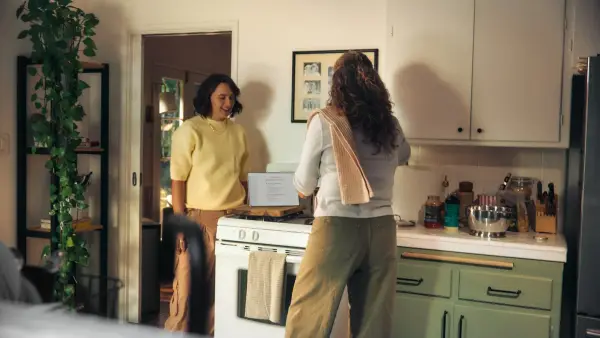
Standing in the kitchen, still wearing the jacket I had not bothered to take off, describing a documentary about deep-sea welders to my wife while she loaded the dishwasher. Not summarizing it. Describing it. The opening shot of the platform at dawn. The face of the diver who said something about pressure that I could not stop thinking about. The part in the second act where the music changed and I leaned forward on the couch without realizing I had moved.
She was rinsing a plate. She said “mm-hmm” in the way she does when she is listening with one ear and loving me with the other. And somewhere around minute nine of my eleven-minute reconstruction of a ninety-minute film, I heard myself and thought - why am I doing this.
Not why am I talking. Why do I need her to have this. Why does the documentary not feel like it happened to me until she has the whole thing, scene by scene, in her hands.
I am fifty-seven years old. I have been doing this for the entire length of our marriage. And I just realized what I am actually doing.
The Boy Whose Day Was Never Requested
My father was not a bad man. He was a quiet one.
He came home from work at the same time every evening, hung his jacket on the same hook, sat in the same chair, and opened the newspaper with the particular efficiency of a man who had already used all his words for the day. He was not cold. He was finished.
I do not remember him ever asking me what happened at school. Not once. Not in the way that invites a story. He asked if I had done my homework. He asked if I had mowed the lawn. He asked functional questions that required functional answers. Yes. No. Almost.
My day - the parts that were confusing or funny or strange - had nowhere to go. I would come home with something I had seen or heard or felt, and there was no one standing at the door of my experience waiting to receive it. Not because they were cruel. Because it never occurred to anyone that a boy’s interior life was a thing that needed to be witnessed.
A child in that house learns something specific. He learns that experience is solitary until proven otherwise. That the thing that happened to you in the afternoon did not fully happen if no one heard about it by evening. And when you grow up carrying that lesson in your body, you start looking - without knowing you are looking - for the person who will finally take the report.
What the Research Says About Narration and Belonging
This is not a quirk. There is real science behind it.
A 2020 study published in the Journal of Social and Personal Relationships found that the act of narrating personal experiences to an intimate partner serves a critical function beyond simple information transfer. The researchers called it “capitalization” - the process by which positive experiences become psychologically real through the act of sharing them with someone who responds actively. When the listener engaged - even minimally - the narrator reported the experience as more significant, more memorable, and more emotionally integrated.
In other words, the telling is not a review. It is the event becoming real.
Gabor Mate has written extensively about how children who grow up in emotionally under-responsive environments develop what he calls a “witnessing deficit” - a chronic, low-grade sense that their internal experience is not quite real because it was never reflected back to them. The adult version of this is not dramatic. It does not look like a wound. It looks like a man standing in his kitchen on a Thursday night telling his wife about a documentary she will never watch.
A 2018 study in Psychological Science found that autobiographical memory consolidation - the process by which experiences move from short-term into long-term storage - is significantly enhanced when the experience is narrated aloud to another person within hours of occurring. The act of putting the experience into language, of structuring it into a beginning and middle and end for someone else’s benefit, physically strengthens the neural pathways that store it.
The man who retells every film is not wasting his wife’s time. He is making sure the afternoon actually happened.
The Eleven-Minute Summary
Here is what it looks like from the outside, and I know because I have watched my wife’s face during these performances.
I start with the setup. I always start with the setup. “There’s this documentary” or “I watched something last night” or “you would have liked this one” - which is a generous claim, because she would not have liked it, and we both know that, but the sentence is not really about her preferences. It is about securing permission to begin.
Then I walk her through it. Not in order, usually. I start with the part that stayed with me and work backward to explain why it mattered. I describe the cinematography even though I do not know the word for what I am describing. I do the voices sometimes. I pause at the part I am still thinking about and say something like “and this is the thing” before delivering the insight that the documentary already delivered better than I ever could.
She listens. She asks a question sometimes - not about the film, but about me. “Why did that part get you?” And when she does that, something in my chest releases that I did not know was holding.
Because the question my father never asked - what happened today - is the question she just answered without either of us naming it.
What She Probably Already Knows
I think my wife figured this out before I did.
I think she knows that when I stand in the kitchen and reconstruct a film I watched alone on the couch while she was upstairs reading, I am not performing a review. I am handing her the hours. I am saying - here is where I was while you were somewhere else. Here is what happened to me in the time between us. Here is the proof that I was still a person with a working mind and a beating heart even when you were not in the room.
Dr. John Gottman, who spent decades studying what makes marriages survive, identified what he calls “turning toward” - the small, almost invisible moments when one partner makes a bid for connection and the other responds. A bid can be as small as a sigh, a comment about the weather, a question about dinner. Most people think the big gestures hold a marriage together. Gottman found it was these. The tiny offerings. The “look at this.” The “listen to what happened.”
Every time I stand in that kitchen and narrate a film, I am making a bid. I am turning toward. And every time she says “mm-hmm” or “and then what happened” or even just keeps loading the dishwasher without leaving the room, she is answering the question a boy stopped asking forty-five years ago.
She is saying: I am here. Tell me everything.
The Report That Was Always Due
I am not going to stop doing this.
I know it is probably too long. I know she does not need all eleven minutes. I know I could say “I watched a good documentary about deep-sea welding” and she would nod and that could be the end of it.
But the boy in me - the one who came home from school with a strange feeling about something a teacher said, who carried it around all afternoon waiting for someone to ask, who eventually stopped carrying it because the weight of holding an unreceived story is its own kind of loneliness - that boy is not finished yet.
If you are the man who does this - who narrates movies, who recaps podcasts during dinner, who describes the thing you read online with more detail than anyone requested - I want you to know what you are actually doing. You are not boring anyone. You are not bad at reading social cues. You are not failing to understand that she does not need a scene-by-scene reconstruction.
You are filing a report. You are submitting evidence. You are standing in front of the only person whose attention ever made the world feel solid and saying - this happened to me today and I need you to hold it because I was never taught how to hold it alone.
And if she is still standing there - if she is still loading the dishwasher, still saying “mm-hmm,” still asking “and then what” - then the report has been received. The experience is real. The afternoon counted.
You were witnessed. And the boy who was never asked about his day just got his answer, forty-five years late, in a kitchen that smells like dish soap and the particular warmth of someone who has decided, again, to stay in the room.