He's 59 and has just realized that every time his wife asks 'what are you thinking about' he says 'nothing' - not because he is hiding something or feeling empty but because what he is actually thinking about is whether they have enough saved if one of them gets sick, whether the sound the furnace made this morning is the kind that costs three hundred dollars or the kind that costs three thousand, whether his daughter's boyfriend looks at her the way she deserves to be looked at, and whether the heaviness in his chest at the top of the stairs is something he should mention to someone, and the reason he says 'nothing' is that a boy whose father answered every question with 'nothing to worry about' learned that a man's job is to carry the full weight of the worry so the room never has to feel it
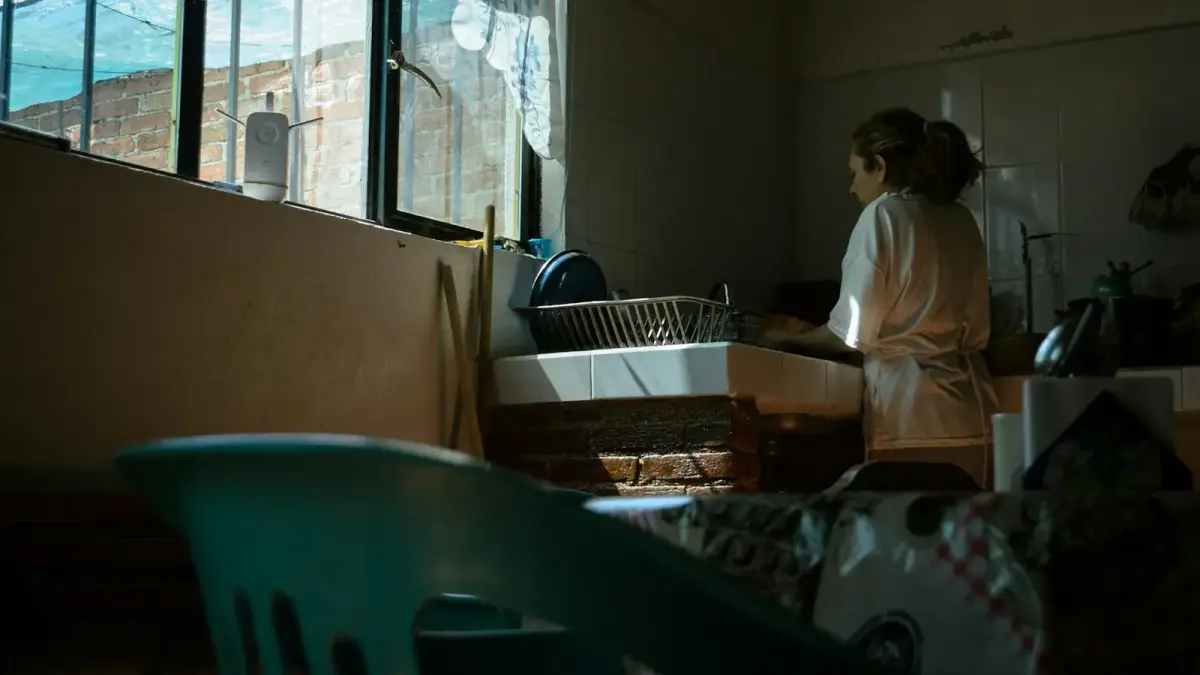
I was standing at the kitchen sink last Tuesday, hands in warm water, staring at the backyard through a window I’ve looked through ten thousand times. My wife walked up behind me and put her hand on my shoulder.
“What are you thinking about?”
“Nothing,” I said.
She nodded. Walked away. And something about the softness of the way she accepted that answer - like she’d stopped expecting a different one years ago - made me stand there a full minute longer, trying to figure out why I’d just lied to the person I trust most in this world.
Because it wasn’t nothing. It has never been nothing. Not once in thirty-two years of marriage has the answer actually been nothing.
What “nothing” is actually holding
Here is what I was thinking about at that sink, with my hands in dish soap and my wife’s warmth still on my shoulder.
I was thinking about our savings account. Specifically, whether the number in it would survive six months of one of us not working. I was doing the math the way I always do - silently, without a calculator, rounding up on expenses and rounding down on income because that’s the only way the math feels honest.
I was thinking about the furnace. It made a sound that morning - a low thud followed by a rattle - and I was trying to decide if that was the three-hundred-dollar kind of sound or the three-thousand-dollar kind. I was also thinking about whether I could fix it myself, and whether trying to fix it myself at fifty-nine was the kind of stubbornness that saves money or the kind that lands you in the emergency room.
I was thinking about my daughter’s boyfriend. Not whether I like him. I like him fine. I was thinking about whether he looks at her the way she deserves to be looked at - the way I looked at her mother when we were that age and I didn’t know yet how much weight a look like that was promising to carry.
And I was thinking about the heaviness in my chest at the top of the stairs. The one that showed up about four months ago and hasn’t left. The one I haven’t mentioned to anyone.
All of that was “nothing.”
The inheritance of silence
I learned this from my father. Not through a conversation - my father and I never had the kind of conversations where someone teaches you something on purpose. I learned it the way sons learn most things from their fathers: by watching.
My dad was a worrier. I know that now. I didn’t know it then because he never once let the worry show on his face. When my mother asked him what was wrong, he’d say “nothing to worry about” - and the emphasis was always on the second half. Not “nothing’s wrong” but “nothing for you to worry about.” The worry existed. It was just his to carry.
A 2015 study published in the Journal of Counseling Psychology found that men who grew up with emotionally restrictive fathers were significantly more likely to develop alexithymia - a clinical term for the inability to identify and describe your own emotions. Not the inability to feel them. The inability to name them.
I don’t think my father couldn’t feel. I think he felt everything. I think he lay awake at night running the same inventory I run - the money, the house, the kids, the body that’s starting to send messages he doesn’t want to read. I think he carried it all in a word designed to sound empty so the room could stay light.
And I think he taught me, without ever meaning to, that this is what love looks like when you’re a man. You hold the weight. You keep the room safe. You say “nothing” and you mean “everything, but none of it is yours to carry.”
The vocabulary of one word
Here is something I’ve been sitting with lately. I have a rich inner life. I think constantly. I worry with a specificity and creativity that would be impressive if it weren’t so exhausting. I can lie in bed and construct an entire catastrophe - from the first phone call to the funeral arrangements - in the time it takes my wife to fall asleep beside me.
But when someone asks me to put any of it into words, I have exactly one: nothing.
It’s not that I don’t want to share. It’s that the pathway between what I feel and what I can say out loud has been so neglected for so long that it barely functions anymore. It’s like a road that was paved once, fifty years ago, and nobody has driven on it since.
Psychologist Dan Kindlon, who spent years studying the emotional development of boys, described this as a kind of emotional illiteracy - not a deficit of feeling but a deficit of language. Boys are taught to act, not to narrate. To fix, not to describe. And by the time they’re men, they’ve built entire emotional lives with no vocabulary to report on them.
I can tell you exactly what’s wrong with the furnace. I can describe the sound, locate it in the ductwork, estimate the repair cost within a hundred dollars. But ask me what I feel about the fact that my body is fifty-nine and making sounds I don’t recognize, and I will look at you like you’ve asked me to speak a language I studied once in high school and forgot entirely.
The weight he never puts down
There’s a particular kind of exhaustion that comes from carrying worry you never share. It’s not dramatic. It doesn’t look like burnout or breakdown. It looks like a man who falls asleep in his recliner at eight-thirty. It looks like someone who goes quiet at dinner. It looks like a guy who seems fine - always fine - and whose wife has started to wonder if he’s even in there anymore.
He’s in there. He’s in there running calculations.
A 2019 study in Frontiers in Psychology found that men who engaged in high levels of unexpressed emotional labor - worrying about family finances, children’s wellbeing, household logistics - without verbalizing it showed significantly elevated cortisol levels compared to men who shared their concerns with partners. The worry wasn’t reduced by silence. It was compounded by it.
I think about this sometimes. The fact that my silence isn’t protecting anyone. That my wife doesn’t feel reassured by “nothing” - she feels shut out. That my daughter doesn’t see a strong father when I refuse to name what’s bothering me - she sees a man she can’t reach. That the weight I’m carrying doesn’t get lighter because I carry it alone. It just presses down on a body that’s already trying to tell me something at the top of the stairs.
But knowing this and changing it are two very different things when you are fifty-nine years old and the only emotional tool you were ever handed was a single word that means “I love you too much to make you carry this.”
The three-hundred-dollar furnace and the three-thousand-dollar heart
My wife asked me once - maybe ten years ago, during an argument that had gotten quiet the way our arguments do, not loud - whether I trusted her.
“Of course I trust you,” I said.
“Then why won’t you ever tell me what’s going on in your head?”
I didn’t have an answer. I still don’t, not really. Because it was never about trust. It was about role. Somewhere deep in the architecture of who I was taught to be, there’s a load-bearing wall that says: the people you love should never have to feel the weight you feel. Your job is to hold the ceiling up. Their job is to live beneath it without ever knowing it’s heavy.
That’s not emotional unavailability. That’s a man doing the only version of love he was ever shown.
Adam Grant once wrote about the difference between suffering in silence and suffering alone - how the first feels like sacrifice and the second is just isolation wearing a noble mask. I read that on my phone in the bathroom, sitting on the edge of the tub, and I sat there for a long time afterward because he’d described something I’d been doing for thirty years without ever having a name for it.
The furnace, by the way, was the three-hundred-dollar kind. I fixed it on a Saturday. My wife never knew it was broken.
And the heaviness in my chest - I made the appointment. I haven’t told her yet. I’m still deciding how to say it without making her worry.
Which is, of course, the whole problem. I’m so practiced at carrying the worry that even the worry about my own heart becomes something I try to carry alone.
What I am learning at fifty-nine
I am not going to tell you I’ve figured this out. I haven’t. I am fifty-nine years old and I am still, most nights, lying beside a woman I adore and answering her questions with a word that contains everything and communicates nothing.
But I am starting to notice it. That’s new. For most of my life, “nothing” didn’t feel like a choice - it felt like the only available response, the way breathing doesn’t feel like a choice. You just do it. Now I catch myself saying it and there’s a half-second pause where I can feel the other words - the real ones - sitting right behind my teeth, waiting.
I haven’t let them out yet. Not all of them. But last week, when my wife asked what I was thinking about, I said, “The furnace. And some other stuff.”
She looked at me. Really looked at me. And said, “What other stuff?”
And I said, “I don’t know how to say it yet. But I’m working on it.”
She took my hand. She didn’t push. And something in my chest - not the heaviness, something else, something lighter - shifted just enough for me to feel it.
I don’t think the goal is to suddenly become someone who narrates his inner life in real time. I’m fifty-nine. The road between what I feel and what I say is going to take more than one conversation to repave.
But I think the goal might be smaller than I thought. Not eloquence. Not vulnerability performances. Just one true sentence when she asks.
Not “nothing.” Not even “everything.” Maybe just: “I’m worried about a few things, and I’d like to tell you about one of them.”
That’s a start. That’s a man putting down one small piece of the weight and trusting that the room can hold it.
That’s a man learning, at fifty-nine, that “nothing” was never the answer. It was just the only word he had. And he’s finally, quietly, looking for another one.