He is 63 and just realized he has kept every tool his father ever owned in a box in the garage - the rusted pliers, the cracked level, the tape measure with the broken clip that has not measured anything since 1987 - not because any of them still work but because a boy who never once heard his father say the words I love you learned to find those words in the things his father's hands had touched, and a man who opens that box twice a year and holds a wrench that has not turned a bolt in thirty years is not being sentimental but visiting the only language his father ever spoke
The Box That Nobody Talks About
There is a cardboard box on a shelf in my garage that I have moved to six different houses over forty years.
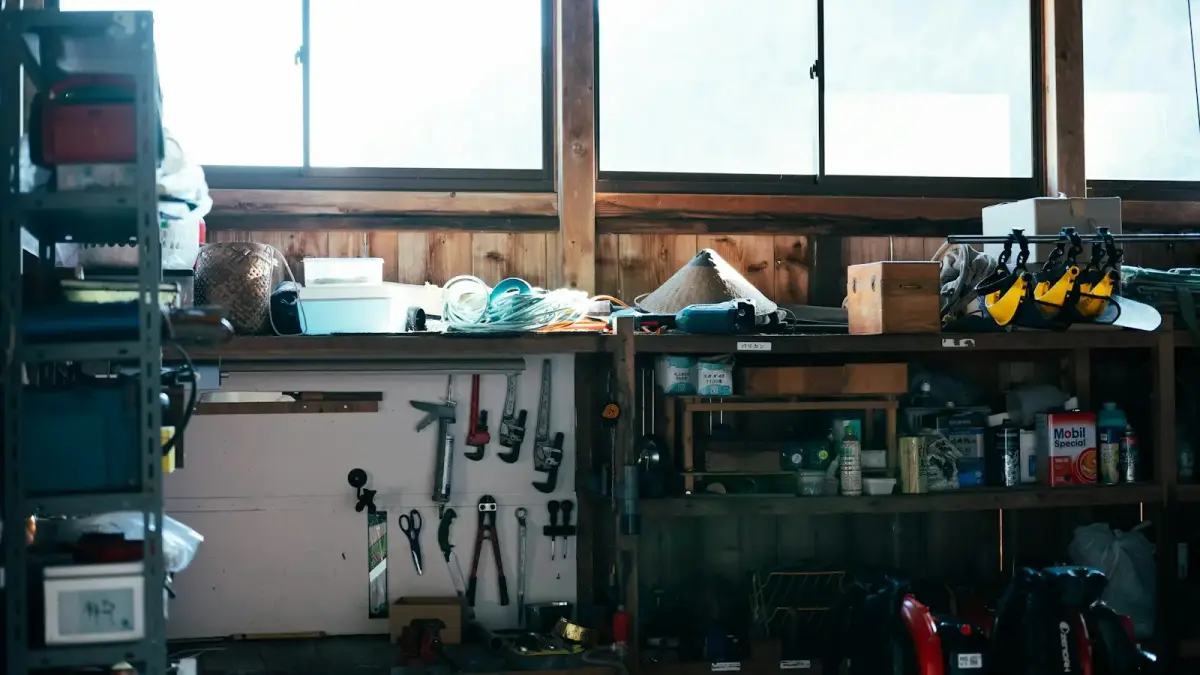
It weighs maybe fifteen pounds. The flaps don’t close anymore because the cardboard has softened with age, gone the color of weak tea. Inside, wrapped in nothing - just tossed in the way he would have tossed them - are my father’s tools.
A pair of pliers with rust blooming along the jaw. A tape measure whose clip snapped off sometime during the Reagan administration. A cracked torpedo level that hasn’t been true since before I graduated high school. A flathead screwdriver with a handle worn smooth by a palm that is no longer here.
None of them work. I own better versions of every single one. I have a garage full of tools that actually function, organized on a pegboard like a man who has his life together. And yet this box - this soft, sagging, unremarkable box - has survived every move, every purge, every Saturday where my wife suggested we clear out the things we don’t use anymore.
I don’t use any of them. I use all of them.
I just didn’t understand what I was using them for until last winter, when my son watched me open the box and asked why I was holding a wrench and not doing anything with it.
The Dictionary He Never Owned
My father was not a cruel man. I want to say that first because when you start talking about what a man didn’t give you, people assume he was terrible. He wasn’t. He was present. He showed up to every school event, drove me to practice, built me a treehouse that still stands in someone else’s yard.
He just didn’t have the words.
Not in the way people say that now - casually, almost fashionably, as if emotional unavailability is a personality quirk you mention on a podcast. My father didn’t have the words the way a person doesn’t have a limb. The language of tenderness had been amputated from him before he was old enough to know he needed it.
His father hadn’t said it. His grandfather hadn’t said it. The men in our family passed down hammers and silence in equal measure, and both were considered essential equipment for surviving a life that didn’t ask how you felt about it.
A 2019 study published in the Journal of Family Psychology found that fathers who grew up in households with low emotional expressiveness were significantly more likely to communicate care through instrumental support - fixing things, providing resources, showing up physically - rather than verbal affection. The researchers called it “enacted love.” My father would have just called it being a dad.
He said “I love you” with a flashlight held steady while I looked under the hood. With a level pressed against the shelf I was trying to hang. With a pair of pliers handed to me without a word, just the quiet assumption that I would know what to do with them.
And I did know. Eventually.
What Gets Inherited Besides Eye Color
When my father died, nobody fought over the tools. My sister took the photographs. My mother kept the furniture. I took a cardboard box out of his workshop and put it in my trunk and didn’t tell anyone because I didn’t know how to explain that I was taking home a box of broken things.
But here is what I have come to understand about inheritance: we don’t just inherit objects. We inherit the emotional architecture of the people who owned them.
I inherited my father’s hands - the square fingers, the thick knuckles. But I also inherited his belief that love is something you demonstrate with those hands, not something you say with your mouth. That tenderness is not a feeling you express but a shelf you hang level, a faucet you fix before anyone asks, a car you winterize because someone you love drives it and you cannot say the thing so you do the thing instead.
Psychologist Dr. Gabor Mate has written extensively about how children don’t just learn behaviors from their parents - they absorb entire emotional operating systems. The child doesn’t decide to become emotionally restricted. The child simply learns that love arrives in a specific container, and then spends the rest of their life looking for that container everywhere.
My container was a toolbox.
For decades I didn’t realize this. I just thought I was handy. I thought the reason I spent every Saturday fixing things around the house was because I was responsible. Practical. A man who takes care of his home.
It took me an embarrassingly long time to realize I was speaking a language I never chose to learn.
The Rosetta Stone in the Garage
Here is the thing about those tools that nobody tells you.
They smell like him.
Not literally anymore - it’s been twenty-two years. But when I open that box, something happens in my chest that doesn’t have a name. A tightness that isn’t grief exactly, and isn’t joy exactly, but occupies the territory between those two countries that no one has ever bothered to map.
I pick up the cracked level and I can see his hands. Not in a sentimental, greeting-card way. I mean I can actually see his hands. The way the left one steadied the level against the wall while the right one held a pencil. The way he squinted at the bubble. The way he nodded, just once, when it was true.
He was telling me something every time he did that. He was saying: the world is full of things that aren’t straight, aren’t level, aren’t right. And a man picks up a tool and fixes what he can.
That was the entire philosophy. The whole emotional vocabulary. Everything he felt about me, about my mother, about his life - compressed into the act of making something work that had stopped working.
A 2021 study in Frontiers in Psychology examined what researchers called “object-mediated attachment” - the way certain physical objects become repositories for emotional bonds, particularly after loss. The study found that people who maintained strong attachments to a deceased loved one’s belongings weren’t stuck in grief. They were using the objects as what the researchers termed “continuing bonds” - ongoing emotional connections that helped them integrate the loss rather than simply recover from it.
I am not stuck. I am visiting.
The Language Barrier That Shaped a Generation
I don’t think my father was unusual. I think he was typical of a generation of working-class men who were handed a very specific emotional toolkit and told it was the only one that existed.
These were men who grew up in houses where the father left for work before sunrise and came home with his hands cut and his back aching and his love expressed entirely through the fact that he showed up again. And again. And again.
They watched their own fathers build porches and fix engines and replace roof shingles in the rain, and they understood - without anyone ever saying it - that this was what love looked like when you couldn’t afford to be soft.
Brene Brown has talked about how vulnerability requires a feeling of safety, and how many men - particularly men of a certain generation and class - never had access to that safety. Not because their lives were violent, necessarily, but because the culture they grew up in had an unspoken rule: your usefulness is your worth. Your hands are your heart. The things you build are the things you feel.
My father could fix anything in the house. He could not fix the distance between himself and the people he loved most. He could replace a broken hinge but he could not repair the hinge between his feelings and his voice.
And so he did what he could. He fixed the things. He showed up with the tools. He handed me the pliers and stood close enough that our shoulders almost touched, and that almost-touching was the most intimate gesture he knew how to make.
What My Son Asked Me
Last winter, I was in the garage. The box was open. I was holding the wrench - the one with the slightly bent handle, the one that doesn’t fit any bolt in my house or anyone else’s house.
My son walked in. He’s thirty-one. He’s a therapist, which is the kind of irony that life specializes in.
He asked me what I was doing.
I said nothing. I said I was just looking through some old stuff.
He looked at the wrench in my hand and asked if it was my dad’s. I said yes. He asked if it still worked. I said no. He asked why I kept it.
And for the first time in my life, I found the words my father never had.
I told him that his grandfather never told me he loved me. Not once, not ever, not on my wedding day, not when my children were born, not in the hospital at the end. And I told him that for a long time I thought that meant something was missing. That there was a hole in my childhood shaped like three words.
But holding this wrench, I told him, I don’t feel a hole. I feel his hand.
My son was quiet for a long time. Then he said something that undid me. He said, “Dad, you know you do the same thing, right? You fix everything. You show up with tools. You’ve never once just said you were scared or sad. You just go build something.”
He wasn’t being cruel. He was being precise.
The Wrench That Turns Nothing and Holds Everything
I am sixty-three years old, and I am only now learning that keeping a box of broken tools in my garage for four decades is not a failure to let go. It is a fluency.
I speak my father’s language. I didn’t choose it. I didn’t study it. I absorbed it the way you absorb your mother tongue - through proximity, repetition, and the desperate childhood need to understand what the people you love are trying to say.
The tools are my Rosetta Stone. They translate a silence that could have felt like absence into something that feels like presence. Every time I pick up that cracked level, I am hearing my father say the thing he could never say. And every time I put it back in the box, I am saying it back.
A 2023 study in the Journal of Personality and Social Psychology found that adults who had experienced low verbal affection in childhood but high instrumental care - acts of service, physical provision, practical support - reported relationship satisfaction levels comparable to those who received verbal affection. The love arrived. It just arrived in a different vehicle.
My father’s vehicle was a 1978 Craftsman toolbox. And every implement inside it was a sentence he completed with his hands instead of his mouth.
I have started telling my son I love him. Out loud, with words, on the phone, at the end of every visit. It feels foreign in my mouth, like speaking a second language I learned too late to ever sound native.
But I am also keeping the tools. Both things can be true. You can learn a new language and still cherish your first one. You can say the words and still feel them most deeply in the weight of a wrench that hasn’t turned a bolt since before your grandchildren were born.
The box stays. The tools stay. Not because I am stuck in the past, but because some translations are too important to throw away. Because a boy who learned to read love in the grain of a wooden handle and the rust on a pair of pliers grew into a man who understands something that words alone might never have taught him.
Love is not always a sound. Sometimes it is a weight in your hand. Sometimes it is a box you carry to every house you will ever live in. Sometimes it is the quiet way you open it twice a year and hold something broken and feel, for just a moment, completely whole.