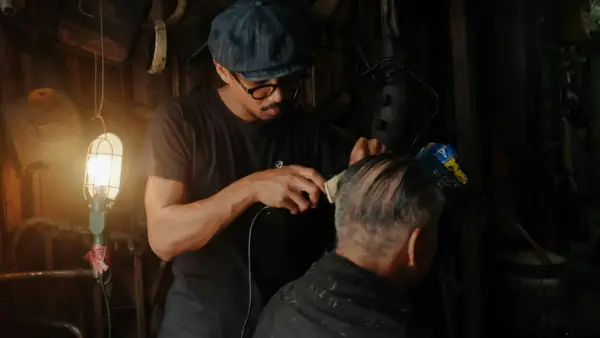
He's 63 and can name every component under the hood of a 1987 Ford pickup - alternator, intake manifold, timing belt, EGR valve, catalytic converter - but has never once found a word more precise than 'good' for what he feels when his wife laughs so hard she has to hold his arm, because the boy who watched his father describe engine trouble with the fluency of a poet and describe love with the vocabulary of a telegram learned that precision was for things, not people
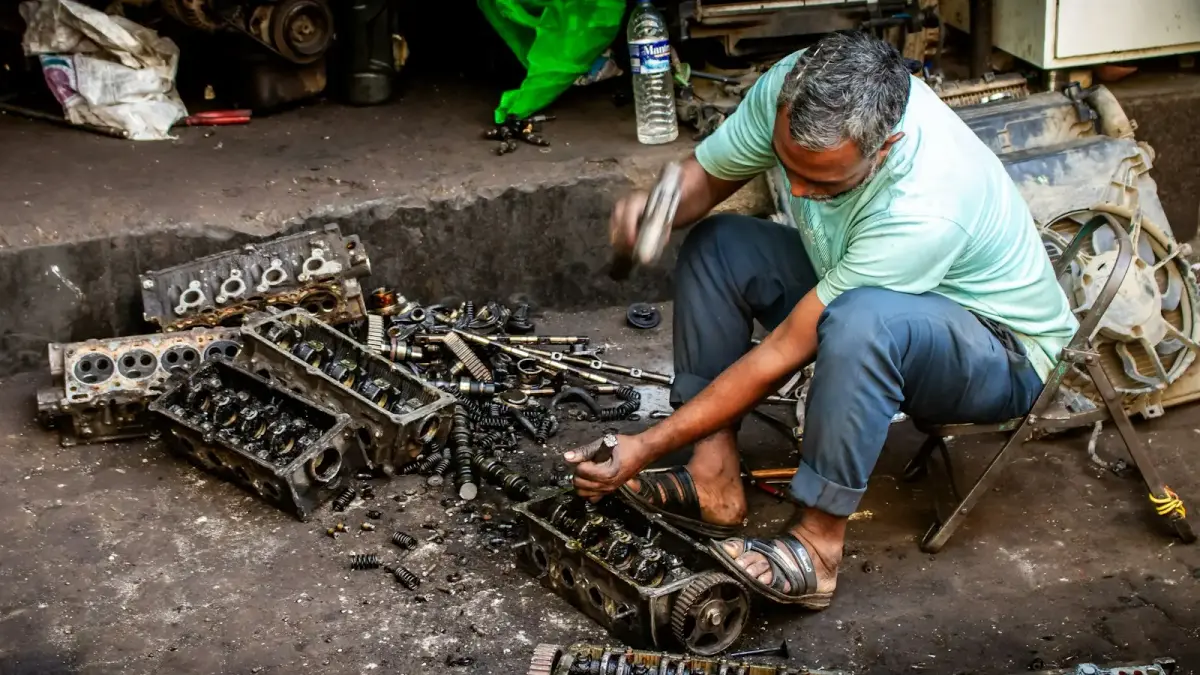
I was standing in my uncle’s garage when I was nine years old, watching him lean over the open hood of a Chevy C10 with a kind of reverence I’d only ever seen in church. He pointed to a cylindrical piece of metal and said, “That’s your alternator. Charges the battery while the engine runs. Without it, everything dies in about twenty minutes.” Then he touched a web of rubber hoses and named them like old friends - vacuum line, heater hose, fuel line, PCV valve.
I remember thinking he sounded like a doctor. Like every part mattered, and knowing its name was how you proved you cared.
That same summer, my grandmother asked him how he was doing after his best friend moved out of state. He said, “Fine.” She pressed. He said, “I’m good.” And that was the end of it.
Two vocabularies. One trained to surgical precision. The other barely surviving on life support.
The garage was a classroom nobody recognized
Men of a certain generation grew up bilingual in a way nobody talks about. There was the language of the physical world - engines, wiring, plumbing, woodwork - where precision was expected, rewarded, and passed down with patience. And there was the language of the inner world, where the entire curriculum was a single word repeated across decades: fine.
My father could hear a timing chain going bad from across a parking lot. He could tell you the difference between a misfire on cylinder three and a misfire on cylinder five by the rhythm of the idle alone. He spoke about mechanical systems the way poets speak about weather - with texture, with layers, with an ear for what most people miss.
But when my mother asked him what he was feeling after his own father died, he stood in the kitchen for a long time and finally said, “It’s rough.”
That was it. That was the entire eulogy his grief received from his own mouth.
Not because he didn’t feel it. I watched his hands shake when he thought nobody was looking. I watched him sit in the driveway for forty-five minutes with the engine off, just gripping the steering wheel. The feeling was enormous. The vocabulary for it was almost nonexistent.
Precision was taught, but only in one direction
Here’s what I’ve come to understand about the men I grew up around: they weren’t emotionally shallow. They were linguistically impoverished - but only in one specific domain. And that poverty wasn’t accidental. It was inherited.
A 2019 study published in the journal Emotion found that people who possess a richer emotional vocabulary - what researchers call “emotion granularity” - are better able to regulate their emotional experiences. They don’t feel less. They feel with more resolution. The difference between saying “I’m upset” and saying “I feel dismissed” is not cosmetic. It’s the difference between a blurry photograph and a sharp one. The feeling was always there. The focus wasn’t.
The men I knew growing up had extraordinary focus - for engines, for lumber grades, for soil composition, for the particular sound a drill bit makes when it’s about to snap. They were taught that the physical world deserved the dignity of accurate language.
Nobody extended that same courtesy to their inner world.
My father could distinguish between forty weight and thirty weight oil by rubbing it between his fingers. But the difference between loneliness and disappointment? Between resentment and exhaustion? Between love and habit? Those were all filed under the same word: “fine.”
The telegram generation
I call them the telegram generation - not because of their age, but because of the communication style they inherited. In a telegram, you pay by the word. You strip everything to the minimum. You say “ARRIVED SAFE” instead of “I was terrified the whole flight but the moment I saw the mountains from the window something in my chest released and I remembered why I used to believe the world was beautiful.”
The men in my family communicated their emotions like telegrams. Four words maximum. No adjectives. No texture.
“How was the funeral?” - “It was hard.”
“Do you love her?” - “Of course I do.”
“Are you happy?” - “I’m good.”
Each of those answers contains a real feeling. But the feeling arrives compressed, flattened, stripped of the very detail that would make it land in another person’s chest. And over time, the people who love these men stop asking. Not because they stop caring, but because four-word answers start to feel like locked doors.
Dr. Dan Siegel, a clinical professor of psychiatry at UCLA, developed the phrase “name it to tame it” to describe how labeling an emotion with precision actually reduces its neurological intensity. The amygdala calms when the prefrontal cortex can assign language to what’s happening. But what happens when a man was never given language precise enough to do the labeling?
He feels everything. He manages almost none of it. And he has no idea why his chest gets tight at family dinners or why he tears up during truck commercials but not at his daughter’s wedding.
What his wife hears vs. what he means
There’s a man I know - sixty-three, retired pipefitter, hands like old leather. His wife of thirty-eight years told me something once that I haven’t stopped thinking about.
She said, “When he says ‘that was nice,’ it could mean anything. It could mean the dinner was adequate. Or it could mean that watching our granddaughter fall asleep on his chest was the most sacred thing he’s experienced in five years. I’ve learned to watch his face instead of listen to his words, because his words are all the same.”
She wasn’t complaining. She was translating.
This is what so many partners of emotionally precise men - men who are precise about everything except emotion - learn to do. They become interpreters. They read the grip strength of a hug, the length of a silence, the way he lingers in a doorway after saying goodnight. They learn that “I’m fine” said while looking out the window means something entirely different from “I’m fine” said while making eye contact.
It works. Mostly. But there’s a loneliness in it that doesn’t get named either.
A 2021 study in the Journal of Social and Personal Relationships found that emotional disclosure - specifically the use of precise emotional language between partners - was one of the strongest predictors of relationship satisfaction over time. Not frequency of conversation. Not grand gestures. Precision. The willingness to say “I feel unseen” instead of “whatever” and “that hurt because it reminded me of something my father used to do” instead of “drop it.”
The men who can’t do this aren’t choosing silence. They’re reaching into a toolbox and finding it empty.
The inheritance nobody talks about
Here’s what I want to be careful about: this is not a piece about men failing. It’s about a curriculum that was never offered.
Think about what these men were taught. From the time they were small, the boys who would become the sixty-year-old men reading this were handed a very specific education. They learned that the physical world was worth describing with care. They learned the names of trees, tools, fish, engine parts, cloud formations, soil types, knot styles. They learned that when something broke, you diagnosed it with language before you fixed it with your hands.
But when they broke - when they were scared, or ashamed, or grieving, or overwhelmed - the diagnosis was always the same. “Tough it out.” “Walk it off.” “You’re fine.”
Researcher Brene Brown has written extensively about how shame operates differently in men, noting that for many men, the primary shame trigger is being perceived as weak. And what is more vulnerable than admitting you feel something you can’t even name? If you don’t have the word for it, you can’t shape it into something shareable. And if you can’t share it, it stays inside you - formless, heavy, expanding.
These men aren’t emotionally illiterate. They’re emotionally fluent in a language they were never taught to speak aloud.
The difference between capacity and vocabulary
I want to be very clear about something. The man who says “I’m good” when his wife’s laughter makes him feel like the whole world just tilted toward kindness - that man is not feeling less than the man who could articulate that sentence. He may be feeling more.
There is emerging research in affective neuroscience suggesting that unexpressed emotion doesn’t disappear. It intensifies. A 2020 study in Psychological Science found that suppressing emotional expression actually amplified the subjective experience of the emotion. The men who say the least may be feeling the most - carrying it in their shoulders, in their jaws, in the way they grip a steering wheel a little too tight on the way home from a family gathering they’ll later describe as “nice.”
The issue was never capacity. It was vocabulary.
And vocabulary is taught. It’s modeled. It’s practiced in safe spaces where a boy can say “I feel scared” and not be told to man up. Where a teenager can say “I think I’m lonely” and not be handed a football. Where a grown man can say “I don’t know what I’m feeling but it’s big and I need help describing it” and the room doesn’t empty.
Those spaces barely existed for the men who are sixty now. Some of those spaces barely exist today.
What I want to say to the man who calls everything good
If you’re reading this and you recognize yourself - the man with a thousand names for the parts of an engine and three words for the inside of his own chest - I want you to know something.
You are not broken. You were not given the tools.
The fact that you can hear a lifter tick at idle and diagnose a failing head gasket by the color of the exhaust means your brain is wired for precision. It means you are capable of extraordinary nuance. That capacity didn’t skip your emotional life. It was just never invited in.
And it’s not too late to start.
You don’t have to become someone who journals or meditates or talks about feelings in a circle. But the next time your wife laughs so hard she grabs your arm, and something moves in your chest that you’d normally file under “good” - pause. Stay there for a second. Ask yourself what the feeling actually is.
Maybe it’s gratitude. Maybe it’s relief. Maybe it’s the specific, irreplaceable sweetness of watching someone you’ve loved for decades still be surprised by joy. Maybe it’s the quiet terror of knowing this won’t last forever, mixed with the even quieter miracle of knowing it’s happening right now.
You have the precision. You always did. The engine was never the only thing worth naming.