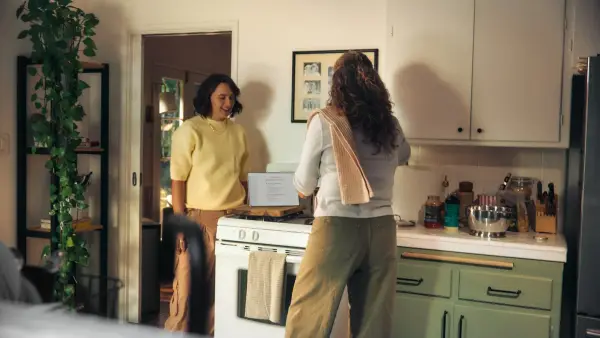
He is 63 and just realized he has never told his wife she is beautiful on a Tuesday - never on an ordinary morning when she is standing at the kitchen counter in the same shirt she slept in, never on a regular afternoon when she is reading on the couch with her glasses pushed up into her hair - because a boy who watched his father save every compliment for company learned that admiration was a performance you gave an audience, not a private truth you offered the person standing next to you in the quiet of your own kitchen

I was sitting at the table last Sunday morning, watching my wife pour coffee.
She was wearing that gray t-shirt she has had for years - the one with the faded logo from a 5K she walked with her sister in 2014. Her hair was pulled back in a way that was not a style, just convenience. She was not trying to look any particular way. She was just standing there, pouring coffee, humming something I could not quite place.
And the thought arrived before I could stop it: I have never told her she looks beautiful like this.
Not once. Not in thirty-seven years.
I have told her she looks beautiful plenty of times. On our wedding day. On anniversaries when she comes down the stairs in something new. At our daughter’s graduation, when she wore that blue dress and I said, “You look great.” At dinner parties. At funerals, even - I once told her she looked beautiful in black, which felt wrong the moment it left my mouth.
But I have never said it on a Tuesday. Never on a Thursday afternoon when she is reading on the couch with her glasses pushed up into her hair. Never in the kitchen on a morning that meant nothing, when she was just standing there being the person I chose to spend my life beside.
And I am sixty-three years old, and I just figured out why.
My Father Was Generous in Public
My father was not a cold man. I want to be clear about that, because when men my age start talking about their fathers, the story usually tilts toward absence or cruelty, and that was not my experience.
My father was present. He showed up. He coached my baseball team and fixed things around the house and drove my mother to every doctor’s appointment she ever had.
But there was a pattern I did not notice until last Sunday morning, standing in my own kitchen with my own coffee getting cold.
My father complimented my mother in front of other people.
At church, he would put his hand on her back and tell whoever was nearby, “Doesn’t she look wonderful today?” At family dinners, he would raise his glass and say something about how lucky he was. At parties, he was the man who bragged about his wife. People loved him for it. They told my mother she was lucky to have a husband who appreciated her so openly.
And she would smile in a way I now recognize as complicated.
Because at home - in the quiet kitchen on a Wednesday morning, in the living room on a Saturday afternoon when it was just the four of us - I cannot remember a single time he turned to her and said anything about how she looked. Not once. Not without an audience.
The Lesson I Did Not Know I Learned
Children do not learn what you teach them. They learn what you show them.
A 2019 study published in the Journal of Family Psychology found that children internalize not just the content of their parents’ emotional expression but the context - they learn when and where feelings are appropriate to display, and they carry those contextual rules into their own adult relationships with remarkable fidelity.
I carried my father’s rule without ever knowing it existed: admiration is something you perform. It requires an occasion. A reason. A witness.
Without those things, saying “you’re beautiful” feels exposed. It feels like you are standing in a room with no walls, offering something tender to a person who might not know what to do with it.
So you wait for the occasion. The birthday. The anniversary. The moment when the compliment has a context that makes it safe - when it is expected, when it fits, when no one will look at you strangely for saying something soft.
And the ordinary moments - the ones where she is just standing there being herself - those pass by in silence. Thousands of them. Tens of thousands. All those quiet mornings when the truest version of what you feel has no stage to stand on, so it stays in your chest and never makes it to your mouth.
What Silence Sounds Like After Thirty-Seven Years
Here is what I think happens when you only compliment someone on special occasions: they start to believe they are only beautiful on special occasions.
I do not know this for certain. I have not asked my wife, because I am still working up to the conversation, and because I am afraid of what she might confirm.
But I think about the way she deflects when I tell her she looks nice before we go out. “Oh, stop,” she says, adjusting her earring. Or, “I look tired.” Or she changes the subject entirely, as if the compliment is a small inconvenience she needs to move past before we can get to the car.
And I wonder if that deflection grew in the silence of all those ordinary mornings. If she learned, over three decades, that admiration was something that arrived with an event attached - and that without the event, she was just a woman in a kitchen, not worth remarking on.
Dr. John Gottman’s research on lasting marriages found that couples who maintain what he calls a “culture of appreciation” - small, frequent, unprompted expressions of admiration - are significantly more likely to remain satisfied in their relationships over time. The key word is unprompted. Not the toast at the anniversary dinner. The Tuesday morning observation that your partner’s eyes still do something to you.
I have been married for thirty-seven years, and I have never built that culture. Not because I do not feel it. Because I was never shown how.
The Difference Between Performing Love and Practicing It
There is a version of love that is essentially public relations. You manage the brand. You say the right things at the right times in front of the right people. You hold her hand at the restaurant. You post the anniversary photo. You give the toast.
And none of that is fake, exactly. You mean it when you say it. You feel it when you hold her hand. The performance is not dishonest - it is just incomplete.
Because the version of love that actually lands - the kind that makes a person feel known and not just appreciated - is the version that shows up without a reason.
It is the Tuesday morning comment. The “I like looking at you” that arrives while she is unloading the dishwasher. The “you’re beautiful” that has no occasion, no audience, no context except the private truth of what you feel when you see the person you have loved for longer than you have done almost anything else in your life.
That is the version I never learned. And I am sixty-three, and I am only now realizing that my wife has lived inside the gap between my public performance and my private silence for nearly four decades.
It Was Never About the Words
I want to be careful here, because I do not think this is just about compliments.
The compliment is the surface. Underneath it is something harder to name - a belief, inherited and unexamined, that tenderness requires justification. That you need a reason to be soft. That vulnerability in the absence of an occasion is just exposure.
A 2021 study in Psychological Science found that people consistently underestimate how much their unsolicited positive feedback means to others. We assume people know how we feel. We assume the feeling itself is enough. We convince ourselves that saying it out loud is unnecessary, redundant, maybe even awkward.
But the study found the opposite. Unexpected compliments - the ones that arrive without a reason - carry significantly more emotional weight than expected ones. They land harder because they are not attached to an obligation. They feel chosen.
My father’s compliments at dinner parties were lovely. But they were also safe. They arrived inside a social contract where saying nice things about your wife was part of the script.
The dangerous compliment - the one that costs something - is the one you give in the kitchen on a Wednesday when no one is watching and there is no script and you just have to stand there in the truth of what you feel and say it out loud to a woman in a faded t-shirt who might not even be expecting you to speak.
What I Am Learning at Sixty-Three
I said it yesterday.
Not perfectly. Not smoothly. She was sitting on the back porch with her book and a glass of iced tea, and her hair was doing that thing where it falls across her forehead when she leans forward, and I stood in the doorway for a moment and then said, “You look really beautiful right now.”
She looked up. She laughed a little - not meanly, just surprised. “What?” she said.
“Right now,” I said. “Just sitting there. You look beautiful.”
She stared at me for a few seconds. And then her face did something I do not have the vocabulary to describe. It was not a smile exactly. It was more like something softening behind her eyes, something that had been braced for a long time relaxing just slightly.
“Well,” she said. “Thank you.”
And then she went back to her book, and I went back inside, and the moment passed. But it did not disappear. I could feel it sitting in the house like a new piece of furniture - something unfamiliar taking up space in a room that had been arranged the same way for decades.
I am not telling this story because I think I fixed something. One sentence does not undo thirty-seven years of silence in the moments that mattered most.
But I am telling it because I think there are other men my age who learned the same lesson I did - that love is something you perform on occasions, not something you practice in ordinary moments. Men who feel things deeply and say them rarely. Men whose fathers were good men, generous men, men who loved their wives and never figured out how to show it when no one else was watching.
You are not broken for learning this. You were taught by people who were taught by people who were taught that tenderness had conditions.
But you are here now. And she is probably in the next room. And it is just a regular afternoon, and there is no occasion, and that is exactly why it would mean everything.
You do not need an audience for this.
You just need to open your mouth and say what has been true for years in the quiet of your own kitchen, on an ordinary day, to the person who has been standing next to you all along.