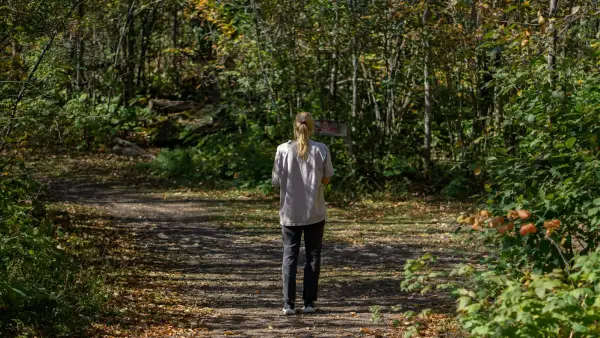
The empty chairs that made room for everything else
My oldest friend stopped calling me on a Tuesday in March, nine years ago.
There was no fight. No slammed door, no tearful phone call, no text that ended with “I think we need space.” Linda just - stopped. The weekly calls became biweekly, then monthly, then a birthday text with too many emojis and not enough words. By the following spring, I realized I hadn’t heard her voice since October. And by the summer after that, I’d stopped reaching for the phone to dial her number.
I grieved that friendship like a death. Because it was one. I spent the better part of a year replaying our last real conversation, looking for the fracture line, the thing I said or didn’t say that cracked us apart. I brought it to therapy. I brought it to my journal. I brought it to my husband at midnight, sitting up in bed, asking “What did I do wrong?” until he held my hand and said, gently, “Maybe you didn’t do anything wrong. Maybe it was just finished.”
I’m sixty-three now. And I can tell you that sentence - “Maybe it was just finished” - took me the better part of a decade to understand. Not intellectually. In my bones.
The mythology of forever
We are raised on a very specific lie about relationships, and it goes like this: the good ones last.
We say it at weddings. We embroider it on pillows. We evaluate our friendships by their duration as if length were a measure of depth. A forty-year friendship sounds impressive. A friendship that ended after twelve years sounds like a failure. We don’t ask what happened inside those years. We just count them.
I was a clinical psychologist for thirty-one years before I retired, and I cannot tell you how many clients sat across from me carrying the weight of a relationship that ended - not because it was toxic or abusive, but simply because it had run its natural course. They weren’t mourning the loss of something bad. They were mourning the loss of something that was once wonderful and had quietly become something else.
The developmental psychologist William Rawlins has studied friendship across the lifespan extensively. One of his findings is so simple it almost sounds obvious, but most of us live as if it isn’t true: friendships are inherently voluntary, and that voluntariness is what makes them meaningful - and also what makes them impermanent. Unlike family, which we’re born into, friendships exist only because both people keep choosing them. When one person stops choosing, the structure dissolves. Not because something went wrong. Because that’s how the structure works.
We know this. And we refuse to accept it.
The three chairs that emptied
Between fifty-four and sixty, I lost three significant relationships. Not to death, though death would have been easier to explain at dinner parties.
Linda, my college friend, who drifted in a direction I still can’t name. We’d been close for twenty-seven years. She moved to Sedona and started talking about energy healing and past-life regression, and I tried to follow her there - I really did. But eventually I was performing interest I didn’t feel, and she was performing patience with my skepticism, and we were two women acting instead of being.
My sister Margaret, who told me at Thanksgiving in 2019 that she’d been carrying resentment toward me for thirty years - about something I barely remembered. We tried to repair it. We went to a family therapist together. But the resentment had calcified into something she needed more than she needed the repair. She chose the story over the relationship. I had to let her.
And my colleague David, who I’d co-authored papers with for fifteen years. When I started shifting my clinical focus toward mindfulness-based approaches in my late fifties, he told me I was “going soft.” It was meant as a joke. It wasn’t a joke. The respect that had held us together had developed a crack, and neither of us could pretend it hadn’t.
Three people. Three empty chairs at the table of my life. And for several years, all I could see was the emptiness.
What grows in cleared ground
Here is what nobody tells you about loss that isn’t death: it leaves you with a terrible freedom.
When Linda left, my Saturday mornings opened up. For two decades, I’d spent them on the phone with her - two hours minimum, sometimes three. I didn’t know what to do with that time. The first few Saturdays, I wandered around my house like someone who’d forgotten what they came into the room for.
Then I started gardening.
That sounds small. It was the opposite of small. I bought a flat of herbs from the nursery on a Saturday in April because I needed something to do with my hands, and by June I had tomatoes coming in and basil on every windowsill and dirt permanently under my fingernails. I started waking up at six to check on things. I started talking to my plants the way I used to talk to Linda - telling them about my week, my worries, the dream I had about my dead father.
My garden didn’t drift away to Sedona. My garden just grew.
When Margaret and I stopped speaking, the holidays contracted. No more tense dinners, no more careful choreography of seating arrangements to keep her away from my husband, whom she’d never liked. That first Christmas without her was brutal and quiet and sad. The second one was smaller and warmer. My daughter made a pie. We played cards. Nobody performed. Nobody kept score.
Research by psychologist Terri Orbuch, who tracked couples and social networks over decades, found something that extends well beyond romantic relationships: the removal of a chronically stressful relationship produces measurable improvements in mental and physical health - often within the first year. It’s not that the loss doesn’t hurt. It’s that the body recognizes the absence of a particular kind of friction and begins, almost immediately, to heal.
I didn’t understand that at first. I thought I was just “getting used to it.” I wasn’t getting used to it. I was getting well.
The people who arrived
This is the part that still astonishes me.
Within two years of those three departures, my life filled with people I am certain I would never have met - or never have had room for - if those chairs had still been occupied.
My neighbor Grace, who is seventy-one and was a jazz singer in her twenties and now paints watercolors of birds she sees from her kitchen window. We walk together three mornings a week and talk about everything and nothing. She never knew me before my losses, so she doesn’t see me as someone diminished. She sees me as I am now, which is a gift so profound I still don’t have the right word for it.
A former student of mine, Priya, who reached out to me after I published a small essay about retirement and aging. She’s thirty-four, just starting her clinical career, and our conversations have the kind of intellectual electricity I used to have with David - except without the undercurrent of competition that I’d been calling respect for fifteen years.
And my husband. The same man I’d been married to for thirty-seven years. But different. Because when those other relationships fell away, I stopped distributing my attention across a dozen directions and started being present - actually present - with the person sitting across the breakfast table. We started cooking dinner together. We started having the kind of conversations we hadn’t had since our thirties. He said to me last year, “I feel like I got a second wife.” He meant it as a compliment. I took it as one.
The math we get wrong
Here is what I know at sixty-three that I did not know at fifty-three: we do the math wrong on relationships.
We count the people in our lives and call a higher number better. We treat each departure as subtraction. We say “I’ve lost” a friend, as if they slipped through a hole in our pocket, as if we were careless. The language of loss frames every ending as a failure of maintenance.
But what if some of those departures were the equivalent of pruning? Not amputation. Not damage. Just the natural process of removing what’s finished so that what’s still living can grow.
The psychologist Adam Grant has written about what he calls “languishing” - that gray space between depression and flourishing where you’re not suffering exactly, but you’re not thriving either. I think many of us languish inside relationships that have stopped growing. We stay because leaving feels like failure, and being left feels like rejection, and the idea that a relationship could simply be complete - the way a book is complete, the way a season is complete - doesn’t exist in our emotional vocabulary.
I’m not talking about giving up on people. I’m not talking about disposability or ghosting or the casual cruelty of treating human beings as interchangeable. I’m talking about the specific, painful, sacred process of recognizing that some connections have given you everything they were meant to give you. And that holding on past that point isn’t loyalty. It’s fear.
What I would tell her
If I could sit across from my fifty-four-year-old self - the one who was crying in her car after Linda’s number went to voicemail for the third time - I would not tell her it gets easier. Because that’s the wrong frame.
I would tell her it gets different. I would tell her that the emptiness she’s feeling is not a wound. It is a clearing. I would tell her that she is standing in a field that has just been harvested, and she thinks the field is ruined, but the field is resting. The field is getting ready.
I would tell her that the people who leave are not always running from you. Sometimes they are running toward something that has nothing to do with you. And sometimes - more often than we want to admit - they are giving you back to yourself.
I’m sixty-three. My life is smaller in some ways than it was at fifty. Fewer names in my phone. Fewer chairs at the table. But the chairs that remain hold people who are actually sitting in them. Not performing. Not keeping score. Not waiting for me to become someone I’m not.
My garden is blooming. My mornings are quiet. My husband and I had a conversation last night that lasted until midnight - about nothing important, about everything that matters.
The people who left took something with them. I won’t pretend they didn’t. But what they left behind was space. And I have spent the last nine years learning that space is not emptiness.
Space is where everything you didn’t know you wanted has room to arrive.