The most honest conversations in a long marriage do not happen face to face - they happen side by side, in the car on a night drive when nobody has to look at anyone, at the kitchen sink when one is washing and the other is drying, in bed in the dark when the only thing visible is the ceiling and the only thing audible is the truth, because two people who spent thirty years learning each other's defenses discovered that the fastest way past them was to stop standing in front of them

My parents had the best conversation of their forty-year marriage on a Tuesday night in November, driving home from a funeral. I know this because my father told me about it once, years later, in a tone I’d never heard him use before - quiet and almost reverent, like he was describing something sacred. He said they talked about things they’d never said out loud. About regret. About the years that felt wasted. About what they were still afraid of.
I asked him why that night. Why then, after four decades of sharing a house, a bed, a life.
He thought about it for a long time. Then he said something I’ve never forgotten: “Neither of us had to look at the other one’s face.”
He wasn’t being cold. He was being precise. He was telling me that the architecture of that moment - two people facing forward, eyes on the road, voices floating in the dark space between the dashboard and the windshield - made it possible to say things that a kitchen table and eye contact never could.
I’ve thought about that conversation for years. And the more I pay attention - to my own marriage, to the couples I talk to, to the research I keep stumbling across - the more I realize my father accidentally described one of the most important and least discussed dynamics in long-term intimacy.
The geometry of where your bodies are determines what your mouth is willing to say.
The architecture of safety
There’s a reason therapists sit across from you. That positioning is designed to create accountability - to make sure you can’t hide. Eye contact, in a clinical setting, is a tool. It says: I see you. You are witnessed. Now speak.
But in a marriage, being witnessed is often the problem.
When you sit across from the person who knows every version of you - the version who cried at the airport, the version who said something unforgivable in 2014, the version who quietly stopped trying for a while - eye contact doesn’t feel like witnessing. It feels like surveillance. It feels like being asked to perform honesty while simultaneously managing how your honesty lands on someone else’s face.
So you don’t say the thing. You say something adjacent to the thing. You sand down the edges so it won’t cut, and in doing so, you remove the part that mattered.
Side-by-side positioning changes the equation entirely. When you’re both facing the same direction - forward, outward, toward the road or the window or the dark ceiling - something shifts. The pressure to compose your face while composing your sentence disappears. You can say “I’ve been lonely” without watching your partner’s eyes fill with hurt. You can say “I don’t know if I’m happy” without seeing the flinch.
The words travel into the shared space between you rather than landing directly on another person’s body. And that tiny spatial difference is the difference between a confession and a confrontation.
Why men open up in cars
If you’ve ever wondered why the most emotionally revealing thing a man in your life has ever said came from the driver’s seat of a moving vehicle, you’re not imagining a pattern. There is real science behind this.
A 2018 study published in the Journal of Research in Personality examined how physical positioning influenced self-disclosure in male friendships. The researchers found that men consistently reported higher comfort with emotional vulnerability during side-by-side activities - walking, driving, watching something together - than during face-to-face interactions. The effect was significant and consistent across age groups.
This isn’t a flaw in men. It’s a developmental pattern that starts in childhood.
Researchers have known for decades that boys tend toward what developmental psychologists call parallel play - doing things alongside each other rather than facing each other. Girls are more likely to sit in circles, face to face, making eye contact the medium of connection. Boys stand shoulder to shoulder, and the connection happens through the shared activity.
This pattern doesn’t disappear in adulthood. It just gets misread.
When a man says the most honest thing he’s said in years while driving on the highway at 11 p.m., he’s not avoiding intimacy. He’s accessing it through the only geometry that ever felt safe. He’s doing what he’s done since he was seven years old - standing next to someone and letting the words come sideways, rather than aiming them directly at a face that might react badly.
And the thing nobody tells you about long marriages is that this isn’t just a male pattern. After enough years, both people develop this need. Both people learn that the front door of each other’s defenses is heavily guarded, and the side entrance is usually open.
The kitchen sink confessional
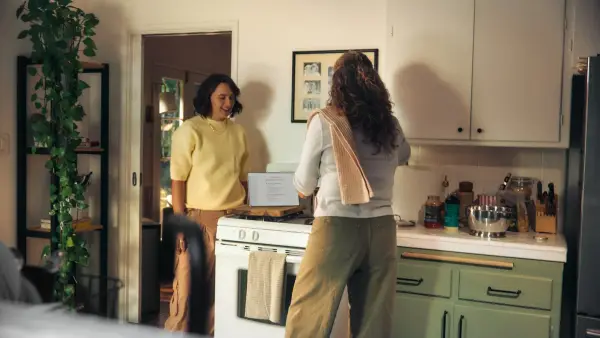
My wife and I have a ritual we didn’t plan. After dinner, she washes and I dry. We’ve done this for years. And somewhere in the middle of the ordinary sounds - water running, plates clinking, the small domestic choreography of a Tuesday evening - one of us will say something real.
Not every time. But often enough that we both recognize the space for what it is.
It works because our hands are busy. Our eyes are on the task. Our bodies are beside each other but not oriented toward each other. There’s enough physical activity to absorb the nervous energy that honesty generates, and enough ambient noise to cushion the silence that follows a difficult sentence.
I’ve heard versions of this from so many couples. The confessions that happen while folding laundry. The truths that surface during a long walk. The quiet revelations exchanged while gardening side by side, neither person looking up from the soil.
These aren’t accidental moments. They’re architectural ones. The physical setup of the interaction creates a container that the emotional content can safely fill. Remove the task, face each other across a table, add eye contact, and those same words become almost impossible to say.
A 2021 study in Frontiers in Psychology found that couples who engaged in collaborative physical activities reported higher levels of emotional disclosure than couples in face-to-face conversation settings. The researchers attributed this partly to reduced self-monitoring - when your body is occupied with a task, you spend less cognitive energy managing your presentation, and more becomes available for honest speech.
Your grandmother knew this without the study. That’s why she talked to your grandfather while snapping beans.
Darkness as permission
Then there’s the bedroom. Not the bedroom of passion but the bedroom of 11:47 p.m. on a weeknight, when the lights are off and you’re both on your backs staring at a ceiling you can’t really see.
Darkness removes the face entirely. You become a voice. Your partner becomes a voice. And voices, disembodied from expressions and reactions and the whole visual theater of human interaction, can carry heavier things.
I think about how many marriages have been saved by words spoken in the dark. How many people have said “I’m struggling” or “I need you to know something” or “I’ve been carrying this” only because the room was black and neither person had to watch the other one receive it.
Daniel Goleman’s work on emotional intelligence talks about the way humans constantly scan each other’s faces for microexpressions - tiny involuntary signals of judgment, disapproval, fear, or disappointment. We do this automatically. We can’t turn it off. And in a long marriage, you get extraordinarily good at reading your partner’s microexpressions, which means you also get extraordinarily good at anticipating their reactions before you’ve even finished speaking.
Darkness shuts that system down. When you can’t see the face, you can’t pre-edit based on the face. You just talk.
And sometimes, just talking is the most intimate thing two married people can do.
The myth of face-to-face intimacy
We have a cultural obsession with eye contact as the gold standard of honest communication. Look me in the eye. Face me when you say that. The implication is that facing someone proves sincerity, and looking away proves evasion.
But anyone who’s been in a long relationship knows this isn’t true.
Some of the most dishonest conversations in a marriage happen face to face. They happen at the dinner table when someone asks “are you okay” and the other person smiles and says “I’m fine” while making perfect eye contact. Face-to-face positioning doesn’t guarantee honesty. It often guarantees performance.
What side-by-side positioning offers isn’t evasion. It’s relief from performance. It says: you don’t have to manage how this looks. You just have to let it out. I’m right here beside you, and I’m facing the same direction, and whatever you say will land in the space between us where we can both look at it together.
There’s a profound metaphor buried in this geometry. Face-to-face says: this is between you and me. Side-by-side says: this is something we’re both looking at. It transforms a problem from an accusation into a shared landscape. You’re not pointing at your partner. You’re pointing at the thing, together.
Couples therapist Esther Perel has talked about how long-term couples often need to find ways to create emotional novelty - new ways to see each other. But maybe the more urgent need isn’t to see each other differently. Maybe it’s to stop staring at each other entirely, and start standing shoulder to shoulder again, the way they did when they were first building something together.
The geometry of repair
My father died six years after that November drive. My mother told me once that she replayed that car conversation more than any other memory of their marriage. Not their wedding. Not the birth of their children. A conversation in a dark car where neither of them had to be brave enough to watch the other person break.
I used to think the best thing you could do in a marriage was face each other. Now I think the best thing you could do is face the same direction.
Because the couples who last aren’t the ones who got better at confrontation. They’re the ones who found the spaces - the car, the kitchen, the dark bedroom, the long walk - where confrontation wasn’t necessary. Where the truth could come out sideways, gently, without the performance of eye contact and the pressure of being watched while you’re trying to be honest.
If you’ve ever noticed that the best conversations in your relationship happen in the car, or at the sink, or in bed with the lights off, you’re not imagining it. You’ve stumbled onto something that developmental psychology, emotional intelligence research, and forty years of your grandparents’ marriage all confirm.
The fastest way past someone’s defenses was never to stand in front of them.
It was to stand beside them.