There is a particular kind of man who learned to braid his daughter's hair from YouTube videos at two in the morning, who sat cross-legged on the bathroom floor with a practice doll head and rewound the same tutorial seventeen times, because he decided that fatherhood is not a custody schedule but a morning routine
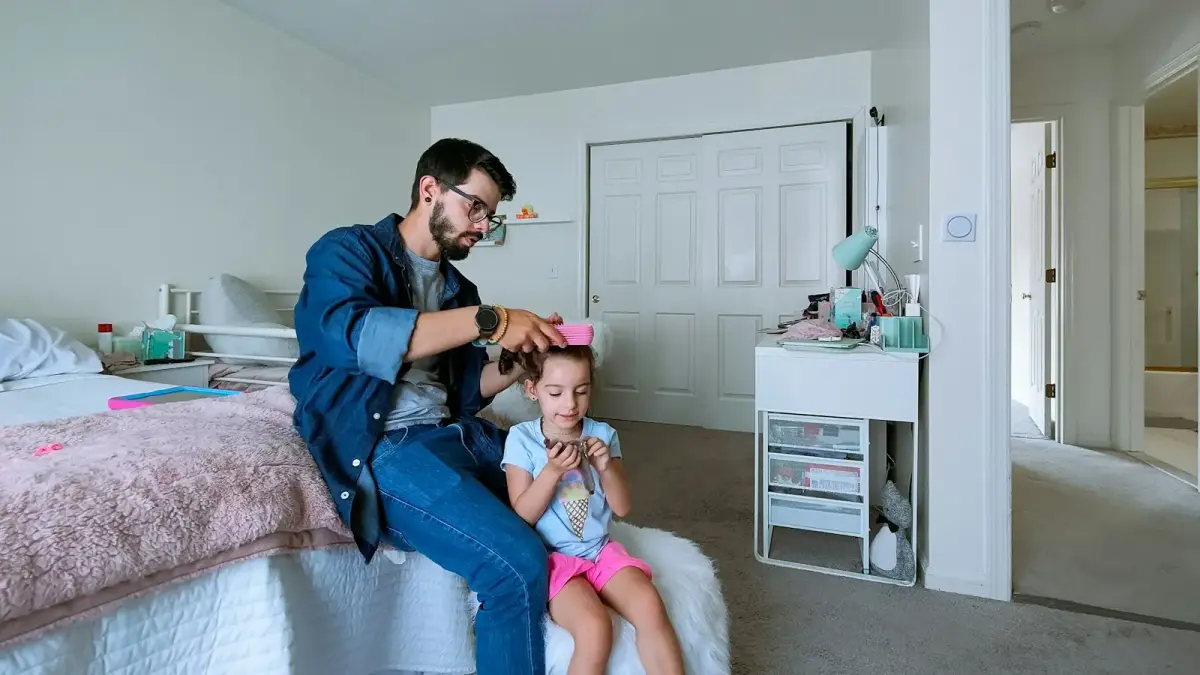
I watched a man in a parking lot once, standing behind his daughter at the trunk of his car, redoing her ponytail before school drop-off. She was maybe seven. He had a comb in one hand and two elastics between his teeth, and he was working with the kind of focused intensity most people reserve for assembling furniture or parallel parking in a tight spot.
It wasn’t graceful. He kept smoothing the same section over and over, tilting his head, trying to get the part straight. She was patient with him in a way that made my chest hurt - standing very still, holding her backpack straps, occasionally reaching back to guide his hand without being asked.
He got it done. It wasn’t perfect. But when she turned around, he looked at her like he’d just built something that mattered.
I sat in my car for a long time after that.
The tutorial at two in the morning
There is a version of fatherhood that nobody photographs, and it happens in bathrooms after bedtime.
It is a man sitting on a tile floor with his phone propped against the toilet, watching a woman with perfect nails demonstrate a French braid on a mannequin head. He rewinds. He pauses. He tries it on the practice head he bought at a beauty supply store for eleven dollars, the one he hid under the bathroom sink because he didn’t want to explain it to anyone.
His fingers are too big for the small sections. He keeps losing the third strand. The video makes it look like the hair just falls into place, and his does not fall into place, and he has been at this for forty minutes.
He does it again.
A 2014 study published in the Journal of Marriage and Family found that fathers who engage in routine caregiving tasks - not just play, but the unglamorous daily maintenance of a child’s life - form attachment bonds that are measurably stronger and more secure over time. The researchers noted that it wasn’t the quality of the caregiving that predicted attachment strength. It was the consistency.
The man on the bathroom floor does not know this study exists. He just knows his daughter has school pictures on Thursday, and her mother used to do a braid that looked effortless, and he has four days to figure it out.
What the small things actually are
When people talk about fathers stepping up after divorce, they tend to talk about the big gestures. Showing up to every game. Never missing a birthday. Fighting for more custody time.
Those things matter. But they are not the things a child remembers when she is thirty-five and trying to explain to her therapist why she trusts her father.
What she remembers is this: he learned to do her hair.
He learned which cereal she actually likes and stopped buying the one that was on sale. He figured out that she needs the hall light on but the door cracked exactly this much. He memorized the name of every girl in her friend group and which ones were being mean that week.
He learned the sound she makes when she’s not really fine but doesn’t want to talk about it yet. And he learned to sit with that sound without trying to fix it.
These are not skills men are taught. These are not skills most men watched their own fathers practice. These are skills that live in the invisible labor column, the one that was always someone else’s job, and when that someone else is gone, the man is left standing in an aisle at Target trying to remember if she needs conditioner or detangler and what the difference even is.
The man whose father left
Here is what nobody says about the man on the bathroom floor: he is almost always a man whose own father did not do this.
His father left. Or his father stayed but was absent in the ways that count - present at dinner but unreachable, home every night but never quite there. His father did not know his shoe size. His father did not ask about the small things because the small things were beneath him or invisible to him or both.
And now this man, this specific man with the doll head and the YouTube tutorial and the too-big fingers fumbling with a braid, is doing something that requires no audience and earns no applause. He is rewriting a story that started before he was born.
Psychologist Dr. John Gottman’s research on fathers and emotional attunement found that children whose fathers are attuned to their daily emotional needs - not their achievements, not their milestones, but their ordinary Tuesday afternoon feelings - show significantly higher emotional regulation and self-worth in adulthood. The effect was independent of the mother’s involvement. The father’s attunement mattered on its own.
The man on the bathroom floor is not attuning in any way a textbook would recognize. He is just trying to make a braid stay in. But attunement is not a technique. It is a decision to pay attention to what a small person needs, even when - especially when - nobody is watching.
Forty-five minutes for something that used to take ninety seconds
His ex-wife used to braid their daughter’s hair in ninety seconds. She could do it while making lunch, while talking on the phone, while doing three other things. It was muscle memory. It was effortless.
He takes forty-five minutes. The part is never straight. The braid loosens by lunch. Sometimes she comes home and he can see it’s been redone - a teacher, a friend’s mom, someone with quicker hands took pity on his work.
He could feel ashamed of that. Some version of him probably does.
But here is the thing about the forty-five minutes: his daughter does not experience it as incompetence. She experiences it as forty-five minutes of her father’s undivided attention. Forty-five minutes of his hands in her hair, gentle and trying. Forty-five minutes of standing in the bathroom mirror together while he asks her about her dreams and she tells him something she would not have told him in the car.
A 2019 study in Developmental Psychology found that children’s sense of security with a parent is not predicted by the parent’s skill level at caregiving tasks. It is predicted by the parent’s willingness to try, to stay present through frustration, and to show up again tomorrow even when today didn’t go well.
The braid comes loose by lunch. He does it again the next morning.
The morning routine as a love language
There is a rhythm to the mornings in this man’s apartment. It is different from the rhythm in the house where she also lives. Different dishes. Different towels. A bathroom that smells like his soap instead of hers.
But the routine is the same. Wake up. Breakfast. Hair. Backpack check. Shoes by the door. The drive to school where they listen to her music, not his, because he learned a long time ago that the passenger seat is not about his preferences.
This routine is not exciting. It will not make a movie. Nobody will write a viral post about a man who pours cereal the right way and remembers that she likes the blue cup, not the green one.
But it is the routine that teaches a daughter what to expect from the men who will come after him. It is the routine that says: someone can know you in the small ways. Someone can learn your preferences. Someone can be inconvenienced by your needs and choose to stay anyway.
Every morning he braids her hair, he is writing a definition of love in a language she will not fully understand until she is much older. Until some man forgets how she takes her coffee, and she realizes it matters. Until someone treats her needs as an imposition, and she recognizes that feeling as wrong, because her father trained her to expect better.
The doll head under the sink
He still has it. The mannequin head with the synthetic hair that doesn’t behave like real hair, that he practiced on until he could do a passable braid with his eyes half-closed.
He keeps it under the sink, behind the extra toilet paper and the cleaning supplies. It is the most ridiculous object he owns. If anyone found it, he would not know how to explain it in a way that sounded dignified.
But dignity was never the point.
The point was that a seven-year-old girl woke up on a Wednesday morning in her father’s apartment and said, “Dad, can you do the braid today?” And he said yes. Not “ask your mom.” Not “let’s just do a ponytail.” Not “I don’t know how.”
Yes.
And he meant it.
What a boy remembers
He was ten when his father stopped coming to the things that mattered. Not all at once. It was gradual - a missed recital, then a missed game, then a pattern so established that missing became the default and showing up became the surprise.
He does not remember the last time his father did anything with his hair. He is not sure his father ever did.
He remembers being twelve and tying his own tie for a school event from a diagram in a library book because there was nobody at home to show him. He remembers the knot being wrong and a teacher fixing it for him without asking why, and the quiet shame of that small rescue.
He is not on the bathroom floor because he read a parenting book. He is on the bathroom floor because he remembers what absence felt like, and he has decided - not once, but every single morning - that his daughter will not have to remember that.
The braid that comes loose
It comes loose by lunch. It always comes loose by lunch. She has fine hair, and his braids are not tight enough, and the elastic he uses is never quite right.
She doesn’t tell him.
She walks through the afternoon with a half-undone braid, and when someone offers to fix it, sometimes she says yes and sometimes she says no. When she says no, she is not being stubborn. She is choosing to keep the thing her father made, even in its imperfect state.
She is seven. She does not have the words for this yet.
But she will.
Somewhere in her twenties or thirties, she will be telling someone about her father, and she will mention the braids. Not the perfect ones her mother did. The ones that came loose. The ones that took forty-five minutes. The ones he learned to do from a phone screen at two in the morning because he refused to let fatherhood be the thing that happened every other weekend.
She will say it like it was nothing. But her voice will change when she talks about it. The way voices always change when people talk about the moments that made them feel, for the first time or the hundredth, genuinely held.
The braid comes loose by lunch. He knows this. He sits on the bathroom floor anyway, every morning she is with him, and he braids her hair. Not because he is good at it. Because he is there.
And being there, it turns out, was always the whole thing.