There is a particular kind of marriage that only reveals itself at the hardware store on a Saturday morning - two people who have been together so long they move through the aisles without speaking, one reaching for the light bulbs while the other already knows the filter size, navigating the entire errand like two instruments in the same orchestra, because thirty years of loving someone can look less like passion and more like a man who already knows which checkout lane his wife will choose before she turns the corner
I Saw a Marriage in Aisle Seven
I was at the hardware store last Saturday, standing in front of a wall of picture-hanging kits I didn’t understand, when I noticed them.
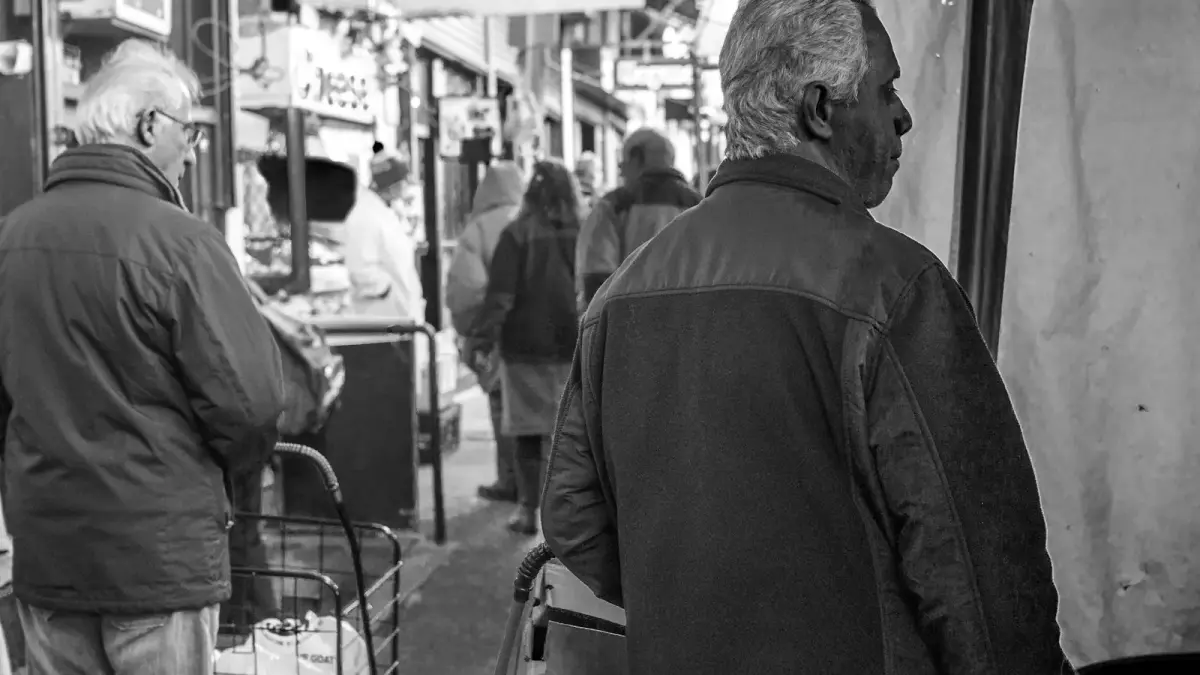
A couple. Maybe late sixties. He was in a faded flannel shirt, she was in a quilted vest with reading glasses pushed up on her head. They weren’t talking. They weren’t even walking together, not exactly. But they were moving through the store with a kind of coordination that stopped me mid-reach.
He turned down the electrical aisle. She kept going toward plumbing. No conversation. No “I’ll meet you over there.” No pause to discuss who was getting what. They just separated like two streams of water splitting around a rock, each knowing exactly where the other was headed.
I watched her pick up a package of washers, turn it over, put it back, and grab a different one. Three aisles away, he was comparing two light bulbs with the quiet concentration of a man who has replaced every bulb in his house for thirty years and knows exactly which ones she’ll say are too yellow.
They met at the register without a word. He put his items on the belt. She put hers next to his. His hand found the small of her back while she dug for her wallet. And something about that gesture - so practiced, so absent of performance - made my throat tight in a way I wasn’t expecting.
The Lie We Tell About What Love Is Supposed to Look Like
We have been sold a very specific image of love. It involves eye contact across crowded rooms. It involves breathlessness. It involves the kind of passion that makes you forget your own name, the kind of wanting that turns ordinary Tuesday nights into something cinematic.
And that kind of love is real. It exists. It’s the opening act.
But somewhere along the way, we started treating the opening act like it was the whole show. We started believing that when the breathlessness fades, something has gone wrong. That when Saturday mornings become hardware store runs instead of tangled sheets, the love has thinned out into something lesser.
Young people look at their grandparents sitting in silence at a restaurant and think, “I never want that.” They see the quiet and assume it’s emptiness. They see the routine and call it settling.
But they’re reading the wrong language. They’re watching a conversation in a dialect they haven’t learned yet - one that takes decades to become fluent in. One that you can only speak after you’ve weathered the things that would have ended a lesser partnership.
A 2019 study published in the Journal of Personality and Social Psychology found that long-term relationship satisfaction doesn’t decline the way popular culture suggests. Couples who stayed together for twenty years or more often reported a different kind of satisfaction - less urgent, yes, but deeper. More rooted. Less about desire and more about what the researchers called “quiet contentment,” which, it turns out, is one of the strongest predictors of overall life happiness.
The breathlessness was never meant to last. It was meant to get you to the hardware store.
Ten Thousand Ordinary Days
There is a language that only exists between two people who have shared ten thousand ordinary days together. It has no dictionary. You can’t study it. You can only build it, one unremarkable morning at a time.
It’s the way he slows down when her knee is bothering her without either of them mentioning it. She didn’t ask. He didn’t announce. His pace just shifted, the way a river adjusts to a bend it’s traveled a thousand times.
It’s the look across the room at a dinner party that means “five more minutes and then let’s go.” No signal agreed upon. No prior conversation. Just a glance that carries thirty years of knowing exactly how long she can tolerate small talk before she starts rearranging the host’s bookshelf in her mind.
It’s the hand on the grocery cart that means “I’ll get the car.” The specific way she leaves his coffee on the counter - not next to the stove where it’ll get cold, not in front of the toaster where he’ll knock it over, but right there on the corner by the window, where the morning light hits it and where his hand reaches first every single time.
These are not small things. These are the largest things. They are the accumulated evidence of a person who has paid such close attention to your life that they’ve memorized the geography of your habits, the rhythm of your needs, the exact temperature at which you feel most yourself.
That kind of knowing doesn’t happen in a year. It doesn’t happen in five. It happens when you’ve watched someone fall apart and come back together so many times that you know the shape of their rebuilding. When you’ve learned that his silence after work doesn’t mean anger - it means he’s processing, and he’ll talk about it at nine fifteen, after the dishes are done, standing in the kitchen doorway with a glass of water.
That’s not settling. That’s scholarship.
The Science of Two Bodies Learning Each Other
There’s a term researchers use that I think about often. Behavioral synchrony. It describes what happens when two people have spent so much time together that their bodies begin to coordinate without conscious effort.
A 2021 study published in Psychological Science tracked long-term couples and found something remarkable. Partners who had been together for decades showed synchronized heart rates, breathing patterns, and even cortisol rhythms. Their nervous systems had literally learned each other. When one partner felt stress, the other’s body responded - not because they were told, but because their physiology had become intertwined through years of proximity and care.
Their movements sync too. Researchers observed long-married couples walking together and found they naturally matched stride length, pace, and even the timing of their pauses. Not because anyone was trying. Because thirty years of walking side by side had trained their bodies into a shared tempo.
This is what I saw at the hardware store. Two bodies that had learned each other so thoroughly that a trip down aisle seven looked like choreography. Not the kind you rehearse. The kind that emerges when two instruments have played together long enough that they stop needing the sheet music.
Daniel Goleman writes about this kind of attunement - the way long-term partners develop what he calls “neural resonance,” a state where one person’s emotional landscape becomes legible to the other at a level below language. You feel your partner’s mood before they speak it. You adjust before being asked. Not because you’re performing empathy, but because your nervous system has absorbed theirs into its own operating rhythm.
That’s not a metaphor. That’s biology deciding that two people belong to each other.
The Relief of No Longer Auditioning
There is a specific kind of relief that comes with being known so well that you’ve stopped performing.
In the early years, love involves a kind of beautiful anxiety. You’re auditioning. Will they still want you if they see this part? Can you be this tired, this boring, this ordinary, and still be chosen?
Every new relationship carries that question underneath it like a bass note you can’t quite hear but always feel.
And then one day - maybe year eight, maybe year fifteen, maybe the morning you both got food poisoning on vacation and spent twelve hours taking turns in a hotel bathroom the size of a closet - the audition ends. Not because the love ends. Because the verdict comes in.
You are known. Fully. The version of you that snores. The version of you that cries at commercials but not at funerals. The version that eats cereal for dinner three nights in a row when the other one travels. The version that still hasn’t forgiven your sister for what she said in 2003.
All of it. Known. And still chosen.
A 2020 study in Frontiers in Psychology found that the single strongest predictor of relationship satisfaction in couples married over twenty years wasn’t passion, communication skill, or even conflict resolution. It was what the researchers called “felt security” - the deep, bodily sense that you are safe with this person. That you don’t have to explain yourself. That your weirdest, most unpolished self has already been seen and the other person is still standing in the kitchen, making coffee the way you like it.
That security doesn’t look exciting. It doesn’t make for good cinema. But it is, I think, the thing most of us are actually searching for when we say we want love.
Not someone who takes our breath away. Someone who lets us breathe.
The Checkout Lane
I keep thinking about that couple at the register.
The way his hand rested on her back. Not a grand gesture. Not a declaration. Just a hand that had found that exact spot so many times it could get there without his eyes. A hand that said, without any language at all, I’m here. I know where you are. I already know which checkout lane you’ll choose.
There is a kind of love that the world doesn’t write songs about. It doesn’t sweep in. It doesn’t knock you sideways. It shows up on a Saturday morning in a hardware store, wearing a flannel shirt, holding a package of light bulbs it already knows are the right color temperature.
This love isn’t loud. It doesn’t need to be. It has been practicing itself for thirty years, getting quieter and more precise with every passing season, until it becomes something so fluent it looks like silence to anyone who doesn’t know the language.
But if you’ve lived it - if you are living it - you know.
That silence is the most articulate thing you’ve ever heard. It is the sound of two people who have loved each other long enough that the love has stopped being a feeling and become a place. A home they carry between them, even in the fluorescent light of a Saturday morning errand, even without a single word.
If you have that, please know what you’re holding.
The rest of us are still learning the language.