Psychology says people who always check behind the shower curtain when they enter a bathroom - who pull it back even in their own home, even after decades of living alone, even when the rational mind knows nothing could possibly be there - are not paranoid and are not watching too many crime shows, they are people whose nervous system installed a threat-detection protocol in a house where surprise was never neutral and quiet spaces were never truly empty, and the hand on the curtain at fifty-three is not fear of a stranger but the body still running the one safety check a seven-year-old invented in a house where you could never be entirely sure which rooms were safe
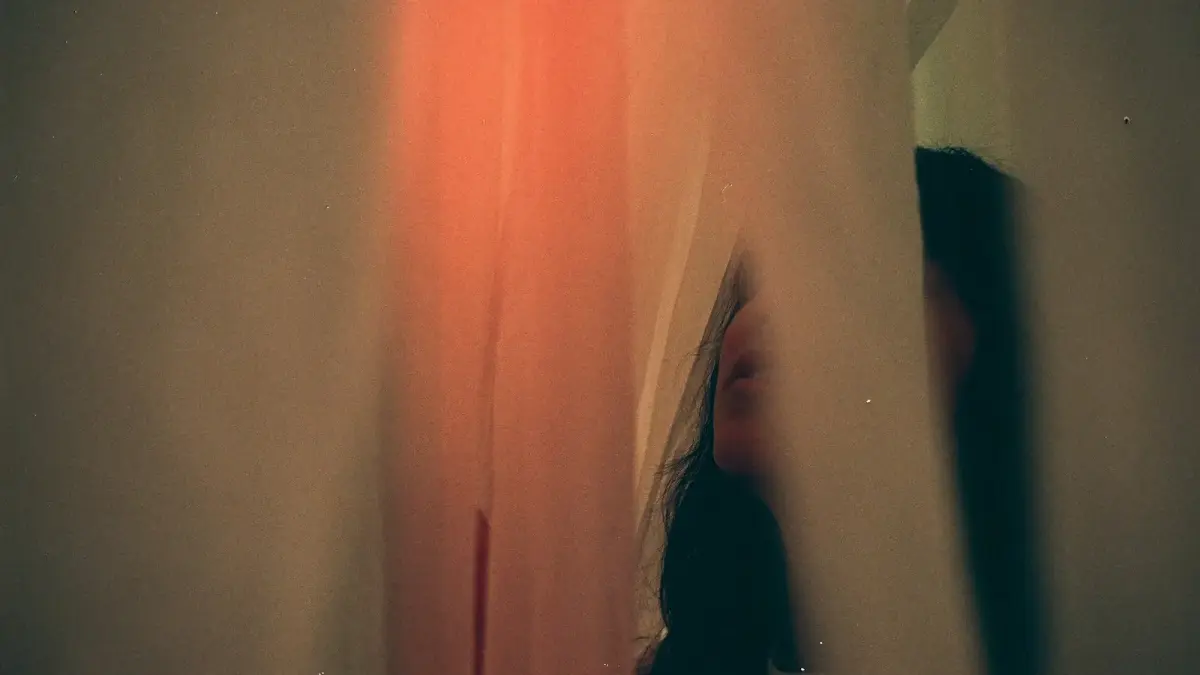
I do it every single time.
I walk into the bathroom - my own bathroom, in my own apartment, in a building with a deadbolt and a security door and neighbors I’ve known for eleven years - and my hand reaches for the shower curtain before I’ve even turned on the light. I pull it back. I look. I confirm. Nothing there. Of course nothing is there.
And then I can use the bathroom.
I used to feel embarrassed about this. I’d laugh it off when someone noticed. “Too many horror movies,” I’d say, rolling my eyes at myself. But that was never the real story. The real story started decades before I ever watched a horror movie, in a house where the scariest thing wasn’t on a screen.
It started in a house where quiet rooms weren’t peaceful. They were uncertain.
What it looks like from the outside
To anyone watching, it seems like a quirk. A funny little habit. Maybe even something you picked up from a roommate in college or a scene in a thriller that stuck with you longer than it should have.
People joke about it. They make memes about it. They say things like “I’m not crazy, I just have to check” and everyone laughs because it feels universal enough to be harmless.
But for some of us, the laughter is a cover for something we can’t quite name. The checking isn’t casual. It’s compulsory. There’s a micro-moment of tension when you walk in, a tightening in the chest that doesn’t release until the curtain is pulled back and the space is confirmed empty.
That tension has a source. And it didn’t start in a movie theater.
The nervous system remembers what the mind forgets
Here’s what psychology actually tells us about this behavior: it’s not about the bathroom at all.
A 2005 study published in the journal Psychological Science found that individuals who grew up in unpredictable home environments developed heightened threat-detection systems that remained active long after the original threat had disappeared. The researchers described it as an “adaptive calibration” - the nervous system adjusting its baseline settings to match the level of danger it experienced during critical developmental windows.
In plain language: if your childhood taught your body that surprises were dangerous, your body kept the alarm system running. Permanently.
The shower curtain is just the most visible checkpoint. But the protocol runs everywhere. You scan parking lots before walking to your car. You note every exit when you enter a restaurant. You sleep lightly, waking at sounds that your partner doesn’t even register.
None of this is paranoia. It’s a surveillance system that was installed by a child who needed it.
The house where quiet wasn’t safe
Think about what it means to grow up in a home where you couldn’t predict what you’d find in the next room.
Maybe it was a parent whose mood shifted without warning. Maybe it was someone who drank, and the drinking changed who they were, so walking into any room meant bracing for a version of them you couldn’t anticipate. Maybe it was conflict that erupted without a trigger you could trace, arguments that seemed to materialize from silence itself.
Or maybe it was subtler than any of that. Maybe nobody hit anyone. Maybe nobody yelled. But the emotional temperature in the house was never stable, never something you could trust to stay the same between the time you left a room and the time you came back.
In that kind of environment, a child learns something that goes deeper than words. The child learns: closed spaces conceal. What you can’t see might hurt you. The only way to feel safe is to verify. Every room. Every time.
Dr. Bessel van der Kolk, whose work on trauma and the body has reshaped how we understand these patterns, describes it as the body keeping a score the conscious mind stopped tracking years ago. You don’t remember deciding to check behind shower curtains. You don’t remember the first time you did it. The behavior just exists in you now, as automatic as blinking.
Because it was never a decision. It was a solution.
The seven-year-old’s security system
I want you to picture the child who invented this protocol.
She’s seven, maybe eight. She’s learned that walking into a room without checking it first is a gamble she can’t afford. She doesn’t have the language for what she’s doing. She doesn’t know she’s “scanning for threats” or “managing hypervigilance.” She just knows that if she looks first - behind doors, inside closets, past the shower curtain - she gets a half-second head start on whatever might be waiting.
That half-second feels like everything when you’re small and the adults in your life are unpredictable.
So she builds a system. It’s elegant, actually. It’s efficient. It costs almost nothing to execute - just a quick glance, a pulled curtain, a fast sweep of the eyes - and it pays out in the only currency that matters to her: a few seconds of certainty that this room, right now, is safe.
The problem is that the system was built for a house she no longer lives in. But nobody told her nervous system that she moved out.
A 2018 study in Frontiers in Psychology examined how early-life stress shapes the amygdala’s response patterns well into adulthood. Participants who reported childhoods with high emotional unpredictability showed amygdala activation in response to neutral stimuli - ambiguous facial expressions, closed doors, unfamiliar sounds - at rates significantly higher than control groups. Their brains were treating uncertainty itself as a threat, because in their formative years, uncertainty and threat were the same thing.
You’re not checking the shower curtain because you think someone is there. You’re checking because your body never received the signal that the danger is over.
Why the rational mind can’t override it
This is the part that frustrates people the most. You know nothing is behind the curtain. You know it intellectually, completely, without reservation. And you check anyway.
That gap between knowing and doing isn’t a failure of logic. It’s a feature of how trauma gets stored.
Cognitive knowledge - the kind you access with language and reason - lives in the prefrontal cortex. But threat responses live in the limbic system, particularly the amygdala, which operates on a faster circuit than conscious thought. By the time your rational brain has formed the sentence “there’s obviously nothing behind the curtain,” your amygdala has already sent the signal: check.
Dr. Stephen Porges’s polyvagal theory offers another lens for understanding this. The autonomic nervous system doesn’t take instructions from the thinking brain. It takes instructions from a much older, much faster system that assesses safety based on patterns laid down in early life. If your early life taught that system to classify hidden spaces as potentially dangerous, no amount of rational self-talk will convince it otherwise.
This is why telling yourself “this is silly” doesn’t work. You’re trying to negotiate with a part of your brain that doesn’t speak your language.
It’s not just the curtain
Once you understand this pattern, you start seeing it everywhere in your life.
It’s the way you read a room before you relax into it. The way you notice tension in someone’s jaw before they’ve said a word. The way you always know where the door is. The way you can sense a shift in someone’s mood from across a house, like emotional sonar that never stops pinging.
These aren’t deficits. They’re skills. Hard-won, expensively acquired skills that came at a cost most people can’t imagine.
You became the person who notices everything because noticing everything was once the only thing standing between you and being blindsided. You developed emotional radar because emotional ambush was a real and recurring threat. You learned to read micro-expressions, to track tone shifts, to feel the weather change before the first drop fell.
A 2021 study in the Journal of Personality and Social Psychology found that adults who grew up in emotionally volatile households scored significantly higher on measures of social perception and emotional granularity - the ability to detect and distinguish between subtle emotional states in others. The researchers noted that this heightened sensitivity, while often experienced as exhausting, represented a genuinely superior perceptual ability.
You’re not anxious. You’re trained.
What the hand on the curtain is actually saying
When you pull back that shower curtain at fifty-three, in your own home, in the middle of an ordinary Tuesday, here is what is actually happening:
A part of you that has been standing guard since childhood is completing its shift. It’s running the same check it ran at seven, at twelve, at nineteen, at thirty-one. It’s not stuck. It’s not broken. It’s loyal.
That’s the reframe that matters. This isn’t a symptom to eliminate. It’s a relationship to understand.
The seven-year-old who built this system was brilliant. She had no resources, no language for what was happening, no adult to say “I’ll keep watch so you don’t have to.” So she kept watch herself. She developed a protocol that worked. And she’s still running it, decades later, not because she doesn’t know she’s safe now, but because safety was so rare and so precious that she refuses to assume it.
That’s not pathology. That’s devotion.
Living with the protocol
I’m not going to tell you to stop checking behind the shower curtain. I don’t think you need to be fixed, and I don’t think the checking is your problem.
What I will say is this: the next time your hand reaches for that curtain, pause for half a second after you’ve pulled it back. After you’ve confirmed the space is empty. In that half-second, instead of feeling embarrassed or rolling your eyes at yourself, try something different.
Try saying - silently, internally, just to yourself - “Thank you. I know why you do this.”
Because the part of you that checks is not your enemy. It’s not your anxiety. It’s not evidence that you’re damaged or dramatic or stuck in the past.
It’s the part of you that kept you safe when no one else was going to. It’s still reporting for duty, every single day, in every bathroom, in every quiet room, behind every closed curtain.
And it deserves to be recognized for what it is. Not a flaw. Not a quirk. Not a punchline.
A child’s best attempt at protection, still running after all these years, because no one ever told her she could finally stand down.
Maybe she doesn’t need to stand down. Maybe she just needs to know that someone finally sees what she’s been doing all this time.
That someone might as well be you.