Psychology says people who cannot fall asleep without checking every lock in the house, turning off each light themselves, and walking through every room one last time before bed are not obsessive - they were children who grew up in homes where the adults could not be trusted to keep things safe, and the nightly patrol they still walk at fifty is the same one a seven-year-old invented to make sure the house would still be standing by morning
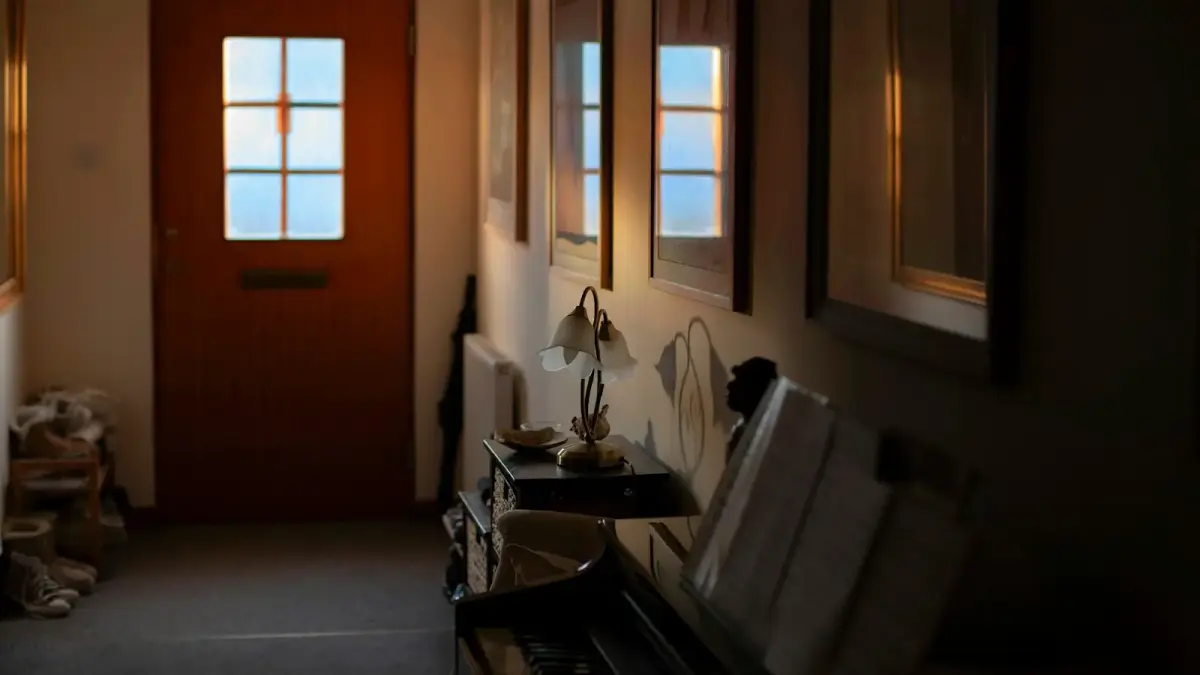
It’s 11:14 at night and you’re doing the walk again.
Front door. Deadbolt turned, then tested with a tug. Chain slid into place. You twist the knob once more just to feel the resistance. Then the back door. Then the sliding glass door - the one with the stick in the track that you put there yourself because the latch never felt like enough. Kitchen next. Stove knobs all in the off position. You touch each one. You touch each one even though you haven’t cooked since yesterday afternoon.
The hallway light gets turned off. The bathroom light. The one above the stove that casts a yellow glow across the counter. You walk through the living room and check the windows. Not just looked at - checked. Hands on the latches.
Your partner is already in bed. They stopped asking why you do this a long time ago. Occasionally they’ll say something from the other room - “you already got the front door” - and you’ll nod, but you’ll check it again on the way back anyway. You cannot explain this to them. You can barely explain it to yourself.
You just know that you cannot close your eyes until you have confirmed, with your own hands, that every entry point in this house is sealed.
And you know - in the part of you that still has a seven-year-old’s clarity about the world - that if you don’t do it, nobody will.
The House That Couldn’t Be Trusted
Not every childhood home was dangerous in an obvious way. Some were. Some had a parent who drank and forgot to lock the doors. Some had a parent who disappeared for hours and left the stove on. Some had screaming that started after midnight, and a child lying in bed calculating whether tonight was the kind of night where they needed to be ready to move.
But some homes were dangerous in quieter ways. A parent who was simply overwhelmed. A household that ran on chaos and good luck. Doors left unlocked not out of malice but out of the kind of adult carelessness that a child interprets - correctly - as a gap in the perimeter.
Children are extraordinary threat detectors. They don’t need to understand danger intellectually to feel it in their bodies. And when a child feels, night after night, that the adults in charge are not monitoring the environment - that nobody has checked whether the house is actually secure - something shifts inside them.
They take the job.
Not because anyone asks them to. Not because they’re precocious or helpful. Because their nervous system identifies a vacancy in the safety architecture and fills it. A child who cannot rely on the adults to check the locks becomes a child who checks the locks. A child who wakes up at 2 a.m. to the sound of the front door banging open in the wind becomes a child who makes sure the front door is locked before they’ll allow themselves to sleep.
This is not a quirk. This is a survival adaptation that was engineered under pressure by a brain too young to understand what it was building - and too competent to build anything less than permanent.
The Nervous System Remembers What the Mind Forgets
You are fifty-three now. You own the house. The mortgage is in your name. The locks are good ones - you picked them yourself. The neighborhood is quiet. There is no drunken parent downstairs. There is no chaos simmering at the edges of the evening.
And still, your body does not believe it.
A 2018 study published in Psychological Bulletin examined the long-term effects of childhood hypervigilance and found that threat-monitoring behaviors established in unstable early environments become deeply encoded in the nervous system, persisting decades after the original threat has disappeared. The researchers described this as a “neural architecture of anticipation” - the brain builds a permanent watchtower, and even when the landscape is peaceful, the watchtower stays staffed.
This is what your nightly patrol is. It’s the watchtower doing its shift change.
Your conscious mind knows the door is locked. You locked it an hour ago. You remember locking it. But the part of you that was built in that childhood home - the part that learned, through repetition and consequence, that things fall apart when you stop watching - that part does not operate on logic. It operates on felt sense. And the felt sense says: verify.
So you get up. You walk the house. You touch every lock with your own hands because your hands are the only instruments of verification your nervous system trusts.
Dr. Bessel van der Kolk, whose research on trauma and the body transformed how we understand these patterns, describes this phenomenon as the body keeping the score long after the mind has moved on. Your thinking brain has updated the file. It knows you’re safe. But your body is still running software from 1983, and that software says you need to walk the perimeter one more time before you’re cleared to stand down.
”You Already Checked That”
There is a particular kind of loneliness that comes with this pattern.
Your partner watches you do the rounds and sees something they might label as anxiety. Maybe they’ve gently suggested you talk to someone. Maybe they’ve made a joke about it - not a mean one, but the kind of joke that lands differently than they intended.
“You know the door can’t unlock itself, right?”
You laugh. You always laugh. And you check it again on the way to the bedroom.
The truth is that this behavior lives in a place that most people in your life cannot access. It predates your marriage, your career, your adult identity. It predates language, almost. It comes from a layer of yourself that was constructed before you had the vocabulary to describe what you were doing or why.
A 2021 study in Frontiers in Psychology found that adults who reported high levels of childhood household unpredictability were significantly more likely to engage in nightly safety-checking rituals - and that these rituals were not correlated with clinical obsessive-compulsive disorder. The checking was not driven by intrusive thoughts or irrational fears. It was driven by a learned, embodied understanding that safety must be personally confirmed because it was never reliably provided.
That distinction matters enormously. This is not OCD. OCD involves a cycle of intrusive thoughts and compulsive behaviors aimed at neutralizing anxiety that the person recognizes as irrational. What you’re doing is different. You’re not neutralizing an irrational fear. You’re completing a procedure that was once entirely rational - that was, in fact, the most rational thing a small child in your situation could have done.
The seven-year-old who got out of bed to check the front door wasn’t anxious. They were accurate.
The Weight of Being the One Who Watches
There is something that nobody talks about when they talk about hypervigilant children, and it is this: it is exhausting to be the safest person in the house when you are also the smallest.
You carried something as a child that was never yours to carry. The perimeter check. The listening for sounds that meant trouble. The mental catalog of every door and window and their current status. The light sleeping - always light sleeping - because deep sleep meant surrendering the watch, and you couldn’t afford to do that.
Some of you lay in bed listening to the rhythm of the house and interpreting every creak and click. Furnace kicking on - safe. Car door outside - assess. Footsteps in the kitchen past midnight - calculate. Is it the kind of footsteps that mean someone is getting water, or the kind that mean something is about to go wrong?
You became an expert in household acoustics before you finished elementary school.
And the cost of that expertise is a nervous system that never learned how to fully power down. Even now, in your own home, in your own bed, with your own good locks and your own quiet street, you sleep with one ear open. You hear the house settle and your body does a micro-assessment before allowing you to drift back off. You wake when the furnace cycles. You know, at all times, whether the back door is locked.
This is not dysfunction. This is the residue of a child who did an adult’s job with a child’s resources and somehow pulled it off. The fact that you’re here - that you made it through those nights, that you kept the perimeter secure with nothing but your own small body and your own fierce attention - is not a symptom. It is an achievement.
What the Patrol Was Really Protecting
Here is the thing I want you to hear.
That seven-year-old was not checking locks. They were checking whether the world was going to hold together for one more night. They were asking a question that no child should have to ask - is it safe to close my eyes? - and answering it themselves because nobody else was going to.
Every lock you checked was a promise you made to yourself. Every light you turned off was you tucking yourself in. Every walk through every room was you doing what a parent is supposed to do - surveying the territory, confirming the perimeter, signaling to the small creature under the covers that someone is on watch and the house will be standing in the morning.
You were your own parent in the dark. And you did it beautifully.
The nightly patrol you still walk is not evidence that something is wrong with you. It is evidence that something worked. A very young version of you built a safety protocol under impossible conditions, and that protocol has been running, uninterrupted, for thirty or forty years. It has kept you alive. It has kept you sane. It has been the most reliable thing in your life because you are the one who built it, and you never let it fail.
The House Is Yours Now
You can keep doing the walk for as long as you need to.
I want to be clear about that. There is no deadline for putting this down. There is no therapist’s office where someone will tell you that you should have stopped by now, that you should be over this, that a person with a good house and a good life shouldn’t need to check the locks every single night.
You check the locks because a small, devoted version of you is still on duty. And that version of you - the one who lay awake listening, the one who got out of bed barefoot on cold floors to make sure the deadbolt was turned - deserves something other than a diagnosis.
They deserve to be thanked.
So tonight, when you do the walk, let yourself know what it actually is. Not anxiety. Not obsession. Not a problem to be solved. It is a child’s loyalty to their own survival, carried forward into an adult life with the same quiet dedication it has always had.
And if the night ever comes when you walk past the front door and don’t feel the pull to check it - if your body finally, slowly, after all these years, begins to believe that the house will hold without you watching - that will be okay too. Not because the patrol was wrong. But because the thing it was built to protect has finally, fully arrived.
You are safe. The house is yours. And the seven-year-old who kept watch all those years can rest now - not because they failed, but because they finished.