Psychology says people who keep the hospital bracelet from when their child was born - tucked in a jewelry box, a baby book, or a drawer they haven't opened in twenty years - are not being sentimental or clinging to the past, they are holding physical evidence of the exact moment their identity split in two, because the bracelet was not memorabilia but proof of passage
I found mine on a Tuesday afternoon, the kind of unremarkable day where you are just looking for a paperclip or a stamp and your whole past reaches up and grabs you by the throat.
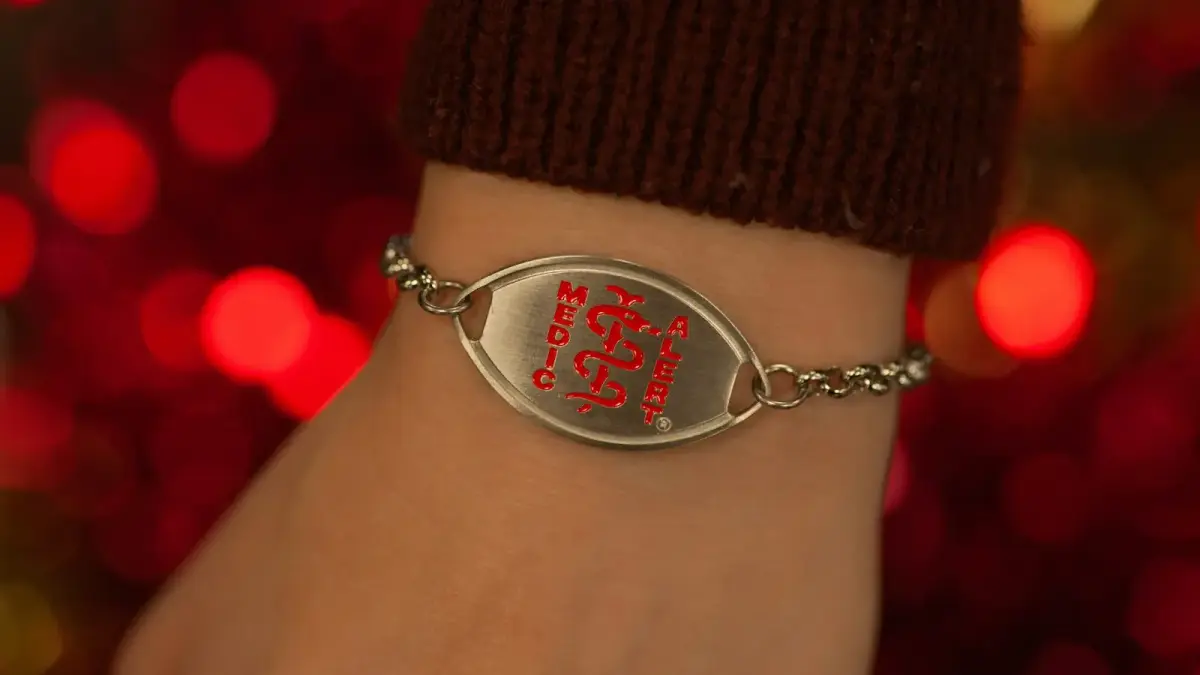
It was in a drawer I hadn’t opened in maybe fifteen years. Underneath a broken watch and a stack of old birthday cards, there it was - a tiny plastic hospital bracelet, faded to the color of weak tea, with my daughter’s last name and a string of numbers that meant nothing to anyone but the nurse who typed them. I picked it up and my hands started shaking. Not because I was sad. Not because I missed those early days. But because I was holding the border between two versions of myself, and I could feel, even after all those years, exactly where the seam was.
If you have one of these - tucked into a jewelry box, pressed between the pages of a baby book, sitting in a ziplock bag in a closet you avoid - I want you to know something. You are not being dramatic. You are not being overly sentimental. You are holding one of the most psychologically significant objects a human being can possess.
The person who walked in and the person who walked out
We talk about parenthood like it is a role you step into. A hat you put on. A new chapter in the same book.
But the research says something far more radical. Parenthood is not a chapter. It is a different book entirely, written by someone who shares your name but processes the world through an entirely restructured brain.
A 2016 study published in Nature Neuroscience, led by neuroscientist Elseline Hoekzema, found that pregnancy causes significant reductions in gray matter volume in regions of the brain associated with social cognition - the areas responsible for understanding other people’s thoughts and feelings. These changes were so pronounced and so consistent that researchers could identify which women had been pregnant and which had not simply by looking at a brain scan. And the changes persisted for at least two years after birth.
This was not damage. This was reorganization. The brain was not losing capacity - it was specializing, sharpening, rewiring itself to prioritize a new human being’s survival above everything else, including the person you used to be.
That bracelet you kept? It was issued at the door of a metamorphosis you could not have understood while it was happening.
Why we anchor transformations to objects
Here is what most people do not realize about keepsakes. They are not about memory. They are about proof.
Psychologists who study transitional objects - a concept originally explored by Donald Winnicott in his work on childhood attachment - have long understood that physical objects serve as bridges between psychological states. A child clutches a blanket not because the blanket is special but because the blanket holds the feeling of safety during a moment of uncertainty.
Adults do the same thing, just with less obvious objects. We keep wedding rings after a spouse dies. We keep the ticket stub from a first date. We keep the pen we used to sign divorce papers. These objects are not memorabilia in the casual sense. They are anchors. They tether us to moments when we became someone new, and they give us something tangible to hold when the magnitude of that becoming threatens to feel unreal.
The hospital bracelet is perhaps the purest example of this. It was not given to you as a keepsake. It was a medical identifier - functional, disposable, meant to be cut off and thrown away. The fact that you kept it means your body knew something your conscious mind may not have had words for yet.
You were not saving a souvenir. You were preserving evidence.
The identity split that no one names
Becoming a parent is one of the few identity transitions that happens in a single, identifiable moment. You can point to it on a clock. You were one person at 3:41 AM and a fundamentally different person at 3:42 AM.
We do not have good language for this. We call it “having a baby,” which puts the emphasis on the baby. We call it “starting a family,” which makes it sound like a project plan. What we almost never call it is what it actually is - a death and a rebirth happening simultaneously, while fluorescent lights buzz overhead and someone asks you if you want ice chips.
Research from the University of British Columbia, published in the Journal of Personality and Social Psychology in 2019, found that the transition to parenthood represents one of the most significant identity disruptions in adult life. Participants reported not just a shift in priorities or daily routines but a fundamental change in how they understood themselves as people. Many described feeling as though the person they had been before was not gone exactly, but no longer accessible in the same way - like a room in a house they could see through a window but could no longer enter.
This is what the bracelet holds. Not the memory of your child being born. The memory of you being born. The second version of you, the one who walked out of that room carrying someone else’s entire existence in your arms.
The neuroscience of becoming
The brain changes that accompany parenthood are not subtle. And they are not limited to the person who carried the pregnancy.
A 2022 study published in Cerebral Cortex found that new fathers also experience measurable changes in brain structure, including reductions in cortical volume in areas related to visual processing and default mode network activity. The brain was making room. It was deprioritizing the internal monologue - the constant narration of self - to make space for a new kind of attention. An outward-facing vigilance that never fully switches off.
This is why new parents describe feeling like they cannot think the way they used to. Why they lose words, forget appointments, walk into rooms and stand there blinking. It is not exhaustion alone, though exhaustion is real. It is neurological renovation. The brain is under construction, and the old floor plan no longer applies.
Researchers have also found that these neural changes correlate with increased activity in the amygdala - the brain’s threat detection center. After becoming a parent, your brain is literally scanning for danger at a higher baseline rate than it was before. The world did not become more dangerous. Your brain simply decided, without asking your permission, that the stakes had permanently changed.
The bracelet marks the moment those stakes changed. The moment your nervous system crossed a threshold it would never cross back over.
What keeping it really means
People who keep the hospital bracelet often cannot explain why. If you ask them, they will shrug. They will say something about being sentimental. They might even look a little embarrassed, as if holding onto a piece of plastic for two or three decades is somehow excessive.
But here is what I think is actually happening, based on everything we know about how humans process identity transitions.
Keeping the bracelet is an act of self-witnessing. It is the psyche’s way of saying: something enormous happened to me, and I need proof that it was real, because the world moved on so quickly that I never got to stand still and understand it.
Think about how we treat the moment of becoming a parent. Within hours, you are expected to know how to feed, soothe, and protect a brand-new human. Within days, people stop asking how you are and start asking how the baby is. Within weeks, your old identity is treated as irrelevant - you are “mom” now, or “dad,” and that is supposed to be sufficient. That is supposed to be the whole answer.
But it is not the whole answer. And somewhere deep in your psychology, you know that. So you kept the bracelet. Not because you are stuck in the past. Because you needed at least one object in this world that acknowledged the size of what happened to you.
The ones who threw it away feel this too
If you did not keep the bracelet - if it was thrown away in the hospital room, or lost in a move, or never occurred to you to save - that does not mean the transformation was any less real. It just means you processed the passage differently.
Some people anchor identity shifts to objects. Others anchor them to stories, to specific sensory memories, to the way the light looked in the room or the first sound their child made. The mechanism varies. The underlying need is the same.
We need markers. We need borders between who we were and who we became. Because without them, transformation can feel like erasure - like you did not change so much as disappear, and the new person simply showed up wearing your face.
The bracelet, for those who kept it, is the border made tangible. It is proof that both people existed. The one before and the one after. And it is quiet permission to honor both of them.
Why this matters now
If you are reading this and your children are grown - maybe they are thirty, maybe they are forty, maybe they have children of their own - and you still have that bracelet somewhere, I want you to sit with what that means.
You have carried proof of your own transformation for decades. Through moves, through losses, through every drawer cleanout and garage sale and moment where you could have let it go.
You didn’t.
Not because you are clinging to the past. Not because you cannot let go. But because part of you has always understood that what happened in that room was not just a birth. It was two births. And the second one - yours - was never given a name, a certificate, or a ceremony.
A 2021 paper in Frontiers in Psychology on identity continuity found that people who maintain physical connections to pivotal life transitions report higher levels of self-coherence - a sense of narrative wholeness, of being a continuous person with a story that makes sense. The bracelet is not an anchor weighing you down. It is a thread connecting the chapters of who you have been.
So if you find it someday, in a drawer you forgot about, on a Tuesday that was not supposed to mean anything - hold it. Let your hands shake if they want to. You are not being sentimental.
You are holding the exact moment you became who you are. And that is worth keeping.