Psychology says people who still check the coin return of every vending machine they pass - who reach into the slot with two fingers after every purchase, who feel along the bottom of every change cup at self-checkout, who glance at every pay phone they walk past even though they haven't made a call from one in twenty years - are not cheap or compulsive but practicing the oldest form of optimism a particular kind of childhood can produce, because a child who grew up where money was counted in coins and found quarters were small miracles learned that the world sometimes leaves behind gifts for the person who thinks to look in the places everyone else has stopped checking
I still do it
I was at a gas station last Tuesday, paying inside because the card reader on the pump was broken, and on my way out I passed a vending machine tucked against the wall near the restrooms.
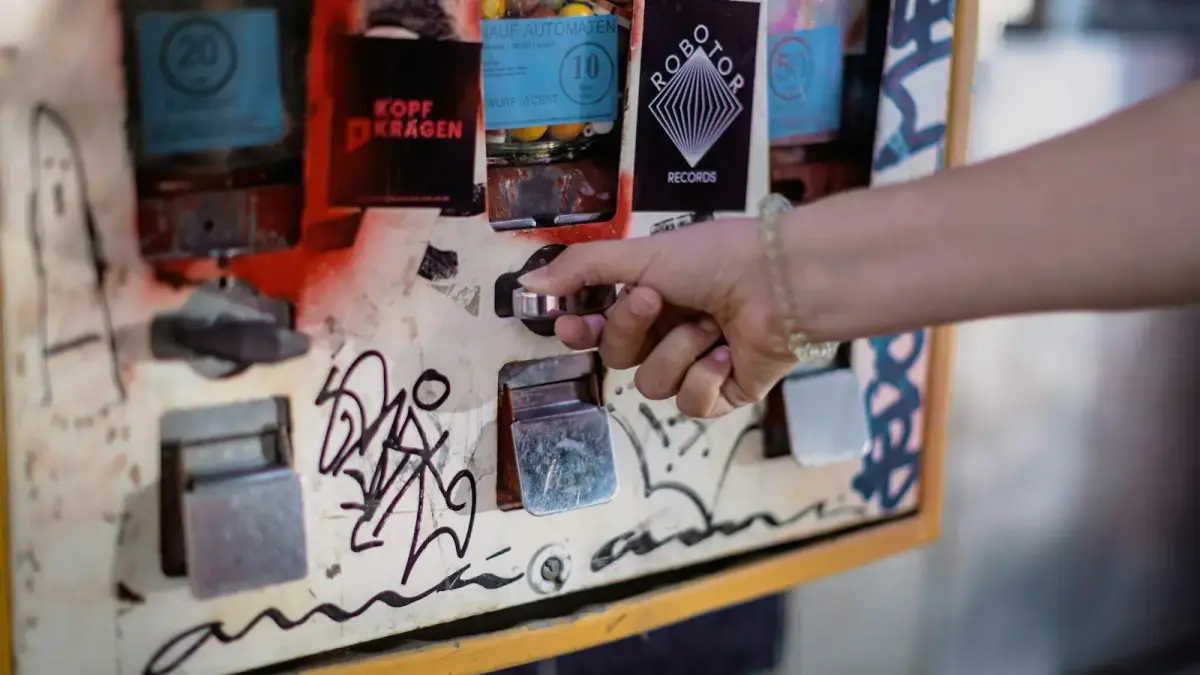
I didn’t buy anything from it. I didn’t even want anything from it. But my hand reached out anyway - two fingers sliding into the coin return slot, feeling the cold metal curve of the empty cup.
Nothing there. There almost never is.
My partner, who grew up in a house where money was something that simply appeared and rarely needed discussing, watched me do it. He didn’t say anything, but I could feel the slight pause in his stride. The micro-second of observation. The quiet categorization of the behavior as something quaint or strange or possibly neurotic.
And I realized I’ve been doing this my entire adult life. Every vending machine. Every self-checkout. Every parking meter with a coin slot. I do it without thinking, the way some people touch a doorframe when they leave a room. It’s not a decision. It’s closer to a reflex - except it carries the full emotional weight of a childhood I thought I’d left behind decades ago.
If you do this too, I want you to know something. You’re not cheap. You’re not strange. You’re practicing something much older and much more tender than you realize.
The coin return generation
There’s a particular kind of childhood that produces this behavior, and it has almost nothing to do with poverty in the way most people imagine it.
It’s the childhood where your mother counted coins on the kitchen table before grocery shopping. Where a quarter found in a coat pocket was announced to the household like good news. Where you learned the specific weight of a dime between your fingers before you learned cursive.
It’s the childhood where scarcity wasn’t dramatic - no one was starving, the lights stayed on most months - but where there was a constant low hum of financial vigilance that colored everything. You learned to scan the world for small advantages. For the overlooked cent on the sidewalk. For the coin that someone left behind.
A 2021 study published in the Journal of Personality and Social Psychology found that people who experienced economic scarcity during childhood develop what researchers call “persistent vigilance patterns” - heightened attention to environmental resources that continues long after the scarcity itself has resolved. The brain, having learned that resources can be found in unexpected places, never fully stops scanning.
But here’s what the study didn’t quite capture, what the clinical language can’t hold. This vigilance isn’t anxiety. It isn’t deprivation talking. It’s a form of hope that got wired into your nervous system before you had words for it.
What the check actually means
Think about what you’re really doing when your fingers slide into that coin return.
You’re not expecting to find money. You haven’t found money in a coin return in years, maybe decades. The rational part of your brain knows the odds. It knows that vending machines have changed, that most transactions are digital now, that the whole infrastructure of coin-operated life is disappearing.
But you check anyway.
Because the checking was never really about the coin. It was about maintaining a relationship with the possibility that something good might be waiting for you in a place no one else thought to look.
Psychologist Martin Seligman’s work on learned optimism suggests that some forms of optimistic thinking aren’t taught through affirmations or positive self-talk - they’re absorbed through repeated experience. When a child grows up in an environment where small found things occasionally appeared and mattered, the child internalizes something powerful. The world is not always generous, but it is sometimes careless in ways that benefit the person who pays attention.
That’s not pessimism dressed up as hope. That’s a genuinely sophisticated understanding of how the world works. The coin return check is your body remembering a time when it learned that good things sometimes hide in places that don’t advertise themselves.
The difference between scanning and grasping
There’s a distinction that matters here, and most people miss it entirely.
Checking the coin return is not the same as being preoccupied with money. It’s not the same as hoarding, or refusing to spend, or living in a constant state of financial fear. Those behaviors come from a different place - from the belief that there will never be enough.
The coin return check comes from somewhere warmer. It comes from the belief that there might be something left over. That the world occasionally produces small, unearned kindnesses for the person willing to receive them.
If you grew up the way I did, you can probably feel the difference in your body right now. The tightness of “there’s never enough” lives in the chest, in the jaw. But the coin return impulse lives in the fingers. It’s lighter. It’s almost playful.
A 2019 study in Frontiers in Psychology examined how early economic experiences shape adult “approach behaviors” versus “avoidance behaviors.” The researchers found that many adults who grew up in modest economic circumstances developed a heightened sensitivity to potential gains - not because they were desperate, but because their early environment had rewarded noticing. They became, in the researchers’ language, “opportunity sensitive.”
I love that phrase. Opportunity sensitive. Not broken by scarcity but tuned by it. Not damaged but calibrated.
The pay phone glance
Here’s the detail that breaks my heart a little, in the best way.
Some of you still glance at pay phones. Not to use them - you haven’t made a call from a pay phone in twenty years. But your eyes drift to the coin return anyway. And many of you do it even though you know the phone doesn’t work anymore, even though the chrome is green with oxidation and the receiver is missing.
You look because looking is the inheritance. The behavior outlived the circumstance that created it, and that tells you something beautiful about how deeply your childhood optimism is encoded.
This is what psychologists mean when they talk about procedural memory and emotional conditioning working together. Your conscious mind knows there’s no quarter in that pay phone. But the part of you that was seven years old and found thirty-five cents in the return slot of the phone outside the laundromat - that part of you is still delighted by the possibility. Still checking. Still believing that the world hides small gifts in plain sight.
You didn’t choose to keep doing this. It’s not a rational decision you make each time you pass a machine with a coin return. It’s closer to the way your tongue finds the spot where a tooth used to be. The behavior persists because the emotional learning behind it was profound enough to become part of how you move through space.
What your body remembers that your mind forgot
Gabor Mate writes about how the body stores experiences that the conscious mind has stopped processing. We think we’ve moved past our childhoods - we have careers and mortgages and retirement accounts - but the body still carries the original lessons.
Your hand checking the coin return is your body remembering what it learned. That vigilance has value. That small things matter. That the world isn’t stingy so much as it’s distracted, and the person who stays attentive gets to collect what others walk past.
This is worth sitting with for a moment, because I think most people who do this carry a small thread of shame about it. A worry that the behavior reveals something unflattering - that they’re stuck in a scarcity mindset, that they can’t relax about money, that they’re somehow performing their class background in a way that’s visible and embarrassing.
But I want to offer you a different reading.
What if the coin return check is one of the most emotionally intelligent things you do? What if it’s proof that you learned, very early, something that many people never learn at all - that the world rewards presence? That paying attention, in the most literal physical sense, is a form of engagement with life that keeps you open to receiving?
The optimism that doesn’t announce itself
There are loud forms of optimism. Vision boards. Gratitude journals. Morning affirmations spoken into the bathroom mirror. These are fine. They work for some people. They tend to come from people who were taught optimism explicitly, as a philosophy.
Then there’s the quiet optimism of the coin return check. The optimism that never calls itself optimism. The kind that lives in your fingers, not your words. The kind that was never taught to you in a seminar or a self-help book but was handed to you by a childhood where you learned that the universe occasionally tips its hand to the person who stays alert.
A 2023 study in Psychological Science found that what researchers call “ambient optimism” - low-level, non-conscious positive expectancy - was more strongly correlated with long-term well-being than explicit, deliberate positive thinking. The people who weren’t trying to be optimistic but whose behavior reflected an underlying expectation of small good outcomes were the ones who showed the most resilient mental health over decades.
You are those people.
You who check the coin return. You who glance at the ground in parking lots. You who pat your pockets one extra time. You who feel along the bottom of the self-checkout change cup even though you paid with a card.
You didn’t read a book about positive thinking. You lived through something that could have made you bitter or closed or tight-fisted, and instead it made you someone who still reaches into small dark spaces expecting to find something left behind for you.
A small thing that is not small
I found a quarter once, when I was eight, in the coin return of the Pepsi machine outside the grocery store where my mother worked evening shifts. I remember the feeling of it - the cold ridged edge against my fingertip, the weight of it dropping into my palm.
It wasn’t life-changing money. Even then, it barely bought anything. But it was proof of something I needed to believe - that the world had a way of leaving things behind for people like me. For people who checked. For people who didn’t walk past without looking.
I’m forty-six now. I have a good life. Money is not something I count in coins anymore.
But I still check. Every time. And I don’t think I’ll ever stop.
If you check too, please know this. That impulse is not a scar from your childhood. It’s a gift from it. It’s the part of you that still believes, quietly and without fanfare, that good things sometimes wait in places other people have given up on.
And honestly, in a world that keeps telling you to stop looking for magic in ordinary places, I think that might be one of the most hopeful things a person can carry.