Psychology says people who stop to read every memorial plaque, every park bench inscription, and every faded name on a building aren't being sentimental - they're practicing the oldest surviving form of civic witness because a child who watched someone read a stranger's name aloud learned that the dead only disappear when the living stop saying who they were
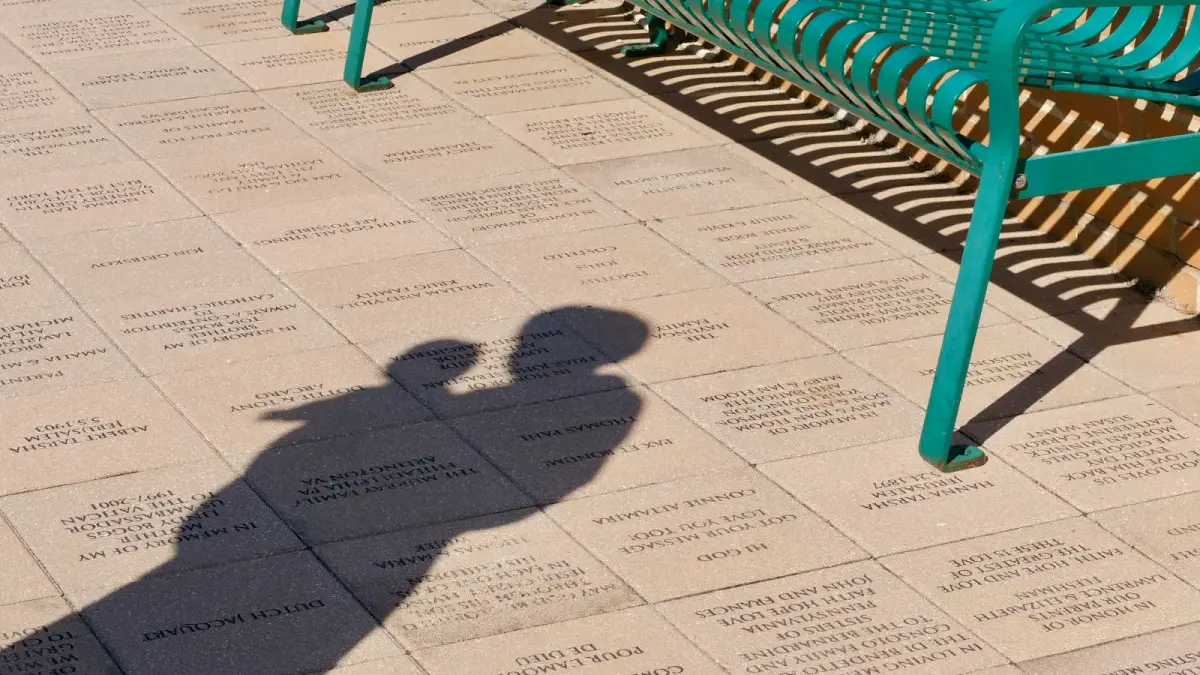
The name on the bench that stopped me
I was walking through a park last October, late afternoon, the kind of light that makes everything look like it’s being remembered instead of seen. I almost sat down without looking. But something made me glance at the small bronze plate on the backrest.
For Margaret, who fed the birds here every morning for thirty-one years.
I didn’t know Margaret. I will never know Margaret. But I sat there for a few minutes longer than I needed to, and I thought about a woman arriving at that same bench with a bag of seed every single morning for three decades. I thought about the person who loved her enough to make sure strangers would know she had been there.
My friend, who had walked ahead, turned back and said what people always say. “You coming?”
I am always the one who falls behind. I read the cornerstones on old post offices. I crouch down to read the faded text on historical markers that nobody has cleaned in years. I trace the names on war memorials with my fingertip, even when I don’t recognize a single one.
For most of my life, I assumed this was a minor personality quirk - something between nostalgia and being a slow walker. But the more I’ve studied the psychology behind it, the more I’ve come to understand that this impulse is not sentimental at all. It is something much older and much more necessary than sentiment.
What you’re actually doing when you read a stranger’s name
When you stop on a sidewalk to read a name etched into brass, you are performing an act that predates every religion, every government, every written language. You are witnessing.
Witnessing is not mourning. It’s not grief. It’s something more fundamental. It is the simple acknowledgment that a person existed, that their existence mattered, and that you - a stranger separated from them by years or decades or centuries - are willing to pause your own life for three seconds to register that fact.
This is not a small thing. In a world that moves as fast as ours does, the decision to stop moving is a radical act. And the decision to stop moving in order to read the name of someone you will never meet is something closer to sacred.
A 2012 study from the journal Psychological Science explored what researchers call “quiet prosocial behavior” - acts of care directed toward people who cannot reciprocate. The researchers found that individuals who engaged in these non-reciprocal acts of acknowledgment showed significantly higher levels of what psychologists call “self-transcendence,” the capacity to feel connected to something beyond your own immediate experience.
Reading a memorial plaque is one of the purest forms of non-reciprocal acknowledgment that exists. Margaret cannot thank you for reading her name. Robert, who loved that view, cannot know you paused to honor it. And that is precisely what makes the act meaningful.
The child who watched someone whisper a name
Here is what I think happens, and I don’t think most people realize it happened to them.
Somewhere in childhood, you watched someone you loved stop in front of a grave, or a plaque, or a name carved into stone. Maybe it was a grandparent. Maybe it was a parent. Maybe it was an aunt who always walked slower than everyone else at family gatherings.
And that person did something very specific. They read the name. Maybe they read it out loud. Maybe they just moved their lips. Maybe they touched the letters the way you’d touch a sleeping child’s forehead - gently, as if the name itself could feel it.
You didn’t understand what they were doing. But you absorbed the lesson anyway. The lesson was this: the living carry an obligation to the dead, and that obligation is breathtakingly simple. You say their name. You read the words someone carved for them. You pause.
That is the entire contract. That is the whole thing.
And the people who still honor that contract - the 58-year-old who stops on a park bench to read a dedication, the 70-year-old who bends down to read a cornerstone date, the 45-year-old who photographs a faded historical marker so the words won’t be lost - these people are not being slow. They are not being sentimental. They are practicing the last surviving form of public witness in a culture that has largely forgotten what witnessing means.
Why mortality makes us more human, not less
There’s a body of research that explains why this matters on a level deeper than etiquette or habit. It’s called terror management theory, and it was developed by psychologists Sheldon Solomon, Jeff Greenberg, and Tom Pyszczynski over several decades of study.
The core finding is counterintuitive. When people are gently reminded of mortality - not in a frightening way, but in a quiet, contemplative way - they don’t become anxious or avoidant. They become more generous. More connected. More oriented toward meaning.
A 2010 study published in the Journal of Personality and Social Psychology found that subtle mortality reminders increased participants’ willingness to engage in prosocial behavior, to seek deeper connections, and to invest in activities that felt meaningful rather than merely productive.
Reading a memorial plaque is a subtle mortality reminder. It says: someone was here. They are not here anymore. Someone who loved them wanted you to know.
And your nervous system responds to that information not with fear but with something that feels like tenderness. A softening. A momentary awareness that you, too, are here, and that “here” is temporary, and that the tenderness you feel for a stranger named Margaret is the same tenderness someone might feel for you someday.
This is not morbid. This is the opposite of morbid. This is what being fully alive actually feels like.
The dead don’t need monuments - the living do
There is an old assumption in psychology that grief is a process of letting go. That healthy mourning means gradually releasing your connection to the person who died until you can function independently of their memory.
Researchers Dennis Klass, Phyllis Silverman, and Steven Nickman challenged this assumption fundamentally. Their work on what they called “continuing bonds” demonstrated that maintaining an ongoing relationship with the deceased - talking to them, thinking of them, honoring their memory in daily life - is not a sign of unresolved grief. It is a sign of emotional health.
The people who read memorial plaques are practicing continuing bonds with strangers. They are maintaining a relationship with people they never knew, simply because those people existed and someone thought their existence was worth marking.
Think about what that means. A bronze plaque on a park bench is a stranger’s act of faith. It says: I believe that someone in the future will stop here, read this name, and care. The person who installed that plaque was betting on your humanity. And when you stop to read it, you prove them right.
That small moment - a stranger from the past trusting a stranger from the future - is one of the most hopeful transactions that human beings engage in. It requires no institution, no ceremony, no shared belief system. It just requires someone willing to stop walking and read.
The quiet awe of a name you’ll never forget
Psychologist Dacher Keltner has spent years studying what he calls “everyday awe” - the small, fleeting moments of transcendence that most people experience but rarely name. His research, including work published in 2023, found that awe doesn’t require mountaintops or cathedrals. It lives in ordinary moments of encountering something slightly larger than your own daily concerns.
Reading a memorial inscription is an everyday awe experience. For just a moment, your world expands beyond your to-do list, your commute, your afternoon schedule. You are standing in the presence of someone’s entire life condensed into a single sentence. For Robert, who loved this view. That’s a life. That’s decades of mornings and arguments and birthday dinners and quiet moments on this exact bench, compressed into eight words.
Keltner’s research found that these brief awe experiences shift people’s psychological orientation away from self-focus and toward connection. After a moment of quiet awe, people report feeling more compassionate, more patient, and more aware that they are part of something larger than themselves.
You know this already, even if you’ve never read the research. You know it because of how you feel after you read the plaque. You feel a little softer. A little more present. A little more willing to believe that the small things matter.
You are not slow - you are the last ones paying attention
I want to be careful here, because I don’t want to turn this into something it isn’t. Reading a memorial plaque is not a grand act. It doesn’t make you a hero. It doesn’t earn you anything.
But it does make you something that is increasingly rare. It makes you a witness.
A witness is someone who agrees to see what is in front of them. Not to interpret it. Not to analyze it. Not to post about it. Just to see it. To register that it is there. To let it matter for the few seconds it takes to read a name and a date and a small sentence about who someone was.
Most people walk past. Not because they’re cruel or indifferent, but because the world has trained all of us to keep moving. Efficiency is the highest modern virtue. Pausing is suspicious. Stopping to read something that has no practical value for your life is, by every metric that matters to productivity culture, a waste of time.
But you stop anyway. You have always stopped. And the reason you stop is that somewhere deep in your nervous system, in a place that was shaped before you had language for it, you learned that names matter. That the dead don’t stay dead as long as someone is willing to read who they were. That the most basic human courtesy is not kindness or generosity but simply acknowledgment - the willingness to say, with your attention if nothing else, I see that you were here.
The contract between strangers
There is a bench in a park somewhere with your name on it. Not literally, not yet. But someday, if you are lucky, someone who loves you will want the world to know you existed. They will choose a sentence. They will pay for the brass plate. They will trust that a stranger, decades from now, will stop long enough to read it.
And someone will. Someone who walks too slowly and reads every plaque and always falls behind the group. Someone who was taught, without words, that the living owe the dead this one small thing.
That person will read your name. They will sit for a moment in the place you loved. And for those few seconds, you will not be gone.
You will be witnessed.
If you are the kind of person who reads the inscriptions, who traces the names, who pauses while everyone else keeps walking - you are not behind. You are not wasting time. You are keeping a contract that most of the world has forgotten exists.
And the dead, if they could speak, would call you by the only name that matters for what you do.
They would call you faithful.