Psychology says people who walk faster the moment they hear footsteps behind them are not afraid and are not anxious - they are a child who was always told to hurry up, to keep up, to stop being in the way, and at forty-nine she still speeds up on an empty sidewalk not from fear but from the oldest instruction her body ever received: you are taking up someone else's time
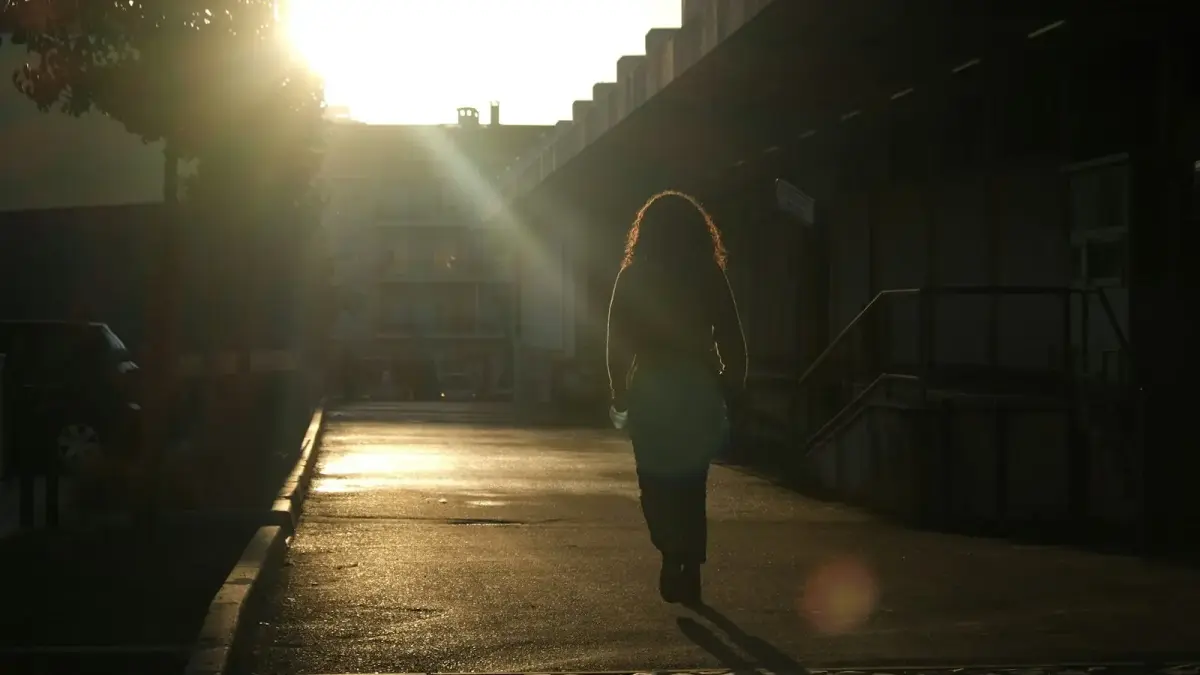
I noticed it at the grocery store last Tuesday.
A woman behind me in the cereal aisle was just browsing, the same way I was, moving slowly and reading labels. But the moment I heard her cart wheels getting closer, something in my legs changed. I sped up. Moved to the side. Grabbed the first box within reach and kept walking as if I had somewhere urgent to be.
I didn’t. I had nowhere to be at all.
And the woman behind me wasn’t impatient. She wasn’t even looking at me. But my body had already made the decision before my brain could weigh in. Someone is behind you. You’re in the way. Move.
I’m forty-seven years old. I have a doctorate. I’ve published papers on how the body stores emotional memory. And I still cannot hear footsteps behind me without my pace quietly, automatically increasing - not from fear, not from any rational assessment of danger, but from something so old it doesn’t have a name anymore. It just has a speed.
If you do this too, I want you to know something. It’s not anxiety. It’s not nervousness. It’s something much more specific, and much more tender, than that.
What most people assume - and why they’re wrong
The common explanation is straightforward. You hear someone behind you, you feel uneasy, you walk faster. People chalk it up to urban vigilance or social anxiety. A reasonable threat response. An introvert’s discomfort with proximity.
But here’s what doesn’t fit that explanation: you do it everywhere. You do it in your own neighborhood. You do it in the grocery store. You do it on a walking trail at nine in the morning with birds singing and not a single reason to feel unsafe.
You do it when the person behind you is a seventy-year-old woman walking her dog.
If it were fear, it would be contextual. You’d speed up in a dark parking lot and stroll freely in a sunlit park. But you don’t discriminate. You speed up everywhere, for everyone, regardless of context. That’s not a threat response. That’s a rule.
And rules like that don’t come from nowhere. They come from childhood.
The body remembers what the mind forgot
Research on procedural memory - the kind of memory stored in muscles, posture, and automatic physical responses - has shown that the body doesn’t just remember how to ride a bike or tie a shoe. It remembers emotional instructions too.
A 2019 study published in Frontiers in Psychology found that early relational experiences become encoded in implicit body memory - motor patterns, postural habits, and reflexive physical responses that operate below conscious awareness. The body learns how to move through space based on how it was taught space belonged to it.
For a child who was frequently told to hurry up, keep up, stop dawdling, stop being so slow, move, come on, we don’t have all day - the body received a very clear lesson. Your natural pace is wrong. The speed at which you exist is an inconvenience to the people around you.
So the body adapted. It installed a rule: when someone is behind you, you are too slow. Speed up. Move aside. Make yourself smaller, faster, less of an obstacle.
This isn’t something you decided. It’s something that was decided for you, by a nervous system trying to keep the peace in a home where your pace was a problem.
It was never about the sidewalk
Think about what it actually means to speed up when you hear footsteps behind you on a wide, empty sidewalk.
It means your body believes you are in someone’s way even when there is no one’s way to be in.
It means you have internalized the idea that your presence at its natural speed is an imposition. That simply existing - walking, browsing, standing in line, taking up room in an aisle - costs someone else something.
Gabor Mate has written extensively about how childhood emotional patterns become embodied responses. The child doesn’t just learn “I should hurry.” The child’s body learns “I am too much at my natural speed.” That belief doesn’t live in thoughts. It lives in the legs, the shoulders, the slight forward lean that happens before you’ve even registered why.
And it doesn’t age out. A forty-nine-year-old woman speeds up on a Saturday morning walk and doesn’t question it. She assumes she’s being polite. She assumes she’s being practical. She doesn’t recognize it as the voice of a parent who’s been gone for twenty years, still telling her to keep up.
The attachment pattern underneath
Attachment theory offers a framework for understanding this that goes deeper than just habit.
Children who develop anxious attachment patterns often learn what researchers call “earning proximity” - the unconscious strategy of staying close to a caregiver by minimizing burden. You don’t earn love by being yourself. You earn it by not being in the way.
A 2021 study in the Journal of Personality and Social Psychology examined interpersonal spatial behavior and found that individuals with lower self-worth consistently gave more physical space to others in shared environments. They moved aside more quickly. They compressed their bodies. They made themselves easier to walk around.
This wasn’t politeness. This was a spatial expression of a belief about belonging.
The child who was told “come on” while their little legs were already moving as fast as they could learned something about their own right to occupy space. They learned it was conditional. They learned it could be revoked by someone’s impatience.
And so the adult body still operates under those conditions. You hear footsteps, and somewhere deep in your nervous system, a calculation fires: someone is behind you. You are costing them time. Speed up or move.
The cruelest part
What makes this particular pattern so quietly devastating is that it disguises itself as consideration.
You think you’re being polite. You think you’re being aware of others. You think you’re just someone who doesn’t like holding people up, doesn’t like being in the way, doesn’t like inconveniencing strangers.
And all of that sounds so reasonable that you never stop to ask: why does walking at my own pace feel like an inconvenience?
Why does taking up the exact amount of space my body occupies feel like too much?
The cruelest part is that the instruction was installed so early and so deeply that it feels like your personality. “I’m just considerate.” “I’m just aware.” “I just don’t like being slow.”
But a child who was never rushed doesn’t speed up for strangers on empty sidewalks. A child who was allowed to dawdle, to wander, to move at the pace their body wanted - that child grows into an adult who walks without apology.
The fact that you can’t do that isn’t a personality trait. It’s a wound wearing the costume of manners.
What the body is actually saying
When you speed up at the sound of footsteps, your body is not saying “I’m afraid.”
It’s saying “I remember.”
It remembers the sigh. The yanked hand. The exasperated “let’s GO.” The look on a parent’s face that said your pace - your natural, child-sized, wonder-struck pace - was a problem to be solved.
A 2022 study in Psychological Science found that implicit body memories from childhood can persist for decades, activated by environmental cues that resemble the original context - even when the conscious mind has no awareness of the connection. The sound of footsteps behind you is one of those cues. It doesn’t trigger a memory you can see. It triggers a response you can feel.
Your legs know something your mind never articulated: someone is coming, and you are in their way, and you need to not be.
That’s not anxiety. That’s loyalty. Loyalty to the oldest instruction your body ever received.
You are allowed to walk slowly
I want to tell you something you might not have heard before, or at least not in a way your body believed.
You are allowed to take up space on the sidewalk.
You are allowed to walk at the speed your legs actually want to move. You are allowed to browse slowly. To stand in an aisle without urgency. To exist at your natural pace without calculating whether it’s costing someone behind you three seconds of their day.
You are not in the way. You were never in the way.
You were a child moving at the speed of a child, and someone who was supposed to slow down to meet you made you speed up to meet them instead. And your body, because it loved them and needed them, learned the lesson perfectly.
Too perfectly.
The next time you hear footsteps behind you and feel that old familiar acceleration in your legs, I want you to try something. Don’t speed up. Don’t slow down, either. Just notice it. Just feel the pull - the urge to move aside, to compress, to make yourself easier to pass.
And then keep walking.
Not to prove anything. Not as an act of defiance. But because at forty-nine, or fifty-six, or sixty-three, you deserve to finally walk at the pace your body has been waiting your whole life to use.
The one that was always yours. The one no one ever let you keep.