Psychology says the woman who always takes the group photo but is never in it - who holds the camera at every birthday, every holiday, every vacation, whose face appears in exactly zero of the two thousand photographs documenting twenty years of her family's happiest moments - is not camera-shy or selfless, she is a girl who learned that the only safe place to stand was behind the lens, where she could preserve everyone else's joy without ever having to prove she deserved to be inside the frame
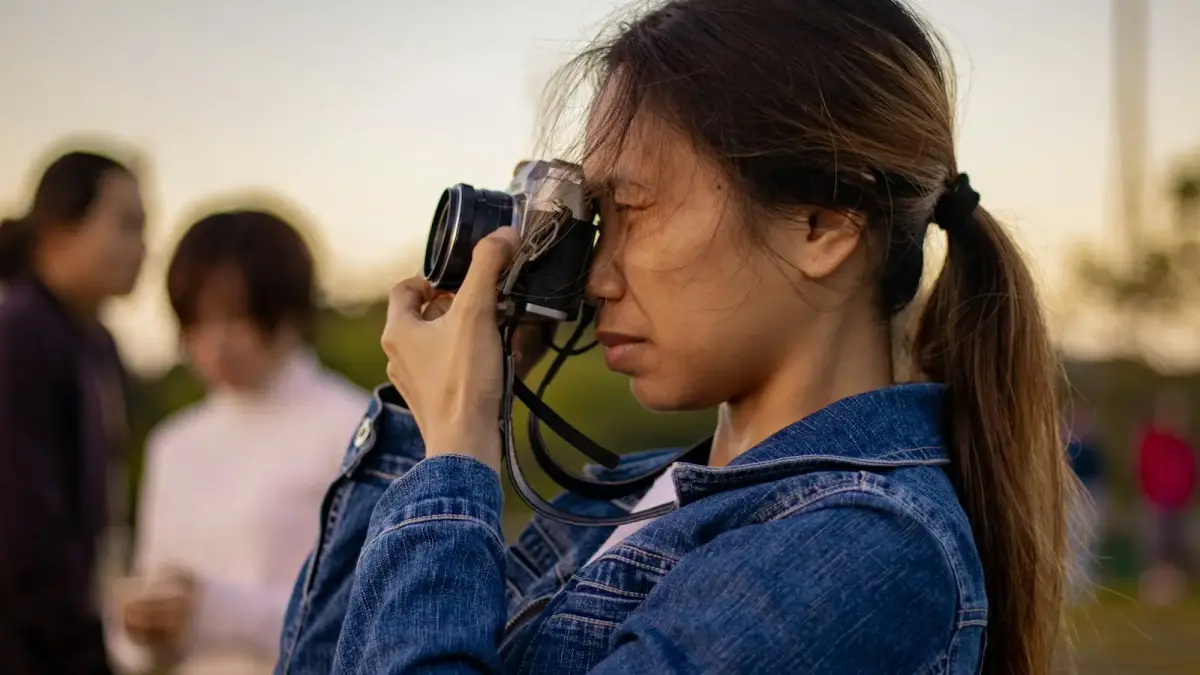
I found the box last November. It was in the back of my closet, underneath a quilt my mother made and a stack of journals I kept promising myself I’d reread someday. Inside were hundreds of photographs - maybe a thousand - spanning almost two decades of holidays, birthdays, school plays, beach vacations, Sunday dinners with the extended family crowded around a table that was never quite big enough.
I sat on the floor and went through every single one.
There were pictures of my daughters blowing out candles. My husband holding a fish he caught off a dock in Maine. My sister-in-law laughing so hard her eyes disappeared. My parents slow-dancing in the kitchen on their anniversary. Beautiful, warm, irreplaceable photographs of everyone I have ever loved.
I was not in a single one.
Not one. Not a candid in the background, not a blurry arm at the edge of the frame. I had been there for every one of those moments. I had organized most of them. I had packed the cooler, frosted the cake, remembered the sunscreen, and set the timer on the oven so we could eat by six. And then I had picked up the camera - because someone had to - and I had made sure the moment was preserved for everyone except me.
I used to tell people I just didn’t like having my picture taken. That was not the truth.
The woman behind the camera is not who you think she is
We have a word for the person who always volunteers to take the photo. We call her selfless. Generous. The one who thinks of everyone else first.
And she accepts those words, because they sound close enough to love that she can live inside them without asking whether love is actually what she’s receiving.
But psychologists who study self-effacement - the habitual pattern of minimizing your own presence, needs, and visibility in relationships - see something more complicated happening. This is not a personality quirk. It is not modesty. It is a deeply practiced strategy for staying safe in a world that taught her, very early, that taking up space was dangerous.
A 2019 study published in the Journal of Personality and Social Psychology found that individuals who consistently minimize their own visibility in group settings often score high on what researchers call “relational self-construal” - a sense of self that is almost entirely organized around being useful to others. Their identity doesn’t just include service. Their identity is service. Remove the helping, the organizing, the behind-the-scenes labor of making sure everyone else is comfortable, and they genuinely do not know who they are.
The woman holding the camera is not just taking a photo. She is performing the only version of herself that ever received approval.
Where this pattern begins
You don’t learn to erase yourself overnight. It happens slowly, in a childhood full of small, ordinary lessons that don’t look like lessons at the time.
Maybe your mother was overwhelmed and you became the quiet one who didn’t add to her burden. Maybe your father only noticed you when you were helpful - carrying groceries, setting the table, making yourself small and competent and easy to have around. Maybe you had a sibling who needed more attention, more intervention, more of everything, and the implicit agreement in the family was that you would be fine because you had to be.
None of this was abuse. Most of it wasn’t even intentional. It was just the water you swam in - the understanding, absorbed before you had words for it, that your presence in the room was conditional. You were welcome as long as you were useful. You were loved as long as you were easy. And the quickest way to be easy was to disappear into the background and make yourself indispensable from there.
Psychologist Harriet Lerner has written extensively about what she calls the “underfunctioning-overfunctioning” pattern in families. One person becomes the helper, the fixer, the emotional scaffolding that holds everything together. And the cost of that role is that nobody ever turns to her and says, “Get in the picture. We want you in this one.”
Because she has made it so natural to be behind the lens that no one even notices she’s missing.
The quiet math of self-erasure
Here is what people don’t understand about the woman who never appears in photographs. She is not absent because she forgot to be present. She is absent because she made a calculation - one she probably couldn’t articulate if you asked her - that her presence in the frame would somehow diminish the photograph.
That the picture would be better without her in it.
This is not low self-esteem in the way we typically talk about it. She is not walking around telling herself she’s worthless. She functions. She leads meetings. She raises children who feel deeply loved. She holds friendships together. She is, by almost every external measure, a woman who has her life handled.
But somewhere underneath all of that competence lives a girl who learned that her face, her body, her unedited self, standing there with nothing to offer except her own existence - that this was not enough. That she needed to be doing something. Holding something. Producing something. Preserving something.
A 2021 study in Frontiers in Psychology examined women who reported chronic difficulty accepting recognition or visibility. The researchers found that these women didn’t lack confidence in their abilities - they lacked what the study called “ontological permission.” Permission to simply exist as a person in the room, rather than as a function the room required.
That phrase has stayed with me since I first read it. Ontological permission. The right to exist - not as a mother, not as an organizer, not as the person who remembers the ice - but as a human being whose face belongs in the photograph simply because she was there.
Why no one notices
The hardest part of being the woman behind the camera is that the system works perfectly. Everyone gets beautiful photographs. The holiday runs smoothly. The birthday is documented. The vacation album is full of smiling faces.
And nobody looks at those albums and thinks, “Wait - where is she?”
This is by design. She has spent decades making sure the machinery of her disappearance is invisible. She volunteers before anyone can ask. She picks up the camera before anyone can hand it to her. She says, “No, no, you all get together - I’ll take it,” with such warmth that it sounds like generosity.
And it is generous. That is what makes this so complicated. The giving is real. The love behind it is real. The desire to capture her family’s happiness is absolutely genuine.
But the refusal to step into the frame is not generosity. It is a boundary she has drawn around her own worthiness, and she has drawn it so quietly and maintained it so consistently that everyone in her life has accepted it as her preference rather than recognizing it as her wound.
Adam Grant writes about the difference between giving that comes from abundance and giving that comes from self-protection. The first kind fills you up. The second kind hollows you out, slowly, over years, until one day you’re sitting on your closet floor looking at a thousand photographs and realizing that you have no visual proof you were ever part of your own life.
What the reframe actually looks like
I want to be careful here, because I am not suggesting that the woman behind the camera is broken or damaged or needs to be fixed. She doesn’t.
What I am suggesting is that the story she has been telling herself - “I just prefer it this way,” “I’m not photogenic,” “Someone has to take the picture” - deserves to be examined. Not to tear it down. But to sit with it honestly and ask whether it is still true, or whether it is just familiar.
Because there is a difference between choosing to be behind the camera and not believing you deserve to be in front of it.
The reframe is not “you should demand to be in every photo.” The reframe is quieter than that. It is this: the impulse to disappear - to hold the camera, to organize the moment, to stand just outside the frame where you can contribute without being seen - is not a flaw. It is evidence of a girl who figured out how to survive a world that didn’t make room for her. She found the one position where she could be present without being judged, useful without being vulnerable, loving without risking rejection.
That was brilliant. At eight or ten or twelve years old, that was the smartest thing she could have done.
But she is not twelve anymore.
And the family standing in front of her, smiling, waiting for the shutter to click - they want her in the picture. Not because she earned it. Not because she organized the trip or baked the cake or remembered to charge the camera. They want her in the picture because she is part of the family, and the photograph is incomplete without her, and no one has ever told her that clearly enough for her to believe it.
The photograph that doesn’t exist yet
I don’t have a neat ending for this. I am still learning how to step out from behind the lens.
Last Christmas, my daughter - she’s nineteen now - took the camera out of my hands before I could frame the shot. She said, “Mom, get in here.” And I felt the familiar resistance rise up in my chest, the quiet voice that said I should just take the photo, that I looked tired, that the picture would be fine without me.
I got in the picture anyway.
It is not a great photograph. My eyes are half-closed and I am clearly mid-sentence because I was trying to tell my nephew to stop making bunny ears behind his sister’s head. My hair is doing something I would rather not describe. It is, by any objective standard, an unflattering image of a fifty-two-year-old woman who was not ready to be seen.
It is my favorite photograph I have ever been in.
Not because of how I look. Because I am there. I am standing inside the frame, in the middle of my family, with nothing in my hands, contributing nothing except my presence. And my presence was enough.
If you recognize yourself in any of this - if you are the woman behind the camera, the one who organizes but never appears, the one whose absence from the album is so consistent that even you stopped noticing - I want you to hear something that you have probably never let yourself believe.
The photograph is not complete without you in it. It never was.
You were never meant to stand behind the lens forever. You were meant to be in the frame. Not because you earned it. Because you exist. And that has always been enough.