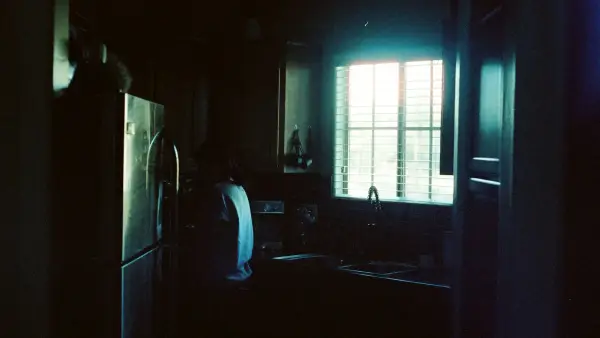
She's 52 and has finally understood that the reason she cannot stop rehearsing tomorrow's conversations in her head is not anxiety, it is twenty years of growing up in a house where the emotional weather changed without warning and her seven-year-old mind learned that the only safe thing to do was predict every next sentence before it arrived

It is 11:14 on a Tuesday night and she is lying in the dark beside her husband, eyes open, running tomorrow’s phone call with her sister for the third time.
Not the easy version. Not the version where Claire agrees that their mother needs more help and they calmly divide the tasks. She is rehearsing the version where Claire gets defensive. The version where Claire says, “You always do this.” The version where the silence after that sentence stretches long enough to swallow everything.
She has mapped every possible turn. If Claire brings up the finances, she will stay calm and redirect. If Claire’s voice gets tight the way it does right before tears, she will soften her own tone by exactly half. If Claire mentions their brother, she will not take the bait.
She has been doing this her entire life. Every dinner, every meeting, every encounter with the neighbor who talks too long by the mailbox. She scripts the conversation in advance, rehearses her lines, anticipates the other person’s reactions, and arrives at the interaction already exhausted from a version of it that hasn’t happened yet.
She has always assumed this was anxiety. A flaw. Something she should meditate away or fix with the right breathing exercise. She is 52 years old, and she is only now beginning to understand that it was never a flaw at all. It was the smartest thing her seven-year-old brain knew how to do.
The house where weather lived indoors
Her mother was not cruel. That is the part that makes it hard to explain.
Her mother was warm, funny, generous - and then, without transition, she was not. The shift could happen between pouring cereal and sitting down to eat it. A comment about the morning news could land wrong. A sock on the floor could rewrite the emotional forecast for the entire afternoon.
There was no pattern a child could study and predict. That was the worst part. Predictable danger teaches you a simple rule: avoid the thing. Unpredictable danger teaches you something far more exhausting - that you must monitor everything, all the time, because the threat could come from any direction.
So she learned to read the kitchen before she entered it. The angle of her mother’s shoulders at the counter. The speed of the spoon stirring coffee. Whether the radio was on or off. Whether “good morning” arrived with eye contact or without.
She became fluent in a language no child should have to speak.
A 2004 study published in the journal Development and Psychopathology found that children raised in emotionally unpredictable households develop heightened neural sensitivity to ambiguous social cues. Their brains learn to treat uncertainty itself as a threat, which means they are not overreacting to the present moment - they are reacting accurately to the environment that built them.
She was not born anxious. She was trained into vigilance by a household that required it.
The prediction engine that never turned off
Here is what nobody tells you about childhood hypervigilance: it does not retire when you leave home.
The system that learned to predict her mother’s moods at seven kept running at seventeen, at twenty-five, at forty. It just changed targets. Instead of reading her mother’s posture in the kitchen, she began reading her boss’s tone in emails. Instead of monitoring the speed of footsteps on the stairs, she started tracking the micro-expressions on her husband’s face when she mentioned plans with friends.
The engine runs constantly. It runs before work meetings, scanning for possible friction points and pre-building her responses. It runs before family dinners, rehearsing which topics are safe and which might detonate. It runs before she calls a friend, because even joy requires preparation when your nervous system learned early that the emotional ground can shift beneath you without warning.
She arrives at every interaction pre-scripted. She knows what she will say if someone brings up a difficult topic. She knows where the exits are - conversationally speaking - if things turn uncomfortable. She has contingency plans for contingency plans.
People call her “so thoughtful.” They say she always knows the right thing to say. They admire how composed she is, how prepared, how gracious under pressure.
They have no idea how tired she is.
The compliment that is actually a cage
This is the particular cruelty of a survival skill that looks like a social grace: it gets rewarded.
Nobody worries about the woman who always has the right words. Nobody stages an intervention for the person who never seems caught off guard. The world reads her hypervigilance as emotional intelligence, her exhaustion as poise, her inability to be spontaneous as maturity.
She has received a version of this compliment her entire adult life. “You’re so good with people.” “You always know exactly what to say.” “I wish I could handle conflict the way you do.”
What they are actually seeing is a woman who has rehearsed the conversation three times before it started. What they are admiring is the performance, not the person. And the distance between those two things is where her loneliness lives.
Because there is a specific kind of isolation that comes from being unable to show up unrehearsed. From never allowing yourself an unscripted reaction. From always, always arriving at the conversation already knowing what you will say, which means you are never truly in the conversation at all.
You are above it. Watching. Managing. Predicting. And wondering why connection feels like something that happens to other people.
What the science actually says
Researcher Martin Teicher at Harvard Medical School has spent decades studying how childhood stress reshapes the developing brain. His work, published in journals including the American Journal of Psychiatry, has shown that children exposed to unpredictable emotional environments develop measurable changes in the amygdala and prefrontal cortex - the brain regions responsible for threat detection and emotional regulation.
These are not metaphorical changes. They are structural. The brain literally reorganizes itself to prioritize prediction and threat assessment, because in the environment where it developed, that reorganization kept the child safe.
This is what makes the “just stop overthinking” advice so painful. You are not overthinking. You are running a prediction system that was installed at the hardware level during a critical period of brain development. Telling someone to stop doing this is like telling someone to stop flinching - the reaction happens before conscious thought even begins.
A 2019 study in Psychological Science found that adults who grew up in unpredictable households showed elevated activity in the brain’s default mode network - the system responsible for mental simulation and rehearsal of future scenarios. In other words, the constant rehearsal of conversations is not a bad habit. It is a neurological signature of an environment that demanded it.
Her brain is not broken. It is doing exactly what it was built to do. The problem is that it was built for a house she left thirty years ago.
The moment she stopped calling it a flaw
She was sitting in her therapist’s office last fall when the language changed.
Her therapist did not use the word “anxiety.” She used the word “adaptation.” She said: “Your brain learned that predicting the next sentence was the only way to stay safe. That was brilliant. That was a seven-year-old girl solving an impossible problem with the only tools she had.”
Something shifted in her chest when she heard that. Not relief exactly. More like recognition - the feeling of a name finally matching a face she had known her whole life.
She had spent decades pathologizing herself. Decades believing that the constant mental rehearsal was evidence of something wrong with her, something she needed to overcome or outgrow. And in one sentence, her therapist reframed thirty years of exhaustion as thirty years of intelligence operating under threat conditions.
Gabor Mate writes about this with extraordinary clarity - the way survival adaptations formed in childhood become the very traits we later punish ourselves for having. The sensitive child who learned to read every room becomes the adult who cannot stop scanning. The hypervigilant child who predicted her mother’s moods becomes the woman who rehearses every conversation. These are not disorders. They are the residue of a mind that did what it had to do to survive.
The exhaustion she feels is not weakness. It is the cost of running a system built for crisis in a life that no longer requires it.
Learning to arrive without a script
She is not cured. She wants to be honest about that.
She still rehearses conversations. She still lies awake some nights running tomorrow’s interactions through her internal simulator, testing for emotional landmines, pre-building her responses. The engine does not have an off switch, and she has stopped pretending it should.
But something has changed. She has stopped hating herself for it.
When she catches herself scripting a conversation with her sister at midnight, she no longer thinks, “What is wrong with me?” She thinks, “There you are. You’re still trying to keep me safe.”
She has started, slowly, allowing herself small moments of unscripted conversation. Not the high-stakes ones - not the call with Claire about their mother, not the performance review at work. But the small ones. The chat with the barista. The exchange with the woman walking her dog. Conversations where the stakes are low enough that her nervous system can tolerate not knowing what comes next.
It is harder than it sounds. Spontaneity feels dangerous when your entire childhood taught you that unscripted moments were where the pain lived.
But she is practicing. And some days, she catches herself laughing at something she did not expect, responding to a question she did not anticipate, and feeling - for a moment - what it might be like to live inside a conversation instead of above it.
What I want you to hear
If you recognize yourself in this - if you are the person who rehearses every interaction before it arrives, who scripts the difficult conversations at 2 a.m., who shows up to every meeting already knowing what you will say - I want you to sit with something for a moment.
You are not broken. You are not “too anxious” or “too controlling” or “too much in your head.”
You are carrying a prediction engine that was built by a child who needed it. And the fact that you are exhausted is not evidence of failure. It is evidence of how long you have been working to keep yourself safe in a world that once gave you very good reasons to try.
You do not need to dismantle this part of yourself. You do not need to rip out the wiring. You just need to know - maybe for the first time - that it was never a flaw.
It was always, always intelligence. And the girl who built it deserves your gratitude, not your judgment.
She kept you alive. She kept you safe. And now, finally, you get to tell her that the weather has changed - and she can rest.