She's 56 and has realized that the reason she has never once sent food back at a restaurant - not when it was cold, not when the order was wrong, not when she quietly found something in her soup and ate around it rather than say a word - is not patience or good manners, it is forty years of being a girl who learned that her discomfort was never quite important enough to justify making someone else uncomfortable, and the silence she holds at fifty-six is the same silence that kept a childhood kitchen from turning dangerous
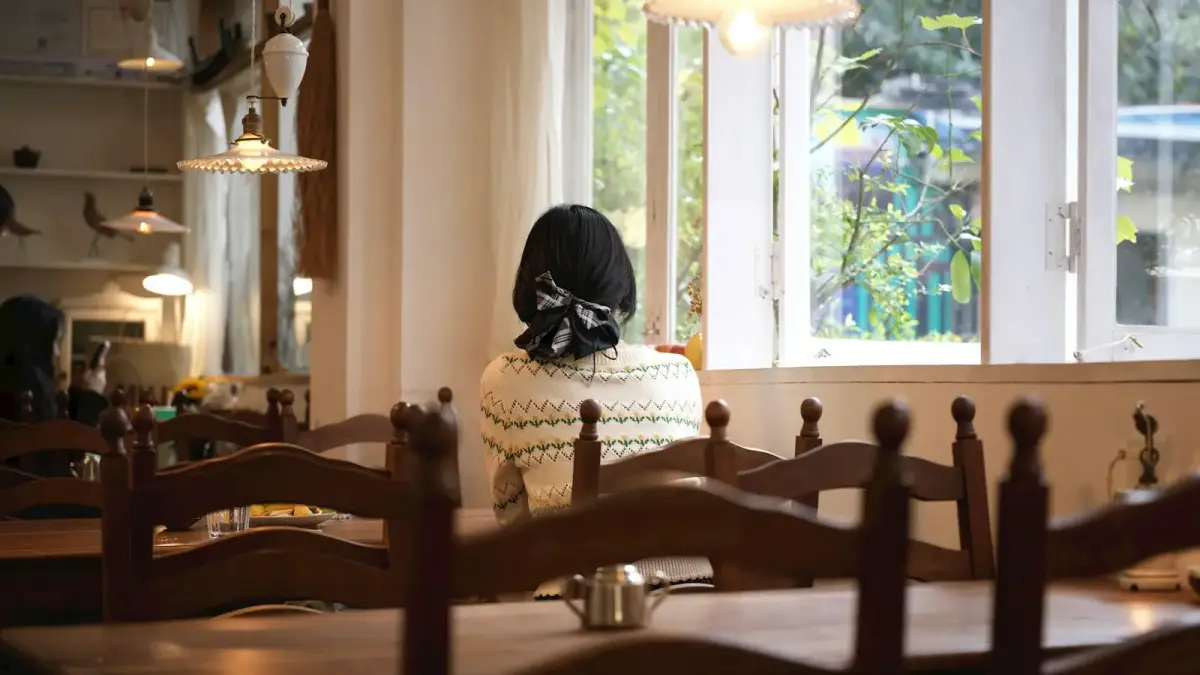
The Soup
I was having dinner with a friend last month - a woman I’ve known for over thirty years - when something small happened that changed how I understand myself.
The waiter brought my order. It was wrong. Not slightly wrong. Entirely wrong. A dish I hadn’t asked for, covered in a sauce I’m mildly allergic to. My friend looked at the plate, then at me, and waited.
I picked up my fork.
She put her hand on my wrist. “Elena,” she said. “That’s not what you ordered.”
I knew that. I’d known it the second the plate touched the table. But my body had already begun the familiar choreography - smile at the waiter, say thank you, find the parts I could eat, fill up on bread. I’d done it a thousand times. At fifty-six, this script runs without my conscious permission.
“I know,” I said. And then, because she was still looking at me with that expression - the one that was gentle but also a little horrified - I added, “It’s fine.”
It wasn’t fine. And somehow, sitting in that restaurant with someone who’s watched me do this for three decades, I finally heard how automatic those words had become.
The Pattern You Don’t See Until Someone Names It
If you recognized yourself in that story, I want you to sit with that recognition for a moment. Don’t rush past it. Don’t explain it away.
Because this isn’t about restaurants. The restaurant is just where the pattern becomes visible.
It’s the hairdresser who cuts three inches more than you asked for, and you tell her it looks great. It’s the doctor who prescribes something that gives you headaches, and you take it for four months before mentioning it at a follow-up, almost apologetically, as though your side effects are an inconvenience to the person who prescribed them.
It’s the friend who cancels on you for the third time and you text back “no worries at all!” with an exclamation point you don’t feel. It’s the partner who says something that lands like a stone in your chest, and you let the conversation move on because addressing it would mean a difficult twenty minutes, and you’ve spent your whole life calculating that your discomfort costs less than someone else’s irritation.
You’ve been told this is a virtue. You’ve been called easygoing. Flexible. Low-maintenance. A good sport.
You’ve been praised for the very thing that is quietly eroding you.
Where the Silence Was Learned
Dana Jack, a psychologist at Western Washington University, developed something called the Silencing the Self theory in 1991. Her research showed that many women learn to suppress their own needs and feelings in relationships to maintain connection and avoid conflict. Not because they’re passive. Not because they lack opinions. But because they learned - early and viscerally - that their voice carried a cost.
Jack found that self-silencing wasn’t just a personality trait. It was a relational strategy, shaped in childhood, reinforced through decades of practice until it became invisible even to the person doing it.
I think about that word. Invisible. Because that’s exactly what happens. You silence yourself so consistently, for so long, that you stop registering the silence. It becomes the baseline. It becomes who you are.
But it’s not who you are. It’s what you learned to do.
And most of us learned it in a kitchen.
The Kitchen Table
There was a table in your childhood home where the emotional weather of the family was set each evening. You learned to read that weather before you could read books. You knew by the sound of a cabinet closing whether it was safe to talk. You knew by the angle of a jaw whether tonight was a night for being small.
Maybe it was a parent whose mood could turn the house cold in a single breath. Maybe it was a mother who held everything together so tightly that any complaint felt like pulling a thread that could unravel her. Maybe it was a father who wasn’t violent but whose silence was its own kind of weapon, and you learned that keeping the peace meant keeping yourself in a very narrow lane.
You made a calculation. Not consciously - you were seven, or nine, or eleven - but you made it nonetheless. The calculation was this: my discomfort is survivable. Theirs is not. Their anger changes the temperature of the entire house. My sadness just sits inside me where nobody has to see it.
So you swallowed the thing that bothered you. And when you swallowed it and nothing bad happened - no explosion, no withdrawal, no terrifying silence - your body recorded a lesson. Swallowing works. Swallowing keeps people close. Swallowing is how you stay safe.
A 2016 study in the Journal of Personality and Social Psychology found that children who grow up in emotionally unpredictable households develop heightened sensitivity to the emotional states of others - often at the expense of attunement to their own needs. They become extraordinary readers of rooms. They can feel a shift in someone’s mood from across a house.
What they lose is the ability to feel their own hunger, their own frustration, their own completely reasonable objection to a plate of food they didn’t order.
The Woman Who Is Fine With Everything
You grew into a woman who is fine with everything.
Fine with the restaurant getting the order wrong. Fine with your mother-in-law commenting on your weight every Thanksgiving. Fine with doing eighty percent of the household labor because bringing it up would lead to a conversation you don’t have the energy for. Fine with the friend who only calls when she needs something.
Fine. Fine. Fine.
But here’s what I’ve come to understand, at fifty-six, sitting in front of a plate of food I didn’t want: being fine with everything is not the same as being at peace with it. Being fine is a performance. A masterful, invisible, full-time performance that runs on a fuel source you’ve been burning since childhood.
And at some point - maybe forty-five, maybe fifty, maybe right now as you read this - you start to feel the exhaustion not as tiredness but as something deeper. A flatness. A sense of having lived your life slightly to the left of your own desires, always making room, always adjusting, always being the one who doesn’t mind.
You do mind. You’ve always minded. You just learned so early that minding was dangerous that you buried the capacity to say so.
The Sophisticated Math of a Seven-Year-Old
I want to be careful here, because I’m not describing weakness. I need you to hear that.
What you did as a child - what you learned to do at that kitchen table - was sophisticated. It was intelligent. It was a calculation that required you to read emotional dynamics most adults can’t articulate, and to adjust your behavior in real time to manage the emotional stability of people much larger and more powerful than you.
You were not being passive. You were being strategic. You were working with the only tools available to a child who couldn’t leave, couldn’t change the adults around her, and couldn’t afford to be the reason the house fell apart.
That strategy saved you. It kept meals quiet. It kept doors from slamming. It kept you close to the love you needed to survive, even when that love was conditional on your smallness.
But you’re not seven anymore.
And the waiter who brings the wrong soup is not your father. The hairdresser is not your mother. Your doctor is not the unpredictable adult whose mood you once had to manage. These are people who are paid to get your order right, who would genuinely like to know if something is wrong, who would not withdraw their love if you said, “Actually, this isn’t what I asked for.”
The Cost of Never Sending It Back
A 2019 study published in Psychological Science found that chronic self-suppression is linked not just to depression and anxiety, but to a diminished sense of personal identity. People who consistently silence their needs gradually lose access to what those needs even are. The researchers described it in terms of “self-concept clarity” - and in people who habitually defer to others, that clarity erodes over time.
This is the cost no one talks about. Not the cold soup. Not the bad haircut. The cost is that after forty years of absorbing what isn’t right, you start to lose the signal that tells you what is right. What you actually want. What you actually feel. What would actually make you happy if you let yourself pursue it without first checking whether it would inconvenience someone.
I’ve sat with women in their fifties and sixties who tell me they don’t know what they want for dinner. And they laugh when they say it, as though it’s a charming quirk. But when we sit with it together, it’s not charming. It’s the end result of a lifetime of making sure everyone else’s preference was served first.
You don’t lose your voice all at once. You lose it one swallowed complaint at a time. One “it’s fine” at a time. One cold plate of soup at a time.
What She Deserves to Know at Fifty-Six
If you are reading this and you are the woman who has never sent food back - the woman who has absorbed the wrong order, the careless comment, the unequal division of labor, the small daily dismissals that don’t seem worth mentioning - I want to tell you something that might feel uncomfortable to hear.
Your discomfort matters.
Not more than everyone else’s. Not in some dramatic, demand-the-manager way. But equally. Your discomfort matters equally. And the fact that this sentence might make your chest tighten, might make you want to say “I know, but -” is itself evidence of how deeply this pattern runs.
You were taught that your comfort was the most expendable variable in any equation. That the smoothest path was the one where you absorbed the friction. And you became so good at it that people genuinely believe you don’t mind. They’re not being cruel. They just can’t see what you’ve made invisible.
The cold soup was never about the soup.
It was about whether you’re allowed to take up space. Whether your experience counts. Whether you can say “this isn’t what I asked for” without the room changing temperature.
A Small, Brave Thing
I’m not going to tell you to start sending food back at restaurants. That would be reductive, and honestly, I’m still working on it myself. My friend watched me almost eat the wrong dinner last month, and I wish I could say I flagged the waiter with calm confidence. What actually happened is she flagged him for me, and I sat there with my heart racing as though I’d done something reckless.
But I’m learning. And this is what I want you to know: the learning doesn’t have to be dramatic. You don’t have to confront anyone. You don’t have to rewrite your personality.
You just have to start noticing.
Notice when you say “it’s fine” and it isn’t. You don’t have to do anything about it yet. Just notice. Let yourself feel the gap between what you said and what you felt. That gap is where you’ve been living. It has been your address for decades, and simply recognizing it is the beginning of something.
Brene Brown has written that the most compassionate people she’s studied are also the most boundaried. Not because boundaries are aggressive. Because knowing where you end and someone else begins is the foundation of genuine kindness - not the performed, self-erasing kindness that looks like grace but feels like disappearing.
You have not been patient all these years. You have been extraordinary. You held a household’s emotional weather in your small hands when you were barely old enough to tie your shoes, and you carried that responsibility into every restaurant, every salon, every doctor’s office, every marriage.
You can put it down now.
Not all at once. Not today. But you can start by letting yourself know - really know, in the place below language - that the girl who kept the kitchen safe did enough.
She did enough. And the woman she became deserves a meal she actually ordered.