She's 57 and has finally understood that the reason she cannot fall asleep in a silent room, the reason she needs a podcast humming from the nightstand or the low blue flicker of a television she is not watching, is not that she loves noise, it is that she grew up in a house where quiet was the sound of something about to go wrong, and her nervous system has never once been told that the danger has passed
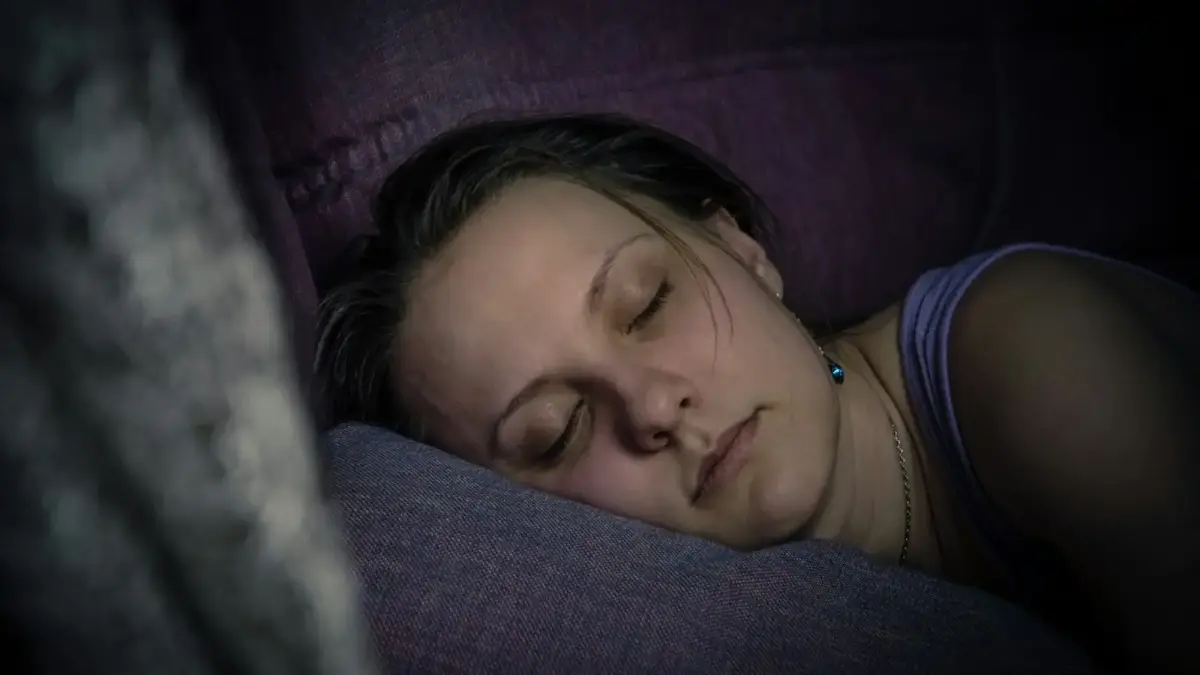
She is fifty-seven, and tonight she has decided to try it. She turns off the podcast on her phone, the one about small murders in small English villages, the one she has fallen asleep to almost every night for the last six years. The room goes quiet.
Her husband is already asleep beside her, his breathing slow and untroubled, a man whose body has apparently never learned that silence is something to survive. She lies on her back. She closes her eyes.
And immediately her shoulder blades tighten against the mattress like they are bracing for a sound that hasn’t come yet. The silence is not neutral. The silence is loud in a way she cannot describe. Her ears strain toward the hallway.
After maybe fifteen minutes she gives up, turns the podcast back on at a whisper volume, and within four minutes she is asleep. Lying there in that in-between moment, half gone already, she realizes something she has somehow never said out loud to herself in fifty-seven years. She has never, not once in her adult life, fallen asleep in true silence. And now, finally, she understands why.
The adult who needs noise to sleep
If you are this person, you already know the inventory. There is the podcast on the nightstand. There is the television left on in the background, muted sometimes, sometimes not, the blue flicker doing something for you that you could not explain if someone asked. There is the white noise app, the box fan, the sound machine set to “rain on a tent,” the audiobook playing from a Bluetooth speaker across the room.
You have been told, at various points in your life, that this is a bad habit. Your partner has gently asked if the TV could go off. Your doctor has mentioned sleep hygiene. An article you read once said blue light was wrecking your melatonin, and you felt briefly guilty and then kept doing it anyway.
You have probably explained it to yourself in small, embarrassed ways. You are a light sleeper. You have a busy mind. You need distraction. You overthink. You are addicted to your phone. You cannot sit with yourself, and this is a character flaw you keep meaning to work on.
I want to gently offer you a different explanation, because I think the one you have been using has been quietly unkind to you for a long time. It is not that you love noise. It is not that you cannot be alone with your thoughts. It is that somewhere very early, your body learned that silence meant something was wrong, and no one has ever told it otherwise.
What quiet sounded like in the house you grew up in
Think back, if you can, to the specific textures of quiet in the house where you were a child. Not loud quiet, not the pleasant hush of a snowy morning. The other kind.
The pause in the kitchen before a glass got set down too hard. The Sunday afternoon where your mother wasn’t speaking to anyone and the whole house oriented itself around the cold weather of her silence. The footsteps down the hall that you learned, without ever being taught, to distinguish from every other set of footsteps in the world.
You learned the sound of your father thinking. You learned the sound of your parents not talking after an argument, the specific geology of that silence, heavier than any shouting. You learned that right before the slammed door there was a held breath, and that held breath was silent, and that silence was the most frightening sound in the house.
Maybe your home was not dramatic. Maybe no one hit anyone. Maybe it was just that when things were about to go wrong, the adults got quiet first, and you, small and watching, were the one who had to read the temperature of the room. Children in those houses become expert readers of silence. They learn that a quiet room is not a resting place. It is a warning.
What that child’s body carried into middle age
Here is what people do not often say about growing up in a house where quiet preceded rupture. You don’t stop reading silence when you turn eighteen. You don’t stop reading it when you move out, marry, build a calmer life, raise children who have no idea what your childhood sounded like.
Your body is not a calendar. It does not know that four decades have passed. The rule it learned at six years old, that silence is the precursor to pain, is still the rule it operates by at fifty-seven, because no one has ever come into your nervous system and rescinded the order.
So when the room goes quiet at bedtime, when there is no podcast and no TV and no hum of a fan, the part of you that is still a child in a hallway tilts its head and listens. It listens for what is coming. It cannot sleep until the coast is clear, and the coast will never, by its old standards, be clear, because the old standard for safe was sound, any sound, proof of life, proof that the adults were still talking to each other, proof that nothing had gone wrong yet.
The cost shows up in ways that seem unrelated. Fragmented sleep. A low-grade tension in the shoulders that never fully lets go. A partner who does not understand why you need the television on, because his body learned a different rule. The gentle, decades-long exhaustion of a nervous system that has been on low-level duty since 1974.
What the research actually says about this
Stephen Porges, the neuroscientist who developed polyvagal theory, has spent decades describing something he calls neuroception, which is basically the body’s unconscious surveillance system for safety and threat. Neuroception runs below conscious thought. It decides, before you have any say in the matter, whether the room you are in is safe.
For a child raised in an environment where quiet preceded unpredictable rupture, neuroception learns to flag silence as a threat cue. Porges has written that these early patterns don’t update automatically with time or good intentions. The body needs specific, embodied experiences of safety, repeated often, to revise the old rule.
A 2018 study in Frontiers in Psychology looking at adults with childhood adversity histories found that baseline autonomic arousal remained elevated well into middle age, and that sleep onset in particular was affected by these early patterns. The researchers noted that what looked like insomnia or sleep anxiety was often better understood as chronic hypervigilance, a body still scanning for a threat it had learned to expect.
Bessel van der Kolk, in his work on how trauma lives in the body, has made the same point in different words for forty years. The body keeps the score. It keeps it in the shoulders, in the breath, in the way a grown woman cannot lie down in a silent room without feeling that something, somewhere, is about to go wrong. This is not weakness. This is memory, stored somewhere older than language.
The reframe, and the small permissions
So here is what I want you to hear, if you are the woman who cannot sleep without the podcast, or the man who needs the TV glow, or anyone whose nervous system still treats silence as a warning. You are not a person with bad habits. You are a person whose body is still doing the job it learned to do when you were very small, which was to stay alert for danger in a house where danger arrived quietly.
The noise on the nightstand is not a character flaw. It is a sensory substitution, a workaround your adult self has found for a rule your child self wrote. Specifically, your body needed proof, any proof, that the environment was populated, alive, not pregnant with a coming storm. The podcast does that. The television does that. The fan does that. They are telling your nervous system what no one ever quite told it: nothing bad is about to happen.
You do not have to give up the noise. I want to say that clearly. There is no moral prize for sleeping in silence, and there is nothing wrong with a grown person using a sound to feel safe.
If you want to experiment, though, there are small, gentle things that have helped me and helped women I have talked to over the years. Some of them work imperfectly, which I think is honest. A weighted blanket, because the body often accepts pressure as a substitute for sound, both of them being ways of saying you are not alone here. A short practice before bed where you name the old rule out loud, something like, the quiet in that house meant something was coming, the quiet in this house does not mean that, and then you put your hand on your chest and you let your body hear you say it.
Some people find that they can slowly shift from a podcast to a lower-stimulation sound over time, rain, a fan, nothing that carries a story. Some people find they cannot, and that is fine. The goal is not silence. The goal is for your body to eventually understand, in its own time, that the danger has passed.
The woman in the dark
She is fifty-seven and she is lying in a dark bedroom with a podcast whispering from the nightstand. Her husband is breathing slowly beside her. Her body is finally letting go of the day.
She is not an addict of noise. She is not broken, and she is not weak, and she is not failing at mindfulness. She is a grown woman whose younger body remembers, with the painful accuracy of bodies, what a quiet room used to mean.
And tonight, maybe for the first time, the older part of her can place a hand on the younger part of her and say, you don’t have to listen for it anymore. You did your job. You can sleep now. The house is safe. You can finally, finally rest.