She's 58 and has quietly realized she has never once arrived anywhere empty-handed - not to a dinner party, not to a hospital visit, not to coffee with a friend she has known for thirty years - and it was never generosity, it was a girl who learned early that her presence alone was never quite enough to justify the space she took up, so she has spent a lifetime bringing something to exchange for permission to be there
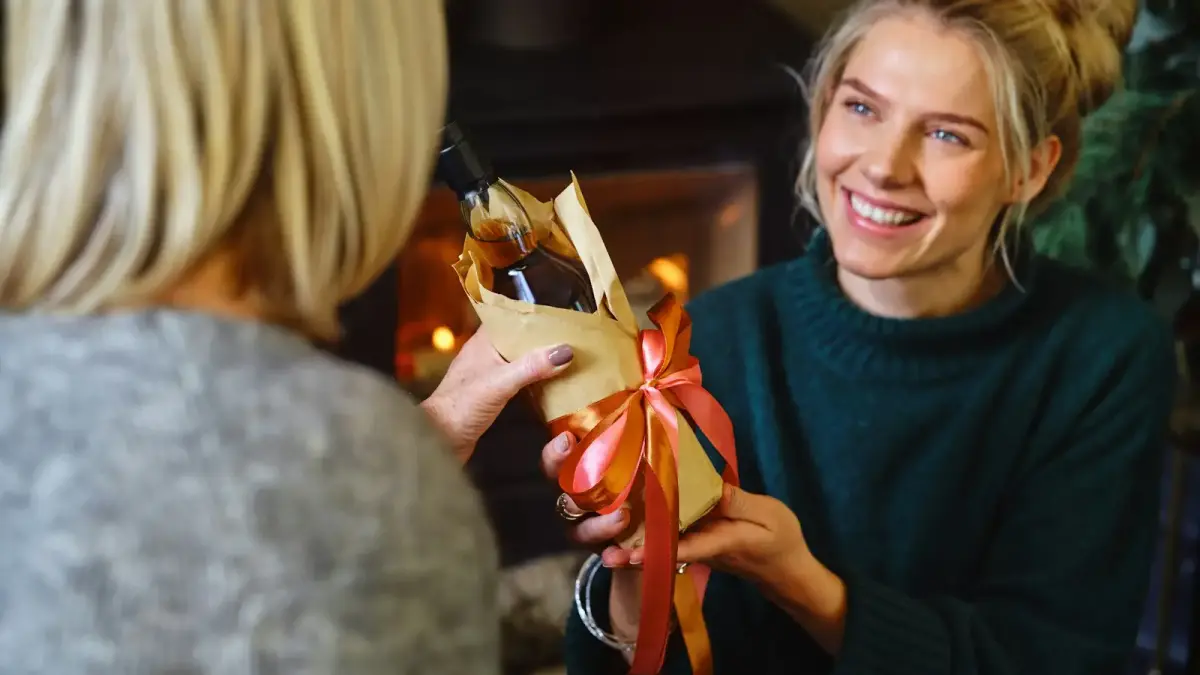
I was standing in my kitchen last Tuesday, wrapping a loaf of banana bread in parchment paper before driving to my friend Karen’s house for coffee. Just coffee. Just two women who have known each other since our kids were in diapers, sitting at a table with mugs and nothing to prove.
And yet there I was, tying a ribbon around bread I’d woken up early to bake, because some part of me could not walk through her front door with only myself to offer.
I’m fifty-eight years old. I have never once arrived anywhere empty-handed. Not once. Not to a dinner party, not to a hospital room, not to a barbecue where the host said “just bring yourself.” I have always brought something - a bottle of wine, flowers from the garden, a card I spent twenty minutes choosing. And for decades, I called this thoughtfulness. I called it being raised right. I called it who I am.
But last Tuesday, standing there with flour on my countertop and a knot forming in my stomach at the thought of showing up with nothing, I finally saw it for what it was. Not generosity. A toll. A tax I learned to pay before anyone ever told me the price.
The Girl Who Learned She Needed a Ticket
I grew up in a house where attention was earned. My mother was not cruel - she was overwhelmed, stretched thin, raising four children on a teacher’s salary while my father traveled for work. Love existed in that house, but it was rationed. It went to whoever needed it loudest or deserved it most visibly.
I was the quiet one. The easy child. The one who didn’t ask for much.
And somewhere in those early years, I absorbed a lesson that no one explicitly taught me: if you want to be welcome somewhere, you need to bring a reason. Your presence alone is not the reason. Your presence is the thing that requires justification, and the justification better be in your hands when you walk through the door.
So I became the child who made cards for every occasion. The teenager who always volunteered to help in the kitchen. The young woman who showed up to every gathering with something - anything - so that no one could look at me and think, “Why is she here?”
A 2019 study published in the Journal of Personality and Social Psychology found that people who grew up feeling conditionally accepted develop what researchers call “contingent self-worth” - a sense that their value depends entirely on what they provide to others, not on who they inherently are.
I didn’t read that study until I was fifty-six. But I’d been living it since I was six.
Everyone Calls It a Virtue
Here’s what makes this particular wound so difficult to see: the world rewards it. Constantly.
“You’re so thoughtful.” “You always remember.” “I don’t know how you do it - you never forget a birthday, never show up without something lovely.” People say these things to me with genuine admiration, and I smile, and I feel warm for a moment, and then I feel something else underneath the warmth. Something closer to relief.
Because the compliment confirms that the transaction worked. I brought something, and in return, I was granted welcome. The system held.
Brene Brown writes about how worthiness cannot be earned - that it is not a product of what we do but a birthright we either claim or spend our lives trying to purchase. I understood this intellectually for years. I recommended her books to friends. I nodded along to her TED talk.
But I never applied it to myself, because my version of unworthiness looked so much like kindness that I couldn’t see the cage inside the gift wrap.
The Moment I Couldn’t Bring Anything
Three years ago, I had surgery. Nothing life-threatening, but enough to keep me in bed for two weeks. Friends visited. They brought meals, flowers, magazines. And I lay there receiving it all with a gratitude that was half appreciation and half panic.
Because I had nothing to give back. Nothing to hand them at the door. Nothing to exchange for the right to take up space in their concern.
I remember lying in bed after my friend Diane left, crying not from pain but from the horrible vulnerability of being loved without having earned it first. Of being visited without having paid admission.
That should have been my wake-up moment. It wasn’t. I recovered, and within a week, I was baking thank-you cookies for every single person who had come to see me. Restoring the balance. Repaying the debt of being cared for.
It took three more years and one ordinary Tuesday morning before I finally let myself see it.
The Weight of a Lifetime of Tolls
When I think about the sheer volume of what I’ve carried through other people’s doorways over fifty-eight years, I feel something between exhaustion and grief. Thousands of bottles of wine. Hundreds of bouquets. Cards I agonized over. Desserts I stayed up late to bake when I was already tired. Gifts wrapped perfectly not because I enjoy wrapping but because the presentation was part of the proof that I’d tried hard enough to deserve entry.
A 2021 study from the University of Houston found that people-pleasing behaviors - particularly those rooted in childhood emotional neglect - activate the same neural pathways as anxiety responses. The body treats the act of showing up empty-handed the same way it would treat a genuine threat.
That explains the knot in my stomach. The low hum of dread I feel when someone says “don’t bring anything.” The way my hands need to be holding something - anything - when I ring a doorbell. It’s not thoughtfulness. It’s a nervous system that learned decades ago that empty hands mean vulnerable. That arriving with nothing means arriving unprotected.
What I Was Really Carrying
The banana bread was never banana bread. The wine was never wine. The carefully chosen cards were never about the words printed inside them.
Every single thing I brought was the same message, repeated endlessly: “Here. This is my reason. This is why you should let me in. This is what I’m exchanging for the right to sit at your table and take up space and time and oxygen that could go to someone who doesn’t need to justify their presence.”
I was not generous. I was bargaining. Every gift was a negotiation - my offering in exchange for your tolerance of my existence in your space.
And the worst part? It worked. For fifty-eight years it worked so seamlessly that everyone, including me, believed I was simply a thoughtful person. The wound dressed itself up as a virtue and walked through the world collecting compliments.
What It Looks Like to Put Things Down
I haven’t stopped bringing things to people’s houses. I want to be honest about that. I’m not writing this from the other side of some dramatic transformation where I show up empty-handed everywhere and feel completely fine about it.
But I’m starting to notice. That’s the beginning.
Last week, I went to Karen’s house again. I brought nothing. I drove there with my hands shaking slightly on the steering wheel and my mind inventing reasons why I should stop at the store. I didn’t stop. I walked up her path with nothing but myself and rang the bell.
She opened the door and said, “Hey, come in,” with exactly the same warmth she always has. She didn’t look at my empty hands. She didn’t pause or seem confused. She just moved aside and let me through.
I sat at her kitchen table, and for a few minutes, I felt almost unbearably exposed. Like I was getting away with something. Like any moment she might realize I hadn’t brought anything and the welcome would be revoked.
It wasn’t. We drank coffee. We talked for two hours. I drove home and cried in my driveway - not from sadness, but from the strange, shaky relief of discovering that the toll booth I’d been paying at my entire life didn’t actually have anyone working inside it.
The Permission Was Never Theirs to Give
Gabor Mate talks about how children adapt to survive their emotional environments, and how those adaptations become invisible to us because they feel like personality rather than protection. “I’m just a generous person” is easier to live with than “I learned at five years old that I wasn’t enough without a gift in my hands.”
But here’s what I’m slowly letting myself believe at fifty-eight: I was always enough. The bread was lovely, but it was never the reason Karen opened the door. The wine was appreciated, but it was never the price of admission to my friend’s dining room. The cards were kind, but they were never the thing standing between me and belonging.
I was. I always was. Just me, with my empty hands and my whole self, walking through a door I never needed permission to enter.
If you recognize yourself in any of this - if you’re the one people call “so thoughtful” and something in your chest tightens when you hear it because you know it’s not quite the whole story - I want you to know something. The weight you’ve been carrying to earn your place in rooms full of people who already love you? You can set it down. Not all at once. Not perfectly. But you can begin to notice it, and noticing is the first and bravest thing.
You were never a burden requiring compensation. You were a child who found an elegant solution to an impossible problem. And now you’re allowed to let the solution go, because the problem was never real. You were always, always enough to walk through the door with nothing but yourself.