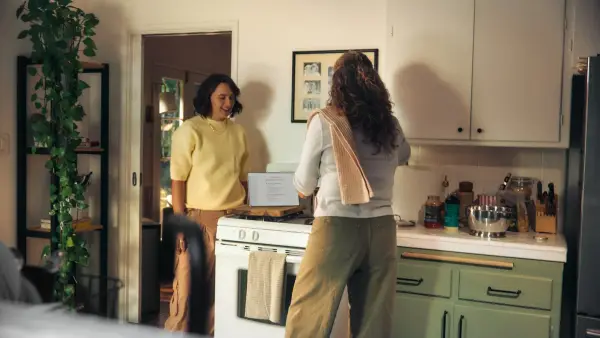
She is 59 and has just realized she has spent her entire marriage pretending she does not know how to use the lawnmower, the power drill, or the circuit breaker - not because she is helpless or incurious but because a girl who watched her mother carefully preserve her father's sense of usefulness in the household learned that a woman's competence is something you reveal selectively, in doses that never threaten the balance of a home built on the unspoken agreement that he fixes and she manages

The garbage disposal and the ten-minute secret
Last March, my husband flew to Phoenix to visit his brother. He left on a Thursday morning. By Thursday afternoon, the garbage disposal had jammed.
I stood at the kitchen sink and listened to the low, grinding hum of a motor that wouldn’t turn. And then I did something I have done exactly eleven times in thirty-three years of marriage - I fixed it myself.
I found the hex wrench in the junk drawer, crawled under the sink, inserted it into the slot at the bottom of the unit, and worked the blades free. The whole thing took less than ten minutes. I ran the water, flipped the switch, and the disposal hummed back to life like nothing had happened.
Then I washed the wrench, dried it, and placed it back in the exact spot where I found it.
When David called that evening and asked how things were going at the house, I said everything was fine. I did not mention the disposal. If it had jammed while he was home, I would have stood at the sink and said, “Something’s wrong with this thing again,” and he would have fixed it while I made dinner. That is how it works. That is how it has always worked.
I am 59 years old, and I have just realized I have been performing a version of helplessness so practiced, so seamless, that I almost forgot it was a performance at all.
What my mother taught me without saying a word
My mother could change a tire in under fifteen minutes. I know this because I watched her do it once when I was nine, on the shoulder of Route 4 on the way home from my grandmother’s house. She moved with a quiet efficiency that startled me - the jack positioned, the lug nuts loosened in a specific order, the spare pulled from the trunk like she’d rehearsed it.
When we got home, she told my father we’d had a flat and that a nice man had stopped to help us.
She could also fix a leaky faucet, re-caulk a bathtub, and rewire a table lamp. She did these things only when my father was at work or out of town, and she did them the way someone commits a small, private crime - quickly, thoroughly, and without leaving evidence.
I never asked her why. I didn’t have to. I understood the lesson the way children understand most of the important lessons - not through words but through the texture of what was never said.
My father was a good man. He was kind. He worked hard. And he needed to be needed in specific, tangible ways. My mother understood this the way she understood weather patterns and grocery prices - as a fact of the environment she moved through. She loved him. Part of how she loved him was by keeping certain abilities invisible.
A 2019 study published in the Journal of Personality and Social Psychology found that women in long-term heterosexual relationships frequently engage in what researchers call “relational accommodation” - the strategic downplaying of personal competence to maintain relationship harmony and protect a partner’s sense of contribution. The study noted that this behavior is rarely conscious. It becomes so woven into the fabric of daily life that the woman performing it often no longer recognizes it as a choice.
My mother would have called it common sense. I called it love. I am not sure I was wrong. But I am no longer sure I was right, either.
The taxonomy of things I pretend not to know
There is a pattern to what I hide and what I show, and it is not random.
I can organize a holiday dinner for twenty-two people, coordinate three children’s school schedules, manage the household budget down to the dollar, and keep track of every birthday, anniversary, and doctor’s appointment for every member of our extended family. These skills I display openly. These are allowed.
But I pretend I don’t know how to start the lawnmower. I pretend the circuit breaker panel confuses me. I hand David the power drill like it’s an artifact from a civilization I don’t understand. When a picture needs to be hung, I hold it against the wall and say, “Is this level?” even though I own a level and know how to use it.
The mechanical, the technical, the physical - these belong to him. The emotional, the organizational, the relational - these belong to me. Neither of us ever sat down and drew up this contract. We didn’t have to. We inherited it, the way you inherit a house with walls already standing. You don’t question the floor plan. You just arrange your furniture inside it.
A 2021 study in Frontiers in Psychology examined what researchers termed “competence concealment” in marriages lasting more than twenty years. They found that a significant number of women reported deliberately understating their ability to perform tasks traditionally associated with male roles - not because they felt incapable, but because they intuitively understood that demonstrating those skills would disrupt an equilibrium both partners depended on.
The researchers used a phrase that landed in my chest like a stone: “performed dependency as relational currency.”
I have been spending that currency for thirty-three years.
The cost of a life-sized disguise
Here is the thing nobody tells you about pretending to be less than you are: it works. The relationship stays balanced. The household runs smoothly. Your husband feels valued. You feel loved.
And then one day you are standing in your garage, alone, looking at a shelf you could build with your eyes closed, and you realize you don’t fully know what you are capable of.
That is the cost. Not anger. Not resentment. Something quieter and harder to name. A slow erosion of your own self-knowledge.
I catch myself sometimes, reaching for the jar I cannot open. My hands are strong. I open jars when David isn’t home. But when he is home, some part of me automatically softens my grip, hands it over, watches him twist the lid free. And there is something in his face when he does it - a small satisfaction, a quiet confirmation that he is still necessary in the most basic, physical sense - that I have been protecting since the first year of our marriage.
Brene Brown has written about the way vulnerability operates differently in men and women. For men, she observed, vulnerability often means admitting you cannot do something. For women, it sometimes means the opposite - admitting that you can.
I have been vulnerable in every direction except the one that would require David to see me as fully capable in his domain. That is not a small thing to realize about yourself at 59.
The unspoken bargain
Every long marriage has one. A silent contract signed by neither party and honored by both. Ours says: he provides physical competence, and I provide emotional competence. He fixes the dryer. I fix the Thanksgiving argument between his mother and his sister. He knows which fuse controls the upstairs bathroom. I know which tone of voice means he’s had a bad day but doesn’t want to talk about it yet.
The bargain is not entirely false. David genuinely is handy. He genuinely does know things about engines and wiring and plumbing that I would have to look up. But the gap between his competence and mine is much smaller than we both pretend it is.
And here is the part that keeps me up at night: I think he might know. Not consciously. Not in words. But in that wordless way that two people who have shared a bed for three decades know things about each other that neither has the language to say.
A 2023 study published in the Journal of Research in Personality explored what they called “mutual role preservation” in long-term couples. The finding that gutted me was this: in the majority of couples studied, both partners were at least partially aware that they were performing exaggerated versions of their designated roles. Both knew. Neither said anything. The researchers described it as a kind of collaborative theater - a production that both actors had agreed to stage without ever discussing the script.
David hands me the jar to open. I soften my grip. He twists the lid. We both play our parts. The show goes on.
Watching my daughter refuse the script
My daughter Claire is 31. She owns a cordless drill and a table saw. She built the bookshelves in her apartment. When something breaks, she watches a YouTube video and fixes it herself, and she does this openly, without apology, without any of the careful concealment that shaped my mother’s life and then shaped mine.
I watch her and I feel two things at once.
The first is pride - fierce, uncomplicated pride. She does not diminish herself for anyone. She does not soften her grip. She does not pretend the circuit breaker is a mystery. She is free of the performance I have been staging for her entire lifetime, and that freedom looks like exactly what I wanted for her without ever being able to name it.
The second feeling is harder. It is a kind of grief, though that word feels too heavy. More like a recognition that the thing I did - the decades of careful concealment, the strategic incompetence, the love expressed through deliberate smallness - was not nothing. It cost me something I cannot fully recover. And naming it does not undo it. It just means I can finally see the shape of what I gave away.
Claire asked me once, a few years ago, why I always let Dad handle the “house stuff.” I said something vague about division of labor. She looked at me the way only a daughter can look at her mother - with a tenderness that barely conceals a challenge.
“Mom,” she said. “You rebuilt the back porch railing by yourself when I was twelve. I watched you.”
I had forgotten she saw that. Or maybe I had chosen to forget.
What this is really about
I want to be very clear about something: I am not angry at David. I am not angry at my mother. I am not angry at the world that taught us this particular dance.
This is not a story about oppression. It is a story about the quiet, almost invisible accommodations that people make for the people they love - and the way those accommodations can become so complete that you forget you are making them.
My mother loved my father. I love David. These are not small things, and the love is not diminished by the fact that it sometimes expressed itself through strategic concealment. Love is messy. It makes you do strange, complicated things. Sometimes it makes you hide your competence in a kitchen drawer next to a hex wrench you’re not supposed to know how to use.
But I think there is something important about naming it. About saying, out loud, to no one in particular: I know how to use the lawnmower. I have always known. I chose not to, and the reasons were complicated, and some of them were generous, and some of them were fear, and untangling which was which is the work of a lifetime.
I am 59. I have time.
Last week, the kitchen faucet started dripping. David was home. I could see him notice it, could see him start to calculate when he’d get to it.
I did not fix it myself. I am not there yet. But I did something I have never done before.
I said, “I think I know what’s wrong with it. The washer probably needs replacing.”
He looked at me. Just for a moment. Something moved across his face - not surprise exactly, but a kind of recalibration. As if a wall he had always known was there had shifted by an inch.
“Yeah,” he said. “That’s probably what it is.”
It was a small moment. Almost nothing. But it was mine, and it was true, and after thirty-three years of careful performance, that felt like more than enough to start with.