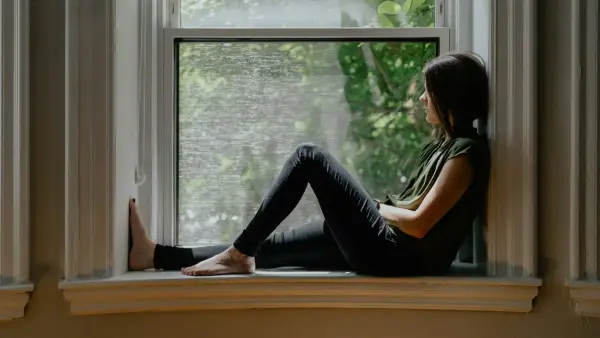
She's 60 and just realized she has never once asked for directions - not because she always knew where she was going but because a girl who asked a question once and watched her father's jaw tighten learned that a woman who needs help navigating is a woman who is in the way
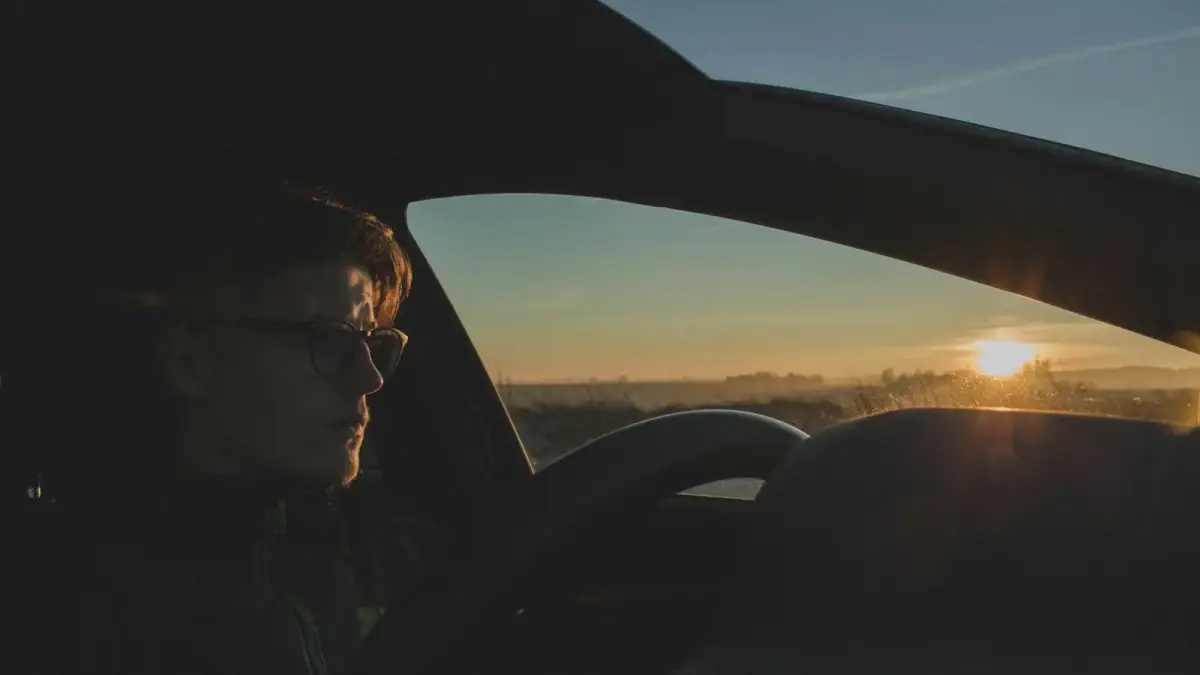
The parking garage
I circled the third floor of a hospital parking garage for eleven minutes last Tuesday.
I know it was eleven minutes because I watched the clock on my dashboard tick forward while I looped past the same dented silver minivan three times, looking for the pedestrian exit to the oncology building. There was an attendant booth twenty feet from where I finally parked. A man in a yellow vest was sitting right there, doing nothing, waiting for exactly the kind of question I could not bring myself to ask.
I found the building eventually. I always do. But I sat in the waiting room afterward thinking about those eleven minutes - about every version of those eleven minutes I have lived over six decades - and something shifted in my chest that I have not been able to shift back.
I am sixty years old. I have driven across this country twice. I have navigated airports in cities where I did not speak the language. I have found obscure restaurants, rural hospitals, government offices tucked behind strip malls. And I have never - not once, not in sixty years - asked another human being for directions.
Not because I have some miraculous sense of direction. I don’t. I get lost constantly.
I just learned very early that getting lost was better than being a burden.
The jaw
I was maybe seven. We were driving somewhere - I think to my grandmother’s house, though the destination has gone soft in my memory the way childhood details do. What hasn’t gone soft is the question I asked from the backseat.
“Daddy, are we lost?”
Three words. A child noticing that the same gas station had appeared twice. An observation, really. Not even a complaint.
His jaw tightened. I watched it happen from behind - the way the muscle just below his ear went rigid, the way his hands repositioned on the steering wheel. He didn’t yell. He didn’t need to. The silence that followed was a complete sentence.
My mother, sensing the shift, said something bright and deflective. “Oh, we’re just taking the scenic route.” She turned around and smiled at me, and in that smile was an entire curriculum: don’t question him. Don’t draw attention to what he doesn’t know. Don’t make a man feel lost by naming it out loud.
I don’t think my father was a bad man. I think he was a man who had also been taught something brutal about not knowing - that it was failure, that it was weakness, that a man who doesn’t know where he is going has no business being in the driver’s seat. His jaw wasn’t really tightening at me. It was tightening at himself.
But I was seven. And what I learned was this: a girl who asks a question is a girl who is in the way.
Forty-five years of extra miles
The thing about a lesson you learn at seven is that it doesn’t stay about directions.
It becomes the architecture of how you move through the world. The girl who learned not to ask “are we lost” becomes the teenager who doesn’t ask the teacher to explain the math problem again. She becomes the young woman who doesn’t ask her boss to clarify the assignment. She becomes the wife who doesn’t ask her husband what he meant by what he said at dinner because the act of not understanding feels like a personal failing she should handle privately.
A 2019 study published in the Journal of Personality and Social Psychology found that women are significantly more likely than men to perceive help-seeking as a sign of incompetence - not because they inherently believe it, but because they have been socially conditioned to associate their own needs with inconvenience. The researchers called it “help-seeking aversion,” and they found it was strongest in women who grew up in households where emotional needs were treated as disruptions.
I read that and felt my whole body recognize itself.
I have spent forty-five years driving extra miles. Not just literally - though literally, too. I once drove twenty-six additional minutes through a town I had never been to rather than stop at the gas station I was passing to ask someone which road led to the interstate. Twenty-six minutes. I timed it afterward, retracing my route on a map, calculating the cost of my silence.
But the extra miles are everywhere. They are the hours I have spent trying to figure out health insurance paperwork alone rather than call the number on the card. They are the two weeks I spent struggling with a new phone rather than walk into the store and ask someone to show me how it worked. They are the decades of quietly absorbing confusion rather than speaking the sentence that would have resolved it in thirty seconds: “I don’t know. Can you help me?”
The woman who gives directions but cannot take them
Here is the part that embarrasses me most.
I am excellent at giving directions. If you are lost, I will walk you to where you need to go. I will draw you a map on a napkin. I will call ahead to wherever you are headed and get you the exact cross streets. I will be patient, thorough, kind. I will treat your not-knowing as the most natural thing in the world - because it is.
I simply cannot extend that grace to myself.
This is the paradox that Brene Brown has written about so precisely - the way we can hold compassion for everyone’s vulnerability except our own. The woman who tells her friend “there’s no shame in asking” is the same woman who will wander a hospital parking garage for eleven minutes because asking feels like an admission of something she has spent her entire adult life trying to disprove.
That she is capable. That she belongs here. That she is not in the way.
A 2021 study in Frontiers in Psychology examined what researchers called “self-reliance as identity protection” in women over fifty. They found that many women in this age group had constructed their entire sense of self around not needing help - not because they valued independence in the abstract, but because they had learned that needing help made them less valuable. The need itself was the threat. Not the problem they couldn’t solve. The fact that they couldn’t solve it alone.
I read that finding in my living room on a Tuesday afternoon and I cried for twenty minutes. Not dramatic crying. The quiet kind. The kind where your body is just releasing something it has held for so long that it forgot it was holding it.
What the girl was really asking
When I asked my father if we were lost, I wasn’t challenging him. I wasn’t testing his competence. I was doing what children do - trying to make sense of my environment by naming what I observed.
But in a household where a man’s authority was threatened by a seven-year-old’s honest question, my curiosity became an imposition. My noticing became a problem. My need to understand became evidence that I was too much.
Gabor Mate has written about how children don’t just learn from what they are told - they learn from what happens in the room when they speak. The words matter less than the atmospheric shift. A child can hear “it’s fine, sweetie” and simultaneously register the tightened jaw, the rigid hands, the temperature change in the car. And the child’s nervous system files that atmospheric data as the real answer.
The real answer I filed was: your questions make people uncomfortable. Your not-knowing is a weight on the people around you. Navigate alone or be navigated around.
The distance between “I don’t know” and “I’m not worth someone’s patience”
I have been thinking about this for weeks now, and what I keep coming back to is the distance.
The distance between “I don’t know where I’m going” and “I am not worth someone stopping to help me get there.” In my mind, those two sentences have always been the same sentence. I never separated them. I never realized there was space between not knowing something and not deserving patience while I figured it out.
But there is enormous space there. An entire life’s worth of space.
Because “I don’t know” is just information. It is a coordinate. It is the starting point of every worthwhile conversation, every real connection, every honest relationship. “I don’t know” is where learning begins and where pretending ends.
It was never dangerous to not know. It was dangerous to not know in a room where someone else’s pride depended on everyone pretending they did.
Pulling over
I did something last week that I have never done before.
I was driving to a friend’s new apartment - a neighborhood I had never been to, streets that wound around in ways my phone’s GPS was struggling with. I missed a turn. Then I missed the correction. Then I was on a road I did not recognize, and my phone was recalculating, and I could feel the old familiar tightness in my own jaw - the inherited tension, the muscle memory of a man who has been dead for fifteen years still telling me that not knowing where I am is not something I am allowed to say out loud.
I pulled into a coffee shop parking lot. I sat there for a moment. And then I got out of the car, walked inside, and asked the woman behind the counter if she knew how to get to Birch Street.
She smiled. She told me. It took about forty seconds.
I sat back in my car afterward and I didn’t cry. I just breathed. Forty seconds. That is what forty-five years of extra miles had been protecting me from. Forty seconds of being a person who doesn’t know where she is going, standing in front of another person, and finding out that the world does not end when you say it.
You were never in the way
If you are reading this and you recognize yourself - the woman who drives extra miles, who Googles frantically rather than ask, who will spend an hour confused before she will spend thirty seconds vulnerable - I want you to hear something.
You were never in the way. Your questions were never too much. Your not-knowing was never a burden. You were a child trying to understand the world, and someone made you believe that understanding was something you were supposed to arrive at silently, without inconveniencing anyone with the process.
That was their limitation. Not yours.
A 2023 study in Psychological Science found that the single strongest predictor of relational satisfaction in adults over fifty was not conflict resolution or shared interests - it was the willingness to ask for help and the belief that asking would be met with warmth. The people who could say “I don’t know” to the people they loved - and trust that the response would be patience rather than contempt - reported the deepest sense of belonging.
You deserved that. You always did.
The parking garage, the gas station, the hotel concierge, the phone store, the government office - none of these were tests of your competence. They were just places where a woman who learned to navigate alone could have rested for a moment and let someone else hold the map.
You are sixty years old, or fifty, or forty-five, and you have driven so many extra miles. You have earned the right to pull over. To walk inside. To ask.
It takes about forty seconds. And the world does not end.