She's 61 and finally understood the reason she apologizes every time she cries - it's not embarrassment, it's the girl who was told her tears were an inconvenience
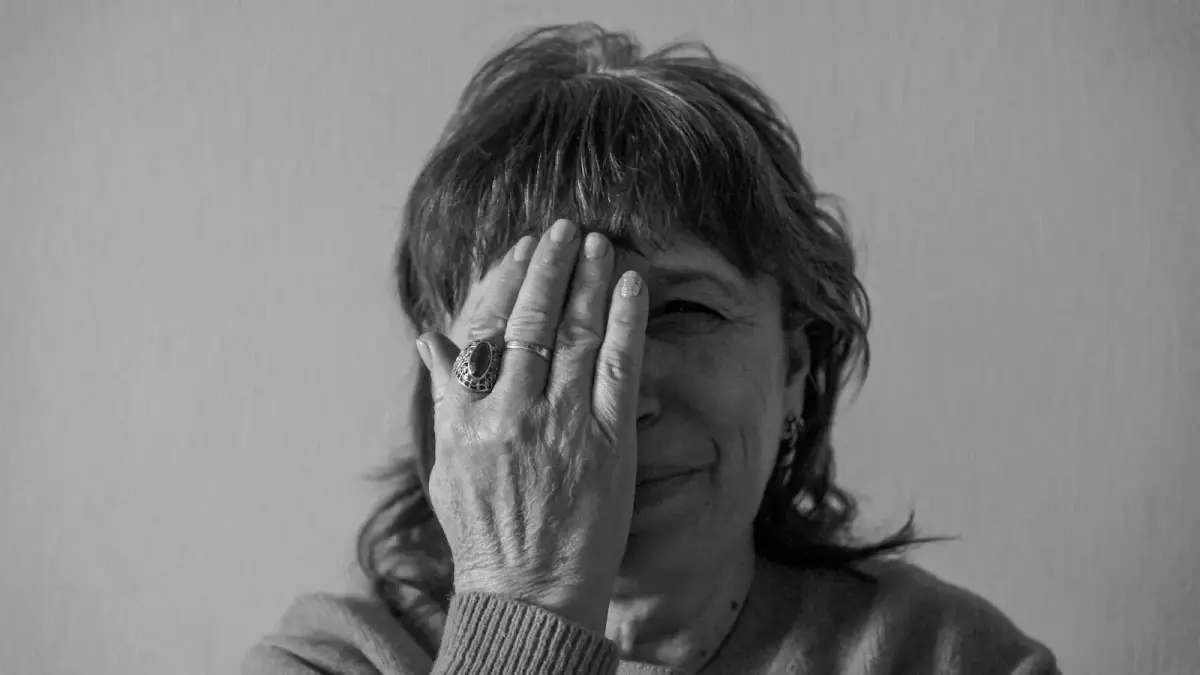
I watched a woman at a funeral last year do something that stopped me mid-breath.
She was standing near the back, holding a tissue she hadn’t used yet, and when the eulogy hit a line about the deceased’s laugh - something small and true - her chin started to tremble. Tears came fast. And before a single one had reached her jaw, she whispered to the woman beside her, “Sorry. I’m sorry. I don’t even know why I’m doing this.”
She knew exactly why she was doing it. She was grieving. But her body had learned, decades ago, that the tears were not the problem. The problem was other people having to witness them.
I recognized that reflex because I have lived inside it for most of my life. The automatic apology. The laugh that follows the cry. The immediate pivot to reassuring everyone around you that you’re fine, you’re okay, you don’t know what came over you. As if sadness were a spill you needed to clean up before anyone slipped on it.
I am 61 years old and I only recently understood where that reflex came from. It did not come from embarrassment. It came from a nine-year-old girl who learned that her tears made the people she loved most visibly uncomfortable - and decided, without anyone asking her to decide, that she would never be the reason a room felt heavy again.
The apology that arrives before the tear does
Here is what nobody talks about when they talk about “emotional suppression.”
They talk about people who don’t cry. They talk about stoicism, about bottling things up, about the strong silent types who carry everything inside. But there is another version that is far more common and far less visible.
It is the woman who cries freely - and then immediately apologizes for it.
She is not suppressing the emotion. The emotion comes. It comes at movie trailers and wedding toasts and phone calls from old friends and that one song from 1987 that she can never hear without her throat tightening. The tears arrive on schedule, every time.
But so does the apology.
“Sorry, I’m being ridiculous.”
“Ignore me, I’m fine.”
“God, I don’t know what’s wrong with me today.”
She is not asking for permission to cry. She is performing a ritual she mastered in childhood - the ritual of making her pain smaller so nobody else has to feel the weight of it. She is crying and simultaneously narrating her own crying as silly, irrational, embarrassing, and temporary. She is producing the emotion and the disclaimer at the same time.
And she has been doing it for so long that she genuinely believes the apology is just politeness.
It is not politeness. It is the scar.
Where the reflex was built
Somewhere between the ages of five and twelve, a girl learns what her tears do to the room.
In some homes, the lesson is loud. “Stop crying or I’ll give you something to cry about.” “You’re being dramatic.” “There’s nothing to cry about.” “Here we go again.” In other homes, the lesson is quieter but equally effective. A parent who sighs. A father who leaves the room. A mother whose face tightens into something that looks like exhaustion, or disappointment, or controlled irritation.
The girl does not need to be told in words. She reads the room. Children are extraordinary readers of rooms.
A 2019 study published in Developmental Psychology found that children as young as four adjust their emotional expression based on how caregivers respond to distress - not just whether comfort is offered, but the caregiver’s facial expression during the comforting. In other words, a parent can say “it’s okay” while their face says “this is exhausting,” and the child registers the face, not the words.
So the girl learns. Not that crying is wrong, exactly, but that crying has a cost. It costs the people around her something - patience, energy, composure. And because she loves these people, because she is small and dependent and wired for attachment, she begins to build a workaround.
She will still cry. She cannot help that. But she will make the crying smaller. She will apologize for it before anyone has to ask her to stop. She will frame it as irrational so they do not have to. She will laugh through it, wave her hand, say “I’m fine” with wet cheeks, and redirect the conversation back to something that does not require anyone to sit with her discomfort.
She will carry this workaround into every relationship she ever has.
The woman she becomes
At 35, she tears up during an argument with her partner and immediately says, “I’m not trying to manipulate you. I just - I can’t help it. I’m sorry.”
She has been accused of using tears as a weapon exactly once, maybe twice, and it branded itself into her memory so deeply that she now preemptively defends herself every time moisture gathers in her eyes. She is not manipulating. She is having a feeling. But she has learned that having a feeling in the presence of another person requires a legal defense.
At 44, her daughter finishes a school play and she is standing in the auditorium with tears streaming down her face, and she turns to the other parents and says, “I’m such a mess, honestly. Don’t look at me.” She is proud. She is overwhelmed with love. But her body cannot produce that love without also producing the apology for displaying it.
At 53, she gets difficult news from a doctor and her first instinct - before fear, before grief, before the full weight of it lands - is to smile. To say “Okay” in a voice that is steady and bright. To make the doctor comfortable. To be a good patient. She will cry in the car. She will cry at home. But she will never cry in a room where someone might have to do something about it.
At 61, she watches a commercial about a father walking his daughter down the aisle, and she feels her eyes fill, and she says to nobody - because she is alone - “Oh, come on.”
She is policing herself in an empty room. The audience left decades ago, but the performance continues.
Why “stop being so sensitive” is the most expensive sentence in the English language
Dr. Jonice Webb, a clinical psychologist who has spent years researching what she calls Childhood Emotional Neglect, describes a pattern that is strikingly consistent across her patients: adults who are deeply empathic, highly attuned to others, and fundamentally unable to take their own emotions seriously.
They feel everything. They just do not believe their feelings are valid data.
This tracks with research published in the Journal of Personality and Social Psychology in 2021, which found that individuals who received dismissive responses to emotional expression in childhood were significantly more likely to engage in what researchers call “emotion appraisal discounting” - a pattern where the person experiences a strong feeling and then immediately reframes it as disproportionate, irrational, or inappropriate.
They are not suppressing the feeling. They are feeling it and then arguing with themselves about whether they are allowed to feel it.
The woman who apologizes for crying is doing exactly this. She is not ashamed of tears in general. She will comfort a friend who is crying without hesitation. She will hold space for her children’s grief with extraordinary tenderness. She will watch a stranger weep and feel nothing but compassion.
It is only her own tears that require an explanation.
It is only her own pain that seems, somehow, excessive.
The body remembers what the mind renames
Here is something I wish someone had told me thirty years ago.
Crying is not a malfunction. It is data. A 2014 study in Frontiers in Psychology found that emotional tears contain stress hormones - specifically adrenocorticotropic hormone and leucine enkephalin - that the body is literally flushing out. Crying is not your body falling apart. It is your body doing maintenance.
When you cry at a movie trailer, your body is recognizing something true. When you cry at a wedding, your body is registering the enormity of love and time and fragility. When you cry at bad news, your body is doing exactly what it was designed to do with information that hurts.
The tears are correct.
The apology is the learned part.
And the distinction between those two things is the entire point. For fifty years, I believed the apology was just manners. Just something polite people did when they made a scene. But the apology was never about manners. The apology was a nine-year-old girl’s solution to a problem no nine-year-old should have to solve: how to have feelings without burdening the people she needs most.
That solution worked. It kept the peace. It kept her safe. It kept the adults in her life from having to confront their own discomfort with emotion.
But it also taught her something that became the foundation of every relationship she built afterward: your feelings are real, but they are also a little bit too much, and the kind thing to do is to make them smaller before anyone notices how big they actually are.
What she is actually saying when she says “sorry”
She is not saying sorry for crying.
She is saying: I know this is inconvenient. I know you didn’t sign up to witness this. I know that my pain creates an obligation you didn’t ask for, and I want you to know that I am handling it, that I will be fine, that you do not need to do anything, that this moment of rawness will pass quickly and I will be the version of me that is easier to be around.
She is saying: please don’t leave the room.
Because that is what happened when she was small. Someone left the room. Someone sighed. Someone made her understand, in the language of body and silence, that her tears were a request they did not want to fill.
And she has been pre-answering that rejection ever since.
The thing that changes at 61
I cannot tell you there is a clean moment when this stops. There is no epiphany that undoes fifty years of muscle memory. I still apologize sometimes. I still laugh when I should let myself be still. I still feel the pull to narrate my own sadness as if it is a quirky character trait rather than a real experience happening inside a real body.
But something has shifted. And the shift was not dramatic. It was just this: I stopped believing the apology was mine.
It was never mine. It was given to me by people who could not sit with emotion - their own or anyone else’s. It was a hand-me-down coping mechanism from adults who themselves were never taught that feelings are safe to have in the presence of another person.
I don’t blame them. I understand them better now than I did at nine. But I also no longer carry their discomfort and call it my personality.
If you are the woman who apologizes for crying - and you know if you are, because you felt something in your chest two paragraphs ago - I want to tell you something that nobody said to the girl who started this.
Your tears are not an inconvenience. They never were.
They are your body telling the truth in the only language it has that cannot be edited, polished, or made more palatable. They are proof that you are paying attention to your own life. That things reach you. That you are not numb, not distant, not “fine.”
You do not owe anyone an apology for being moved by your own existence.
The girl who learned to say sorry was brilliant. She kept herself safe in a home that could not hold her feelings. But you are not nine anymore. And the room you are standing in now has more space than you think.
Let the tears come. And when the apology rises in your throat - because it will, it is old and practiced and automatic - see if you can let it pass without speaking it.
Just once. Just to feel what it is like to cry without narrating it.
You might find that the silence after a tear, without the sorry, without the laugh, without the explanation - that silence is the first honest thing you have let yourself feel in a very long time.