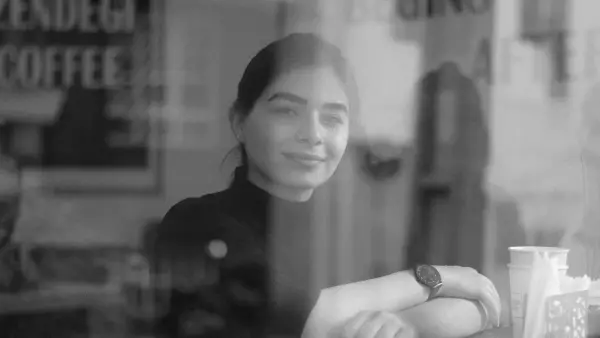
She is 63 and just realized she has never once told the full story of her childhood to anyone - not her husband of thirty-seven years, not her closest friend, not the therapist she saw for eight months in her forties - because a girl who tried once to explain what it was really like at home and watched the listener's face change learned that certain childhoods are easier to carry alone than to watch someone else try to hold, and the sixty-three-year-old who says 'oh it was fine, we didn't have much but we were happy' at every dinner party is not lying but editing, because the unedited version has never found a room that felt safe enough to hear it
The Rehearsed Version
I have a friend - I’ll call her Diane - who tells the funniest stories about growing up. The powdered milk her mother bought in bulk. The one bathroom shared by six people. The way her father would fall asleep in his chair before dinner was even on the table.
She tells these stories at parties with a warmth that makes everyone lean in. People laugh. They say things like “those were simpler times” and “kids today could never.”
And Diane laughs too.
What nobody at the table knows is that Diane has been telling a version of her childhood for over forty years. A curated, softened, strategically funny version that leaves out the parts that would make the laughter stop.
She’s sixty-three now. And she recently told me something I haven’t been able to stop thinking about. She said she has never - not once, not to anyone - told the complete, unedited truth about what her childhood was actually like.
Not to her husband of thirty-seven years. Not to her best friend since college. Not even to the therapist she saw twice a week for eight months in her mid-forties.
And the reason isn’t what you’d think.
The Moment the Story Got Locked Away
Diane tried once. She was twenty-four. Sitting across from a college friend in a diner booth, two glasses of wine in, feeling brave for the first time.
She started telling the real version. Not the funny version. The version with the fear in it.
And she watched her friend’s face change.
It wasn’t judgment. It was worse than that. It was a kind of horrified pity that made Diane feel like she had just become something fragile and broken in her friend’s eyes. The friend reached across the table and squeezed her hand and said, “Oh my God, I had no idea.”
And Diane felt - in her body, immediately - that she had made a mistake.
She spent the rest of the evening reassuring her friend that she was fine. That it wasn’t that bad. That she’d turned out okay. She drove home feeling heavier than before she’d spoken, not lighter.
That was the last time she tried.
A 2019 study published in the Journal of Personality and Social Psychology found that people who disclose traumatic experiences often report feeling worse afterward - not because disclosure itself is harmful, but because the listener’s response determines whether the experience feels validating or retraumatizing. When the listener recoils, minimizes, or becomes visibly distressed, the person who shared ends up carrying a second burden: the emotional labor of managing the listener’s reaction to their pain.
Diane didn’t learn that her story was shameful. She learned that her story was heavy. And she decided, at twenty-four, that she would carry it herself rather than watch anyone else buckle under the weight.
The Art of the Careful Omission
Here’s what people don’t understand about someone like Diane. She’s not hiding. She’s not in denial. She’s not repressing memories.
She remembers everything.
She has simply become so skilled at editing that the edited version feels like the truth now. She’s told the lighter version so many times - at dinner parties, at family gatherings, in passing conversations with coworkers - that it has a rhythm and a shape. It has punchlines. It has a beginning, middle, and end that leaves everyone comfortable.
The unedited version has none of those things. It’s messy. It doesn’t resolve neatly. It would require her to sit in a room and watch someone she loves try to absorb something that took her decades to absorb herself.
And she has decided, quietly and without fanfare, that she would rather be slightly unknown than put someone she cares about through that.
This is something psychologist James Pennebaker’s research on expressive disclosure has circled for years. Writing about trauma in private consistently improves health outcomes. But verbal disclosure - telling someone face to face - only helps when the listener can hold the story without crumbling, without fixing, without turning the teller into a project. When the listener can’t do that, the teller doesn’t just stay silent next time. They build an entire architecture of silence. They become the person who says “oh, it was fine” with such practiced ease that nobody thinks to press further.
Diane has dinner parties where she is warm and generous and present. She asks about other people’s lives. She remembers birthdays. She is the friend everyone calls when they’re struggling.
Nobody calls her when she’s struggling, because she has never let them see her struggle. Not because she doesn’t trust them. But because she tried trusting once, and it cost her something she couldn’t name.
The Paradox Nobody Talks About
There’s a cruel irony buried in all of this.
Every therapist, every self-help book, every well-meaning friend will tell you that intimacy requires vulnerability. That to be truly known, you have to let people see the real you. That the path to connection runs straight through the hard conversations.
And they’re right. In theory.
But here’s what that advice never accounts for: vulnerability requires safety. And safety requires evidence. And the only way to gather evidence is to be vulnerable first.
For Diane, the evidence she gathered at twenty-four said: this is not safe. One data point. One diner booth. One friend’s face changing. And that was enough to close the door for four decades.
A 2021 study in Frontiers in Psychology examined what researchers call “disclosure risk assessment” - the unconscious calculation people make before sharing sensitive personal information. The study found that a single negative disclosure experience in early adulthood can shape disclosure behavior for a lifetime. People who received a poor response to vulnerability didn’t just avoid that specific listener afterward. They generalized the lesson. They stopped testing new rooms, new relationships, new contexts. The door didn’t just close on one person. It closed on everyone.
This is the paradox Diane lives inside. She is deeply loved. She has a marriage that works, friendships that sustain her, a life that looks - and often genuinely feels - full. But there is a room inside her that nobody has ever entered. Not because the door is locked with shame. It’s locked with protection.
She is protecting the people she loves from a story she believes is too much for them.
And she is protecting herself from watching them prove her right.
What the Husband Doesn’t Know He Doesn’t Know
Diane’s husband, Tom, knows more than most. He knows her parents were difficult. He knows the house was chaotic. He knows she doesn’t like to talk about it much.
What he doesn’t know is how much he doesn’t know.
He doesn’t know about the specific moments. The ones that don’t have a funny version. The ones she has replayed alone in bed at two in the morning for thirty-seven years while he slept peacefully beside her.
And here is the part that would break your heart if you let it: Diane doesn’t blame Tom for not knowing. She blames herself for not being the kind of person who can hand someone the full weight of where she came from and trust that the relationship will hold.
She told me once, very quietly, “I think he’d want to know. I think he’d try to understand. But I also think it would change how he sees me. And the way he sees me now - as someone strong, someone who came from nothing and built a good life - I can’t lose that.”
Gabor Mate has written extensively about how childhood trauma doesn’t just shape what we fear. It shapes what we believe we deserve. Diane doesn’t consciously think she deserves to be unknown. But somewhere deep in the machinery of her self-concept is a girl who learned that the full truth of her experience is a burden, and that good people don’t hand their burdens to the people they love.
So she carries it. Alone. While being surrounded by people who would carry it with her if she let them.
The Dinner Party Version and the Two A.M. Version
There are two versions of Diane’s childhood. There’s the dinner party version and the two a.m. version.
The dinner party version has characters and humor and the warm glow of nostalgia. It’s the version where poverty was an adventure and her parents were “characters.” It’s the version that makes people say, “You turned out so well.”
The two a.m. version has no audience. It plays only in her own mind, in the dark, in the hours when the house is quiet and the careful editing falls away. It has no punchlines. It has no arc. It is just a series of moments that a child should not have had to survive, strung together without resolution or redemption.
The dinner party version is not a lie. Everything in it happened. But it is an edit so thorough that the original document is unrecognizable.
And Diane has performed this edit so many thousands of times - at potlucks, at book clubs, at her daughter’s wedding rehearsal dinner - that she sometimes wonders if the two a.m. version is even real anymore. Maybe she’s exaggerating. Maybe it wasn’t that bad. Maybe her mother really was just tired. Maybe her father really was doing his best.
This is what decades of self-editing does. It doesn’t just hide the truth from other people. Eventually, it starts hiding the truth from you.
The Therapist’s Office
People always say “that’s what therapy is for.” And they’re not wrong. But they’re not entirely right, either.
Diane went to therapy at forty-five. She sat in that office twice a week and talked about her marriage, her anxiety, her difficulty sleeping. She mentioned her childhood in broad strokes. Difficult home. Parents who struggled. Nothing specific.
Her therapist was kind. Professional. Asked good questions. And Diane answered them the same way she answers everyone - with the version that protects the listener.
She told me she remembers sitting in that chair, thinking, “I could tell her. This is literally what this room is for.” And then thinking, “But what if her face changes too?”
Eight months. Twice a week. And the full story never came out. Not because the therapist wasn’t good enough. But because Diane had spent forty years building a wall so seamless that even a trained professional couldn’t see where the door was.
Research on therapeutic alliance published in Psychotherapy in 2020 confirms what Diane experienced intuitively. The depth of client disclosure is not determined primarily by the therapist’s skill. It is determined by the client’s felt sense of safety - a feeling that forms in the first few sessions and, once set, is remarkably resistant to change. If the client decides early that this room is not safe enough for the full story, the full story stays locked away, even in the one room specifically designed to hold it.
The Weight That Becomes the Shape
Here is what I want you to know, if any of this sounds familiar.
The story you’ve been carrying alone - the unedited version, the one without the punchlines, the one you’ve never found a room safe enough to tell - is not too much. It is not too heavy. It is not too dark or too messy or too complicated for another human being to hold.
But I also want you to know this: the fact that you’ve been carrying it alone doesn’t mean you failed at vulnerability. It means you learned, at an age when you were too young to learn it, that your pain could hurt the people around you. And you decided - with the kind of quiet, fierce protectiveness that nobody gives you credit for - that you would rather hurt alone than watch someone you love hurt because of you.
That’s not weakness. That’s not avoidance. That is a form of love so deep and so costly that most people will never understand what it takes to maintain it.
Diane is sixty-three. She may never tell the full story. Or she may find, one day, a room that feels safe enough. A person whose face doesn’t change. A moment where the exhaustion of carrying it alone finally outweighs the fear of handing it to someone else.
Either way, she is not broken. She was never broken.
She is a woman who has been holding something heavy in the dark for a very long time. And the fact that she’s still standing, still laughing at dinner parties, still showing up for the people she loves - that is not evidence that the weight doesn’t exist.
It is evidence of exactly how strong she has always been.